Week7-The Triple Goddess as Constructed Framework: From Symbol to Analytical Tool
Based on course feedback, I decided to reexamine my curatorial framework—the Triple Goddess (Maiden–Mother–Crone).
Janet Pérez is a scholar specializing in Spanish literature and mythological symbolism. In her 1987 article, she analyzed how the Triple Goddess operates in literature. She noted that this structure is linked to the three phases of the moon and corresponds to the cycle of birth, maturity, and death. This symbolism emphasizes women’s transformation and temporality rather than a singular identity (Pérez, 1987, pp. 139–141).
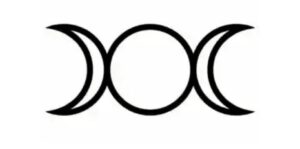
Triple Goddess symbol
At the same time, the Triple Goddess is not an ancient symbol of femininity that has survived unchanged to the present day. It is a modern reorganization of mythological sources. This framework largely stems from the British poet and novelist Robert Graves’s reconstruction of mythology (Pérez, 1987, p. 139). In his model, different deities were combined into a single structure (pp. 140–142).
Since the Triple Goddess is not an unquestionable tradition but rather an interpretive framework within a historical context, it must be approached critically. It can be reinterpreted within a contemporary context. In my curatorial practice, I need to decide how to utilize it, rather than allowing it to constrain me.
This leads me to reflect: if I categorize women directly into three distinct phases, am I overlooking the inherent complexity of women’s experiences?
This has led me to explore how the image of the goddess is reinterpreted in contemporary art.
Feminist art critic Gloria Feman Orenstein (1978, p. 72) notes that female artists bring the Great Goddess back into being through the body and ritual. For example, the artist Ana Mendieta imprinted her body onto the earth, merging her body with the land. She (1978, p. 76) experienced the goddess through her own bodily actions We can see that the image of the goddess is not simply replicated, but rather reinterpreted through practice.
It is more like a mode of action—a way of reinterpreting the body and history.
This had a significant impact on my exhibition. I began to reinterpret the Triple Goddess not as “stages of life” but as “spatial structures.” The Maiden, Mother, and Crone no longer represent age, but rather the ways in which women are shaped within different historical contexts. It became an analytical tool rather than a natural law.
Bibliography:
Orenstein, G. F. (1988) ‘The Reemergence of the Archetype of the Great Goddess in Art by Contemporary Women’, in Arlene Raven et al. (eds) Feminist Art Criticism. 1st edition [Online]. Routledge. pp. 71–86.
PEREZ, J. (1987) ASPECTS OF THE TRIPLE LUNAR GODDESS IN FUENTES SHORT FICTION. Studies in short fiction. 24 (2), 139–147.