Week 5-From historical witch hunts to digital landscapes: How contemporary media are reshaping the image of witches.
This week’s class, themed “Media & Time,” explored the “post-medium condition” of contemporary art. This reminds me of my solo exhibition on witches, where “witch” has become a highly glamorous consumer symbol in contemporary popular culture (Preston, 2018, pp. 150–159). From Harry Potter and Maleficent to Agatha All Along, and its entertainment-oriented settings in various games, witches seem to have shed the shadows of history.
However, this idealized image is vastly different from the brutal witch hunts of history.
Historically, witch hunts were bloody purges of women’s bodies, knowledge, and economic autonomy (Federici, 2021, pp. 190-197). Contemporary film seems to have dissolved it into a harmless form of entertainment.
When these painful histories are transformed into high-definition digital consumer products, are we forgetting this history?
Are we erasing the radicalism of witches as rebels in history?
Through my literature review this week, I discovered a clash of viewpoints.
Jacob King argues that the UbuWeb makes fringe and avant-garde art accessible through digital distribution (King and Simon, 2014, p. 1). To some extent, digitization has allowed the marginalized image of witches to spread globally, drawing more attention to the issue. Scholar Silvia Bovenschen argues that the contemporary reinterpretation of witches, even with its entertainment value, is essentially a reclaiming of discursive power (1978, pp. 83-88). Bovenschen points out that the return of witches represents women no longer fearing the stigma imposed by patriarchal society, but instead transforming this identity into a tool for self-identification (1978, pp. 86-87). From this perspective, digital communication appears to be a liberation of women’s power.
However, Chrissie Iles argues that the eyes and brains of the new generation are completely “mediated by technology,” and that the oversaturation of images and the commercialized environment control our visual experience (Balsom et al., 2013, p. 4). In my view, this is a “digital witch hunt,” where visual manipulation influences people’s cognition, and the rebellious, authentic image of the witch is diluted by algorithms and entertainment.
Therefore, in my exhibition, I not only want to present the image of the female witch, but also to break down people’s stereotypes about her. This is why I greatly admire Jesse Jones’s Tremble Tremble, which uses a fusion of visual and auditory elements to reveal the buried history of witch hunts and the political significance of witches themselves. This work is massive and chilling, yet powerful, making it impossible to ignore the trauma and resistance of women.
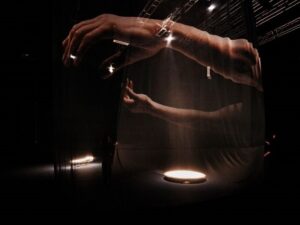
Jesse Jones, Tremble Tremble, 2018, Installation view, Project Arts Centre, photo by Ros Kavanagh
Bibliography:
Balsom, E. et al. (2013) ‘Thoughts About Curating Moving Images’, Mousse, 38 (April).
Bovenschen, S. et al. (1978) The Contemporary Witch, the Historical Witch and the Witch Myth: The Witch, Subject of the Appropriation of Nature and Object of the Domination of Nature. New German critique. 15 (15), 83–119.
Federici, S. (2022) Caliban and the witch : women, the body and primitive accumulation. London: Penguin Books. [online]. Available from: https://www.vlebooks.com/product/openreader?id=Edinburgh&accId=9137656&isbn=9780141998251.
King, J. and Simon, J. (2014) ‘Before and After UbuWeb: A conversation about artists’ film and video distribution’, Rhizome.org, 20 February. Available at: https://rhizome.org/editorial/2014/feb/20/and-after-ubuweb-distributing-artists-film-and-vid/(Accessed: 4 March 2026).
Preston, V. (2018) Reproducing Witchcraft: Thou Shalt Not Perform a Witch to Live. TDR : Drama review. [Online] 62 (1), 143–159.