Week1– Re-reading My Curatorial Practice Through SVAOs

After reading Micro-Curating: The Role of SVAOs in the History of Exhibition-Making, I began to rethink my previous curatorial practice. In the past, I often judged an exhibition by visitor numbers, online visibility, the number of artworks and overall scale. Because of this, I once felt that the two small exhibitions I organised in Shenzhen and Shaoxing were not successful enough. However, the discussion of SVAOs helped me understand that the value of small visual arts organisations is not only about scale. It also lies in how they create forms of viewing, participation and communication through flexible structures, collaboration and specific spaces.
The sex education exhibition I organised in Shenzhen in 2022 can be reconsidered as a small-scale and process-based curatorial practice. The exhibition did not have support from a large institution, but it brought together works by several artists and included interactive installations. These elements allowed visitors to engage with the body, sexuality, shame and sex education in a less pressured way. In the Chinese context, sexuality is still a sensitive public topic. Therefore, the value of this exhibition should not only be measured by visitor numbers. Its more important value was whether it created a relatively safe space where visitors could rethink bodily knowledge, intimacy and social norms through art.

Signage from the Shenzhen sex education exhibition I Asked Many People About You, 2022. Image courtesy of Maylove.
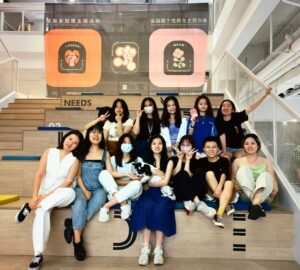
Group photograph of myself and other core organisers of the Shenzhen sex education exhibition I Asked Many People About You, 2022.
In 2025, I organised another exhibition in a private bookstore in Shaoxing. This exhibition focused on female trauma. At first, I saw the bookstore space as a limitation because it was not a professional gallery. However, through the idea of SVAOs, I now understand this informal space differently. The bookstore had a smaller and more intimate scale. It allowed visitors to read, pause and spend more time with the works. For artworks dealing with female trauma, this space reduced the distance often created by institutional settings and made it easier for viewers to approach the artists’ personal experiences.
This reflection also made me aware of the limits of small exhibitions. Intimate spaces are not automatically open, equal or effective. Without enough explanation, public communication or documentation, they may still limit audience understanding. My earlier projects had this problem. I focused on the exhibition atmosphere, but did not fully record audience responses, spatial decisions or curatorial choices.
Therefore, I no longer understand curation only as selecting artworks and organising exhibitions. I now see it as building relationships between artists, audiences, spaces and social issues. Through SVAOs, I realised that small-scale curating does not need to imitate large institutions. Its value lies in developing more flexible, ethical and community-connected curatorial methods.
Bibliography:
Bilbao Yarto, A. E. (2018) Micro-Curating:The Role of SVAOs (Small Visual Arts Organisations) in the History of Exhibition-Making.