Week 2: Course Reflection and Exhibition Experience
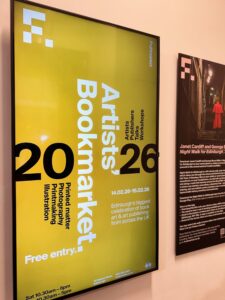
Exhibition Experience: Jaune Quick-to-See Smith 

📍Gallery: Fruitmarket

American Native artist, activist, educator, and curator

Her primary motivation for each new work of art is to communicate an idea, a philosophy, or a history lesson. She is compelled to insert her viewpoint into the racialized discourse of American history and to demonstrate how it is important to the contemporary moment. Each work of art offers the viewer an active role as an interpreter reimagining history from her perspective (Kastner, 2013).

This exhibition marks the first time her works have been shown in Scotland, aiming to explore the history and politics of land management, with a focus on her criticism of colonial history and land appropriation. On display are her paintings and large-scale canoe sculptures. She often incorporates newspapers, commercial symbols, and advertisements into her paintings, making her works not only visual art but also political statements.

Link: Jaune Quick-to-See Smith Wilding


Fruit Market’s “Wilding” exhibition layout:

Divided into two main exhibition floors:

First floor:

The entrance provides exhibition catalogues and background information on the related works.
A large number of works on display are collages and large paintings of the American map series, exploring topics related to land and colonization.
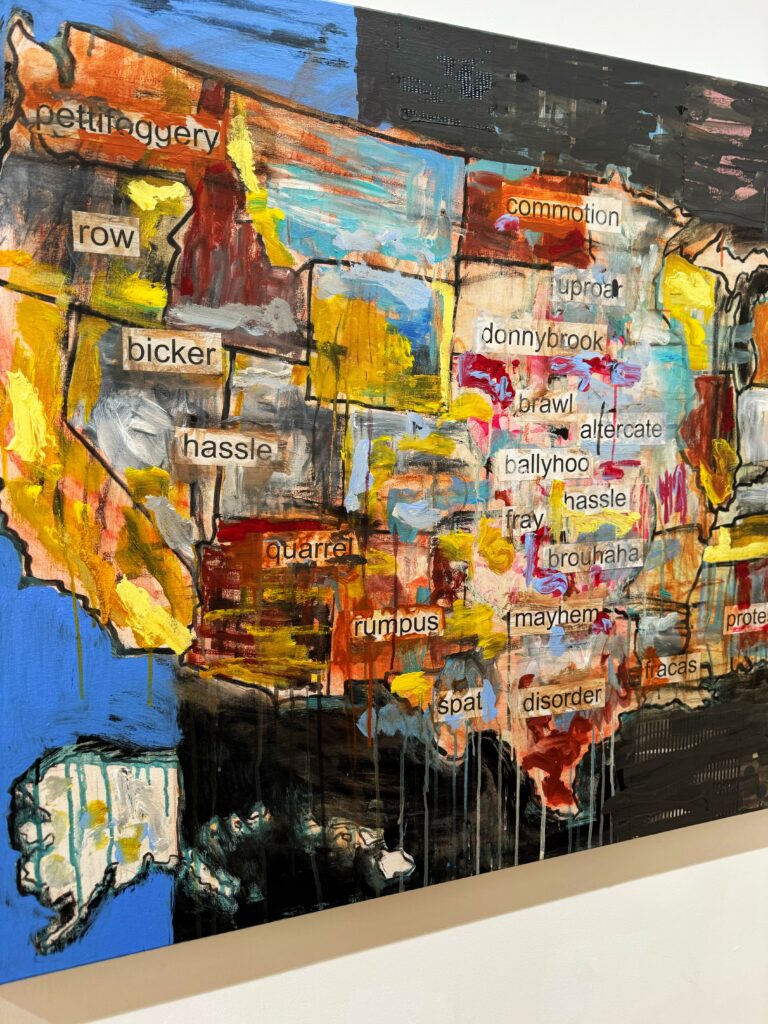
Fig 1 :Artwork Display on the First Floor
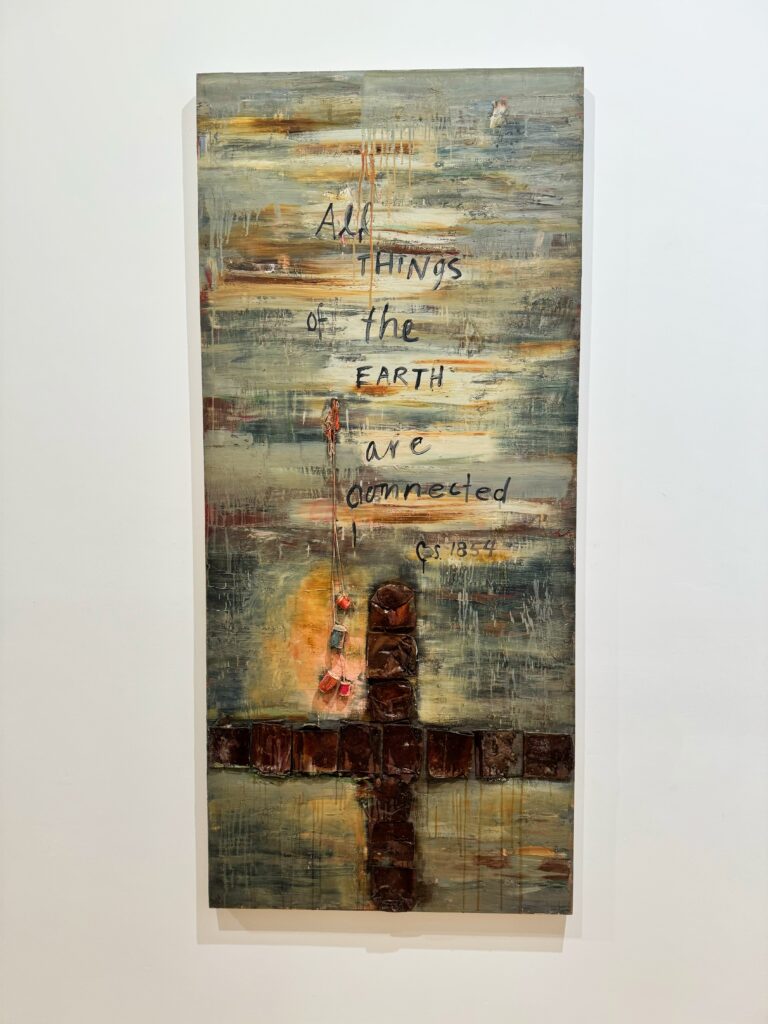
Fig 2 :Artwork Display on the First Floor

Second floor:

A canoe installation filled with animals is suspended above the central staircase, visually connecting the two floors. It not only saves floor space but also has a “leading line” visual effect.
Large-scale figure paintings and animal images are displayed, which are more delicate and spiritual.
In the public area on the second floor, a video of the artist’s son talking about the works and Smith is provided to enhance visitors’ understanding of the artist. Next to the viewing area, there are a reading area and a drawing area to enhance visitor interaction.As Smith suggests, contemporary curating often integrates multiple forms of mediation(Smith, 2017).
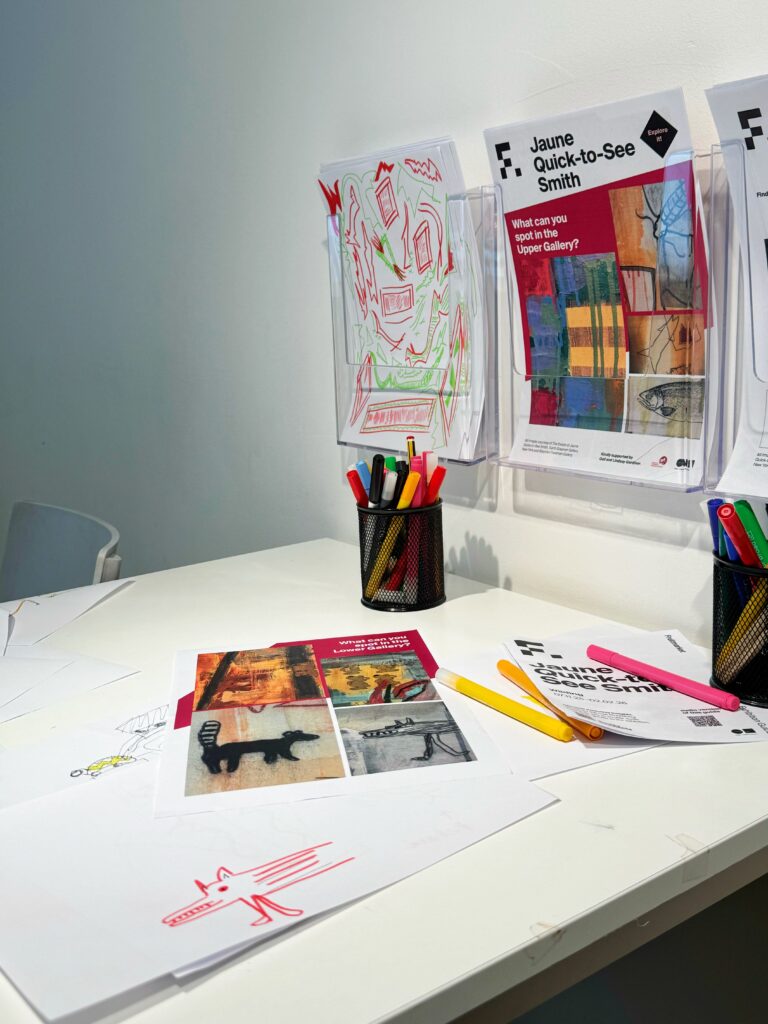
Fig 3 :Second-floor audience interaction area
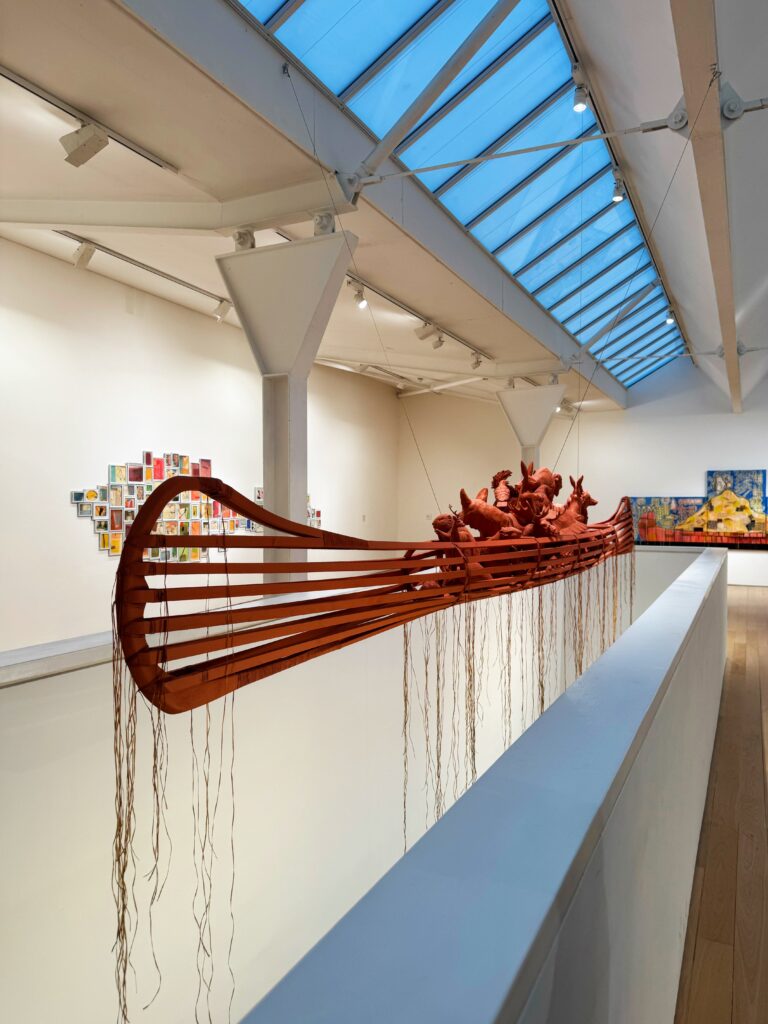
Fig 4 :All My Relations(2025)
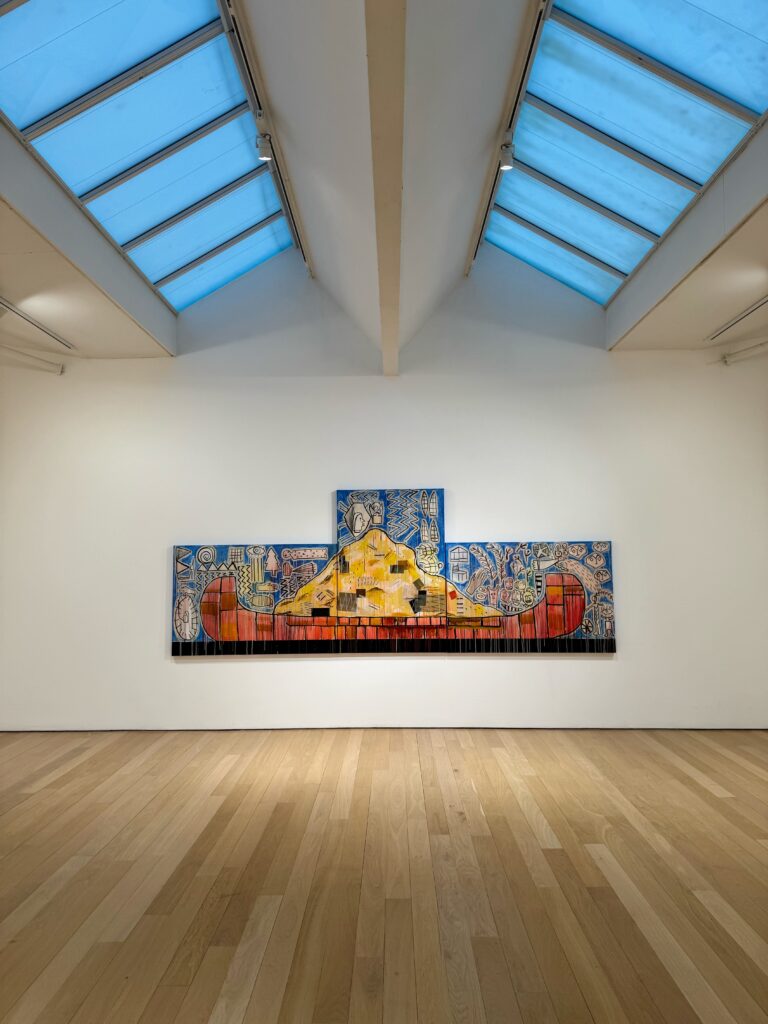
Fig 5 :Trade Canoe: Turtle Island(2024-25)

The design of exhibition spaces is not merely about displaying works, but about structuring visitor movement to create an immersive narrative experience, which aligns with museum theory emphasizing spatial storytelling. As Eilean Hooper-Greenhill suggests, museums are no longer neutral spaces for passive viewing, but places where meaning is actively constructed through the arrangement of objects and the experience of visitors. She argues that “meaning is not transmitted but constructed” through interpretive strategies (Hooper-Greenhill, 2020), highlighting the importance of spatial design in shaping how audiences engage with exhibitions.


Course Reflection: As a form of collective thinking and working

Advantages:

More diverse expertise and perspectives:
Collective work brings together people from different professional backgrounds, allowing them to share ideas and generate a wider range of perspectives.

Sharing the workload:
Tasks can be divided among members, which reduces individual pressure and helps save time.

Promotes learning:
Members can learn from one another, increase motivation, and use others’ strengths to make up for their own weaknesses.

Disadvantages:

Conflicts are more likely to occur:
Differences in opinions and a lack of communication can easily lead to conflicts.

Unequal distribution of responsibility:
Some members may contribute more work than others, which can create a sense of unfairness.

Overconsidering others’ opinions:
During group discussions, individuals may compromise too much in order to consider others’ ideas, which can weaken their own voice.

References

Kastner, Carolyn. Jaune Quick-to-See Smith: An American Modernist. UNM Press, 2013.

Smith, Terry. “Mapping the Contexts of Contemporary Curating: The Visual Arts Exhibitionary Complex.” Journal of curatorial studies 6, no. 2 (2017): 170-180.

Hooper-Greenhill, Eilean. Museums and the interpretation of visual culture. Routledge, 2020


Project Book

Vivien Jiang

Week 1: Curatorial Concept: Female Anxiety in Contemporary Photograph

Curatorial Concept: Female Anxiety in Contemporary Photography

From a feminist perspective, this explores the predicaments contemporary women face under social pressure. Through photographic works, it presents women’s anxiety and unease, their resistance to social expectations, and how they seek self-identity in the interplay of gazing and being gazed at. It aims to break the stereotypes society holds about women and discuss how to express emotions through artistic creation, provoking social reflection and resonance. It records, reveals and resists those intangible pressures and anxieties through visual forms.

Micro-Curating argues the concept of “micro-curating” SVAOs, typically long-term, ongoing non-profit small-scale art institutions.Such institutions are typically embedded within everyday urban life rather than relying on traditional exhibition spaces, thereby redefining the relationship between art and the public (Bilbao Yarto, 2018). They emphasise decentralised, flexible and participatory curation, focusing on long-neglected issues. Through micro-curating, women’s persistent anxieties are continuously and closely visible to the public, creating interactive spaces where audiences can engage in discussion and creation.

On Curating argues that the curator acts as a mediator between the artist, the artwork, and the public (Thea, 2009) ; similarly, exhibitions are not containers for artworks but spaces where meaning is reproduced. Exhibitions possess artistic interactivity and participatory qualities, enabling social and cultural discussions while connecting exhibitions to urban life and local communities. Curators no longer speak solely for women but create conditions for a ‘multivocal’ space through exhibitions, making invisible female pressures and anxieties visible.

Complex Constellations explores and redefines the concepts of “centre” and “margins” within contemporary art curation, challenging fixed notions. This curatorial project regards female anxiety as a constellation of states shaped by interwoven social, cultural and visual mechanisms. The project adopts “multiple viewpoints rather than a single narrative,” presenting complexity through a multifocal structure (Kolb et al., 2019). Challenging traditional art world hegemony, it seeks to excavate marginalised female issues and artists.

Why choose photographic works:

As a medium highly dependent on viewing behavior, photography has an inherent connection with the gender power structure. Women’s anxiety often stems from being stared at and being defined by society. Photography is both a part of the problem and can also serve as a mechanism for reflection. Moreover, women’s anxiety rarely manifests as a single “event”, but exists through repetition, mundanity, and persistence. Photography has the ability to capture these overlooked moments and, through artistic works, enables us to recognize the universality of these issues, thereby making those intangible social norms concrete.

Selection of Works:

Select representative works by female photographers, or works by male photographers addressing women’s issues.The works should demonstrate depth and diversity, encompassing women of varying ages, ethnicities, and cultural backgrounds, thereby provoking reflection and resonance with the audience.

References

Bilbao Yarto, Ana Edurne. Micro-Curating:The Role of SVAOs (Small Visual Arts Organisations) in the History of Exhibition-Making. December 30, 2018.

Thea, Carolee, and Thomas Micchelli. On Curating : Interviews with Ten International Curators. First edition. New York, N.Y: D.A.P./Distributed Art Publishers, 2009.

Kolb, Ronald, Ella Krivanek, Camille Regli, and Dorothee Richter. “Centres  Peripheries–Complex Constellations.” (2019).


Welcome!

Welcome to your new blog site!

This is your first post. You can edit this or delete it and start blogging.

You should read the Terms of Use if you haven’t already.

For help and advice on getting started with a WordPress blog, see the Academic Blogging help pages.

Your blog is private by default

You can open your blog up to as many or as few people as you like in Dashboard > Settings > Reading > Site Visibility:

  • You can open your blog up to specific University members by adding them as users to your blog.
  • You can open your blog up to all University members who have an EASE login.
  • You can make you blog open to the world.


The featured image on this post comes from the University Collections. If you want to use more images in your blog posts, or perhaps use your own choice of image in your blog header, you can: