Week 6: Curating Presentation and Collective Meeting

In this week’s presentation, I received feedback from my tutor and classmates and refined my curatorial project. My tutor noted that the strengths of my proposal lie in calculating artist salaries and exhibition venue rental costs, while the weaknesses require addressing the exhibition’s visibility and transportation-related expenses.


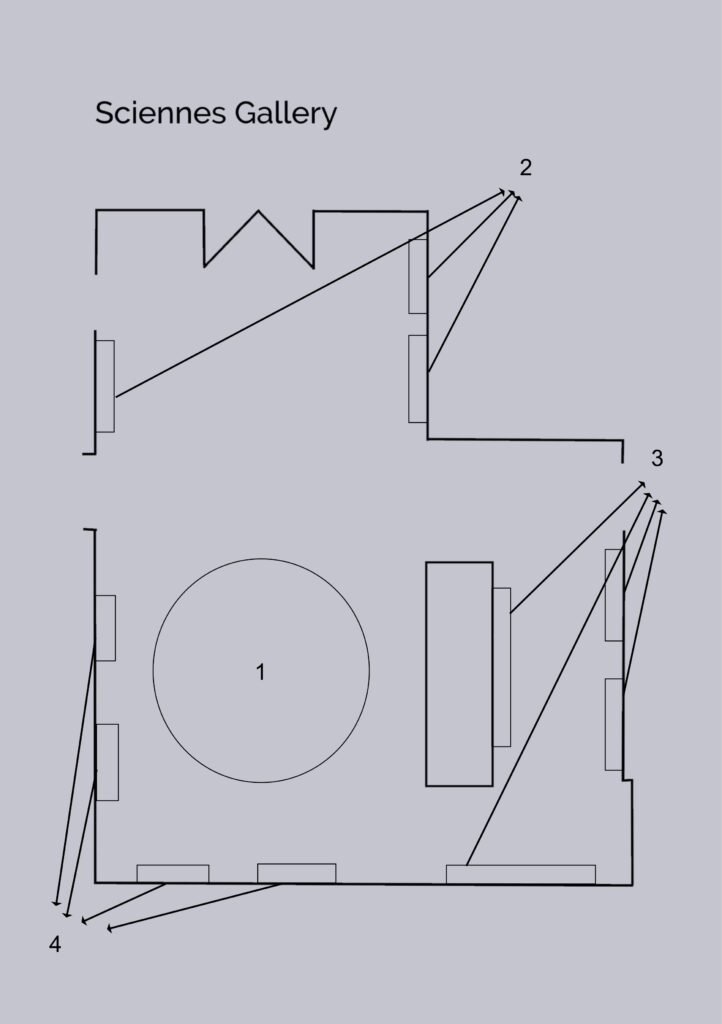
I created the layout plan for my exhibition based on visual suggestions.

Figure 1: SICP floor plan I created based on the summerhall staff’s email reply. 1 Concrete Bamboo, 2 Alness Memorial Geopark Sequence, 3 Intelligent Wilderness, 4 Cooped . Farmed . Displayed


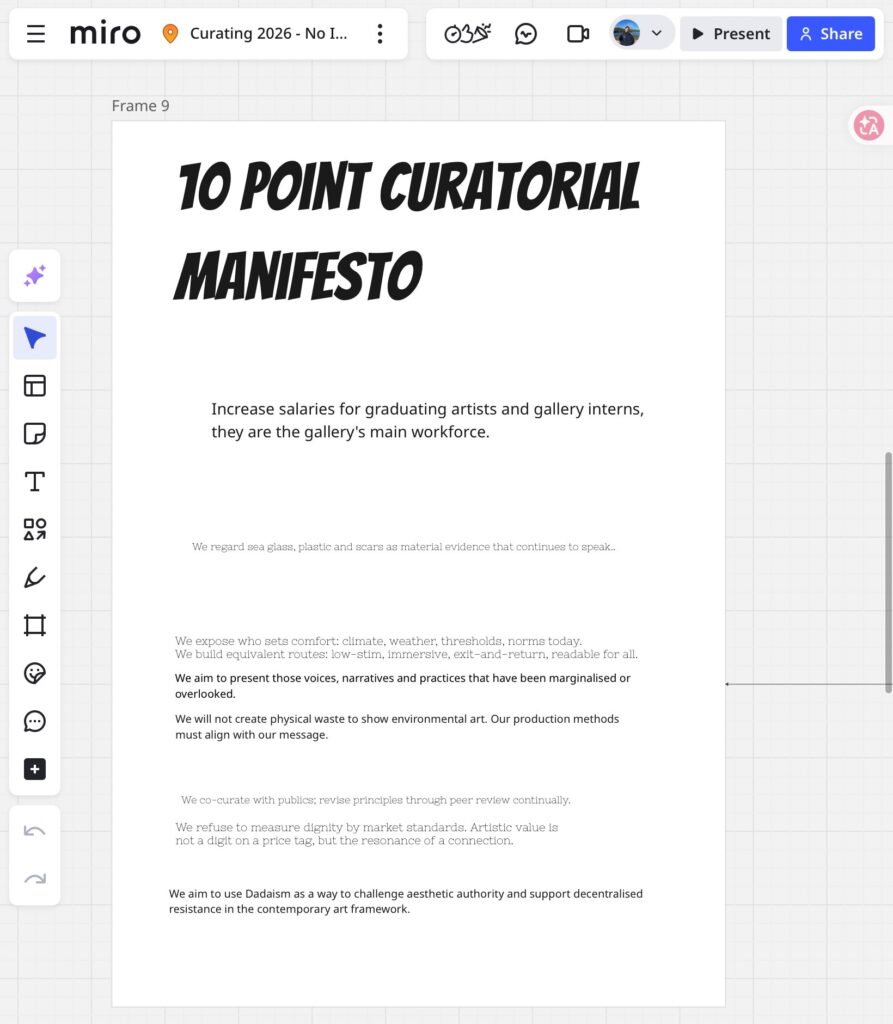
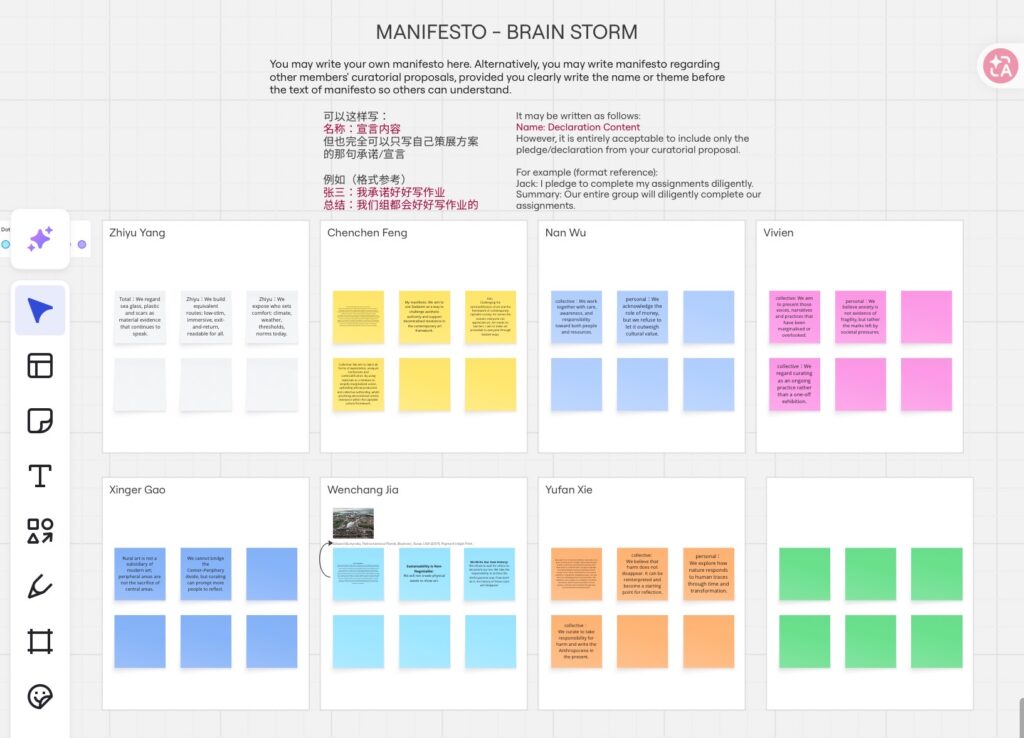
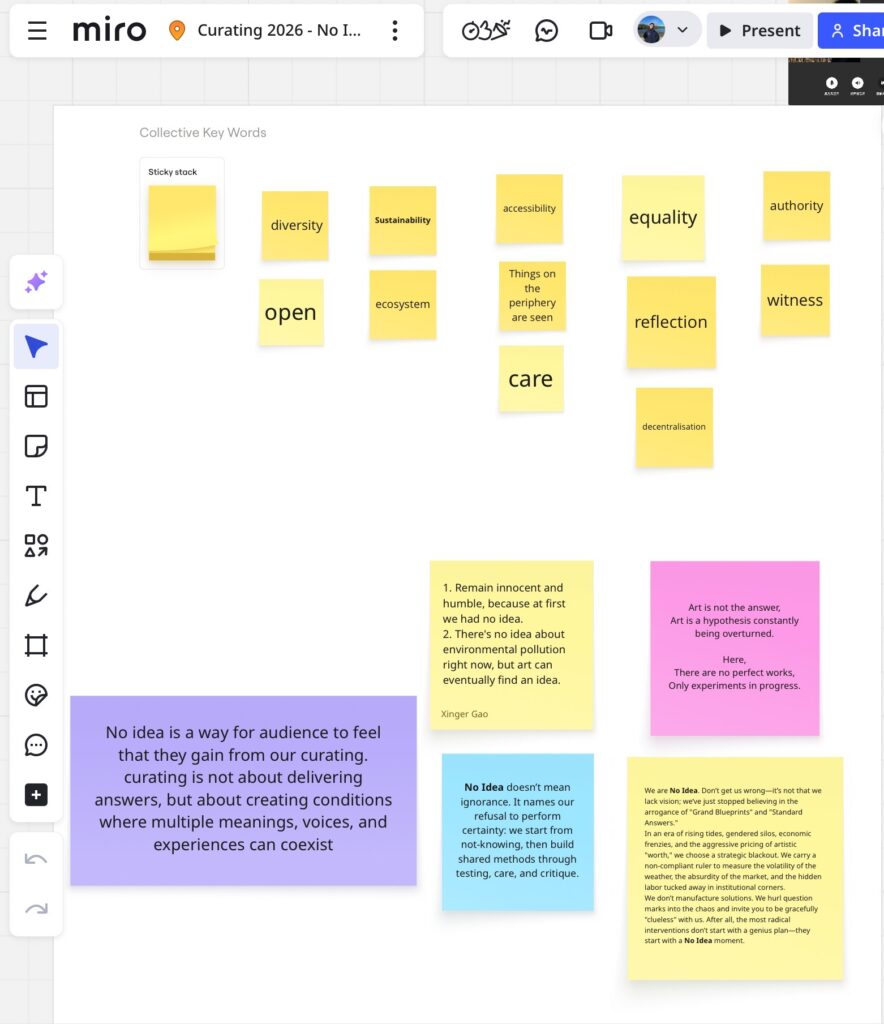
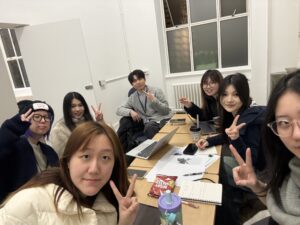
I attended this weekly collective meeting at Summerhall In Vitro Gallery in response to the teacher’s feedback. Our collective is an art curation group named “No idea,” established during weeks 3 and 4. Below are images documenting our collective’s conceptual manifesto activity from week 4.


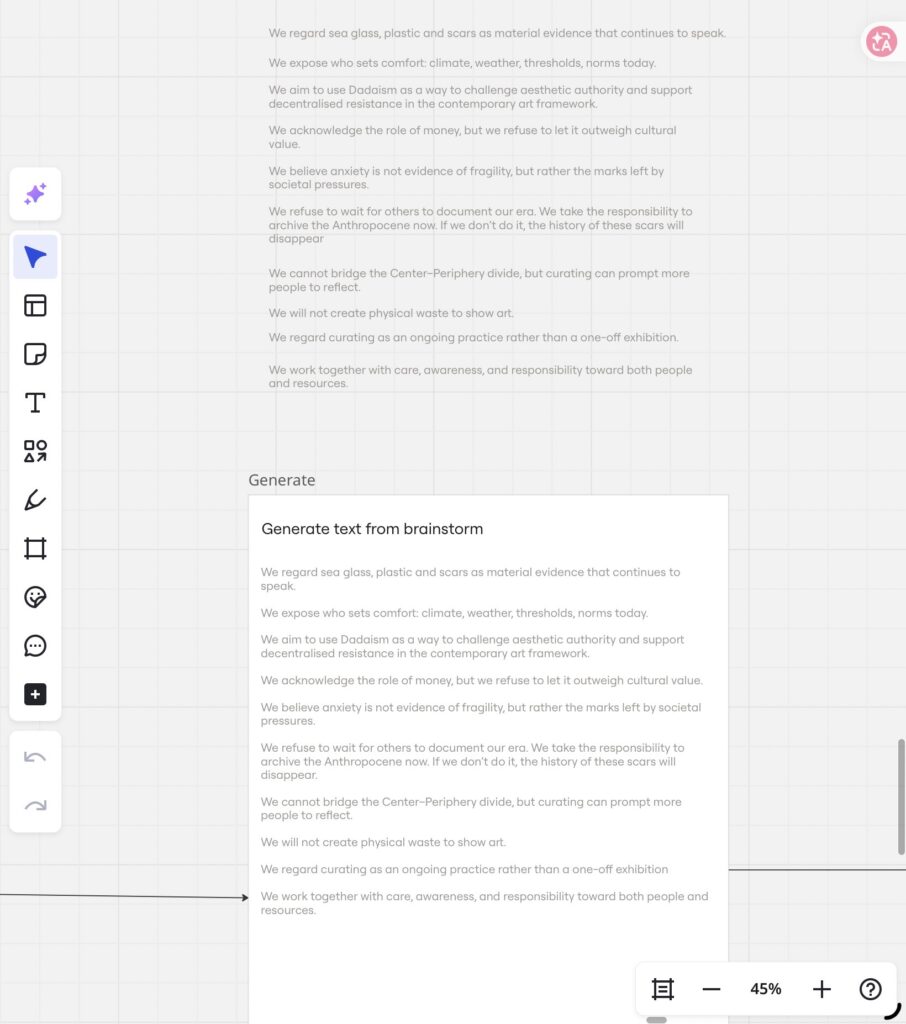
Figure 2: Our collective’s first attempt at drafting a manifesto on miro board

Figure 3: Our collective organized an after-class activity for each student to write two lines of Manifesto.

Figure 4: During the after-class group meeting, each student summarized the key words from their SICP and ideal collective manifesto.

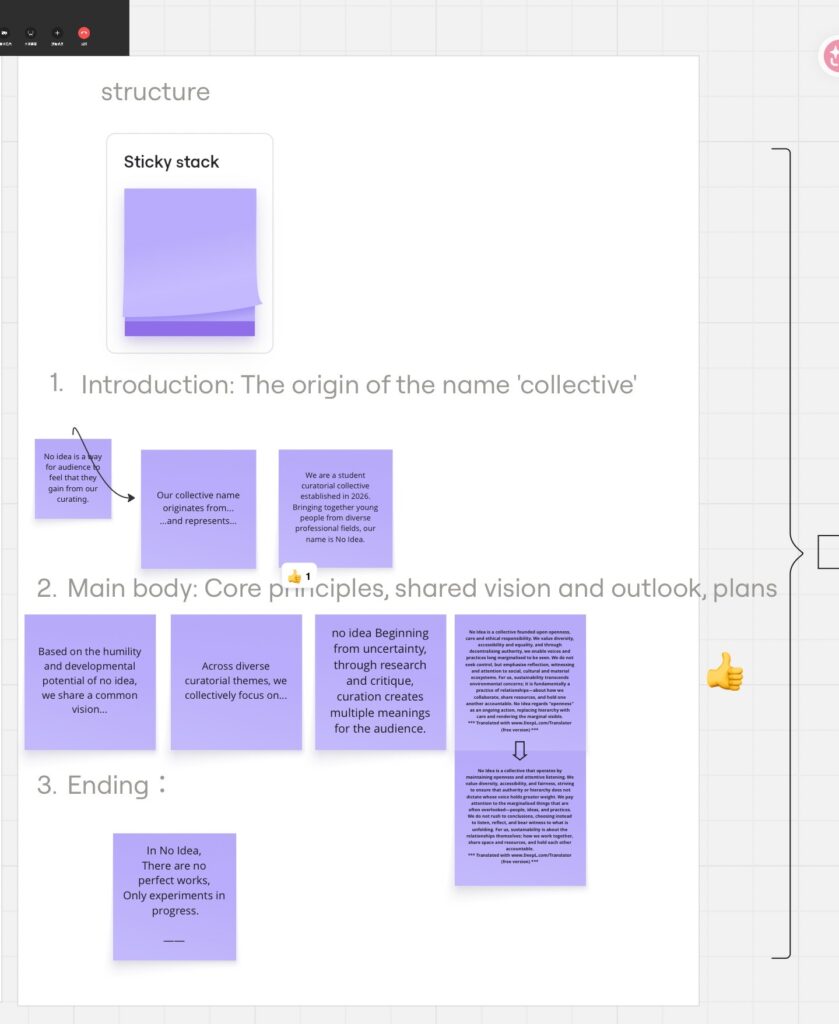
Figure 5: We collaboratively structure the manifesto, including the introduction, conclusion, and main body.

Figure 6: We have completed developing the manifesto on the Miro board.


During the meeting, we discussed and calculated the appropriate exhibition duration, transportation costs for the installations, and expenses for lighting and display screens. Based on Zhiyu’s past experience, most exhibitions require three to five days for installation and one day for dismantling. This means I would need an additional four days to rent the venue, totaling 14 days for my 10-day exhibition. At £250 per day, the cost for Summerhall Sciennes Gallery would be £3,500. Artist fees remain unchanged: £1,796.00 (Five Days, Five Years Artist) + £179.60 (Half-Day Five-Year Artist) + £117.20 (Half-day newly graduated artist) + £117.20 (Half-day newly graduated artist) = £2,210.00.


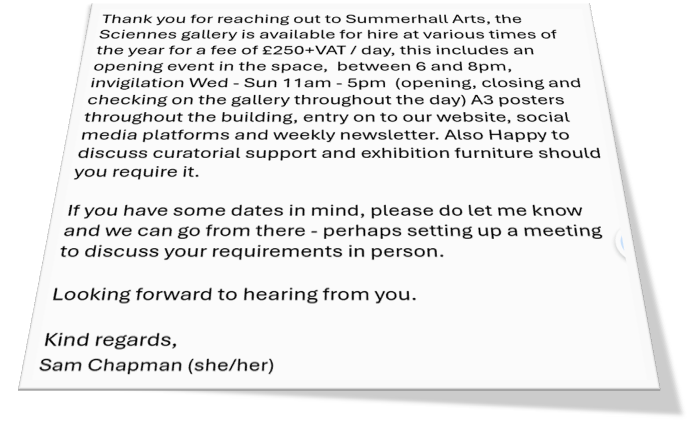
Figure 7: I emailed the staff at Summerhall to inquire about venue rent and the floor plan of Sciennes Gallery


Based on this, my fellow students and I at the collective discussed that the installation could be transported by artist Yuhang Liu, whom I would compensate with five days’ worth of wages. I will cover his £1,500 plane ticket. I want him to use the video equipment and screens rented from ECA during the exhibition preparation to record artist interviews—one reason for his presence. We’ve already decided to rent the exhibition lighting and video screens from ECA.Therefore, the current cost I have calculated is £7,210. I will continue to discuss and calculate other expenses with my colleagues at the collective.


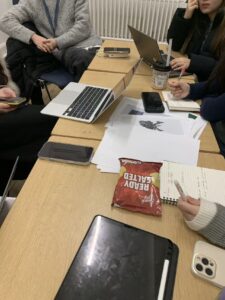
Figure 8: A photo of our collective working at the Summer Hall

Figure 9: A photo of our collective working at the Summer Hall


Curatorial Pitch

Periphery Future

Exhibition Concept

Periphery Future explores the central question: With urban expansion and accelerating capital flows, must rural areas exist solely as peripheral spaces to be consumed? It explores this theme through two approaches: Problem Identification” and “Design Responses.” Periphery Future does not regard the countryside as a place of decline, but rather as a pioneering frontier for experimenting with future social structures. Here, art and design become tools for reimagining the possibilities of rural life.


Artists and Artworks

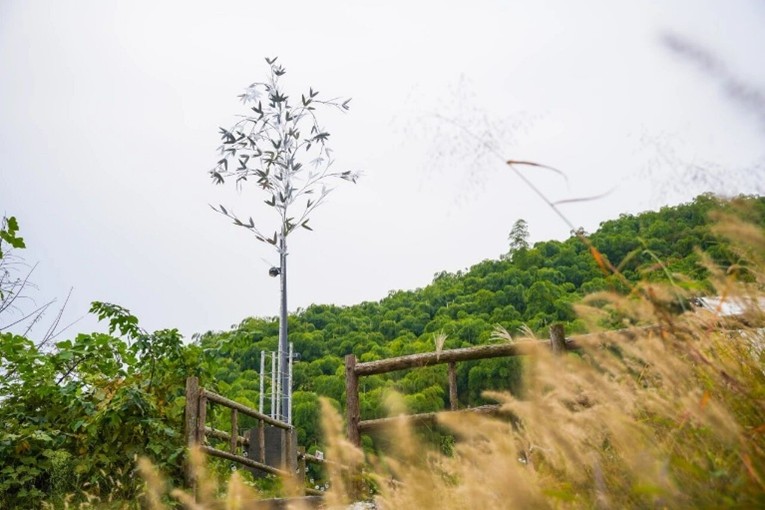
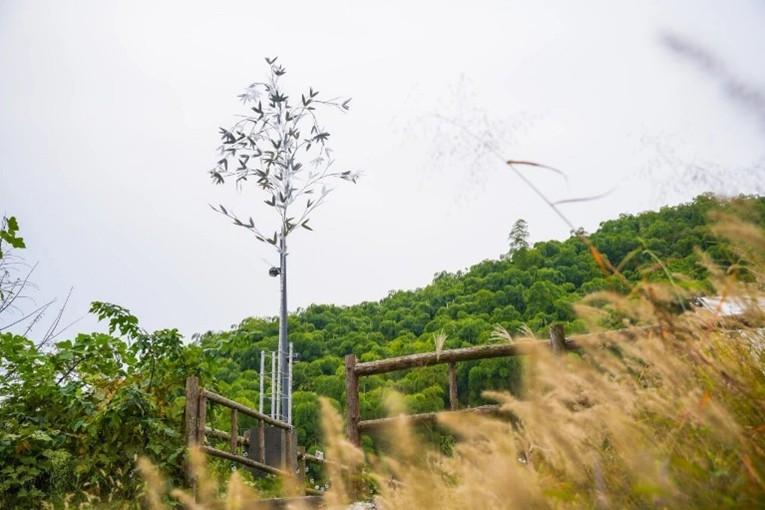
Yuhang Liu’s Concrete Bamboo reveals the reality of contemporary rural areas being replaced by industry amid urbanization. Bamboo—a material symbolizing nature and locality—is substituted by concrete, serving as a metaphor for the power relations between urban and rural areas. The work no longer presents romantic nostalgia but exposes how industrial materials invade and reshape the rural landscape.

Figure 1, Yuhang Liu, Concrete Bamboo, 2023, 180 × 100 × 70 cm, Weathering steel, mirror-polished stainless steel.


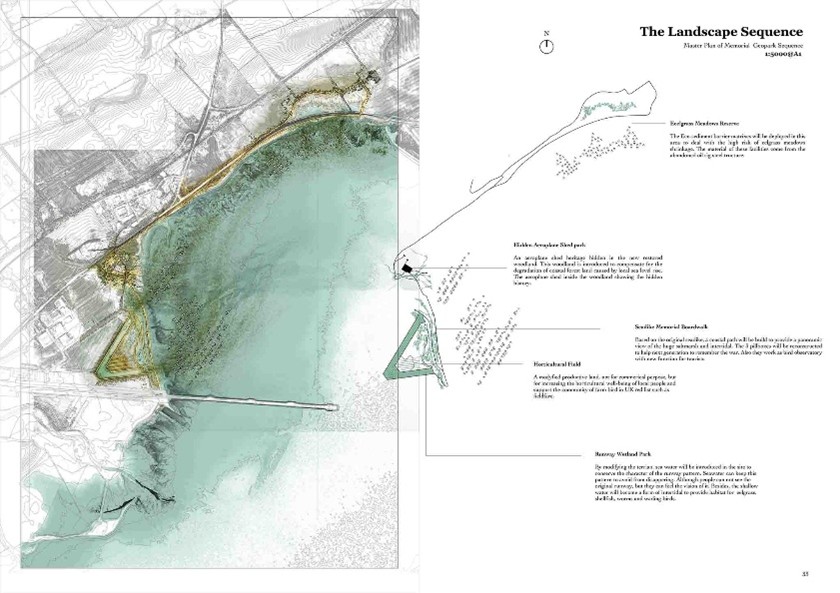
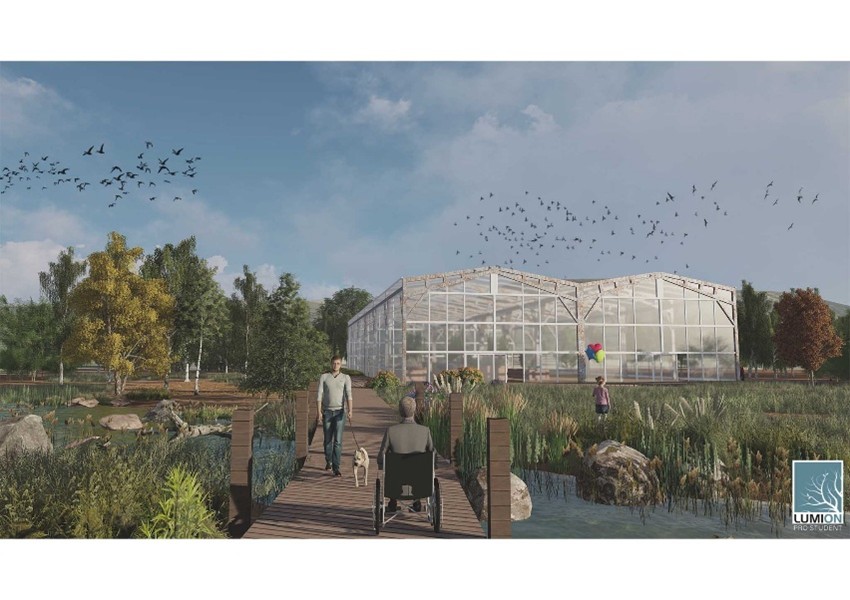
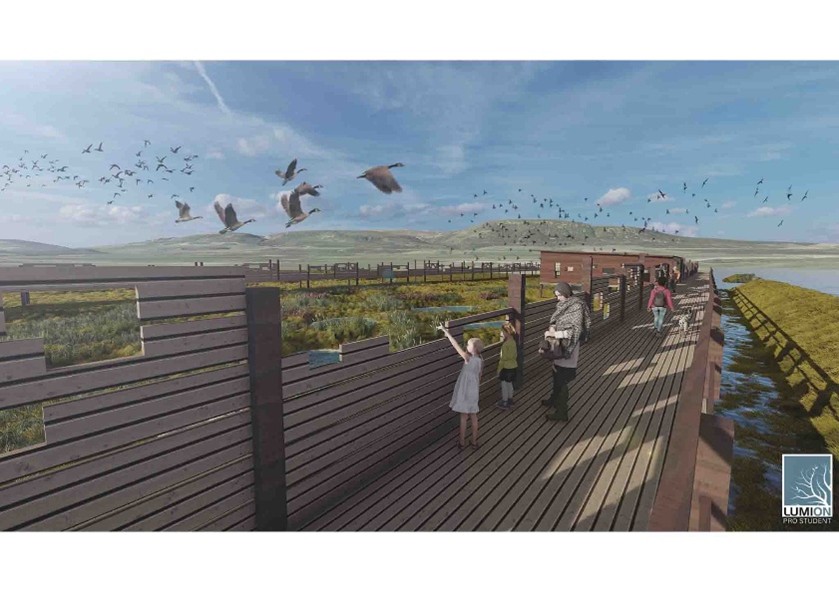
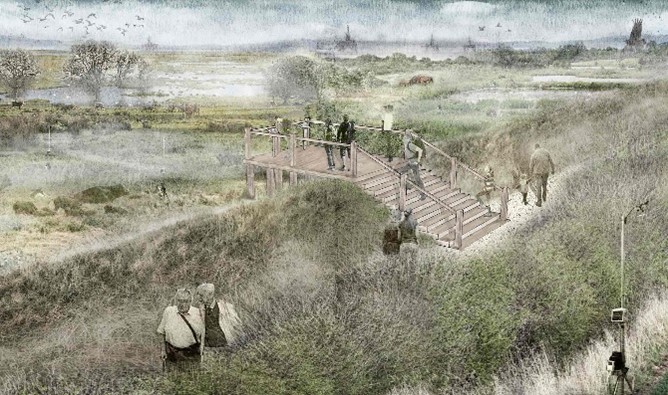
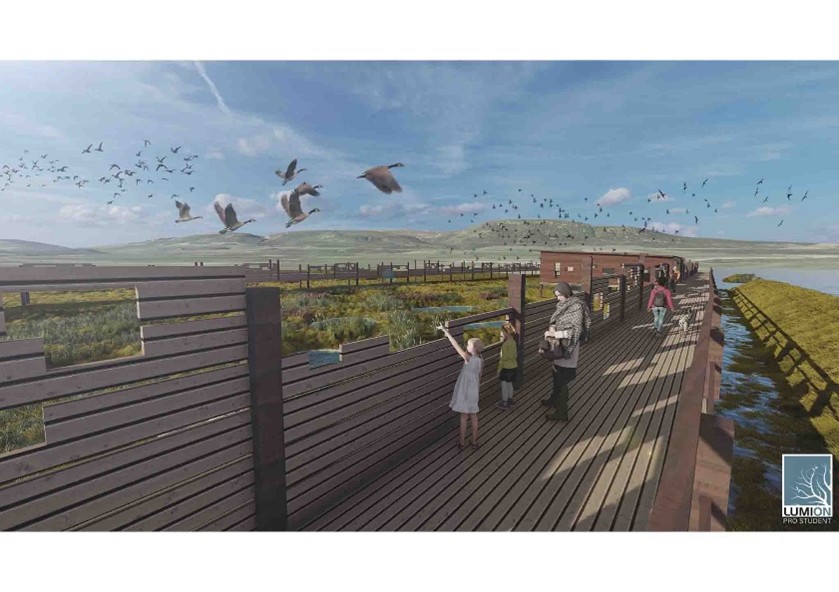
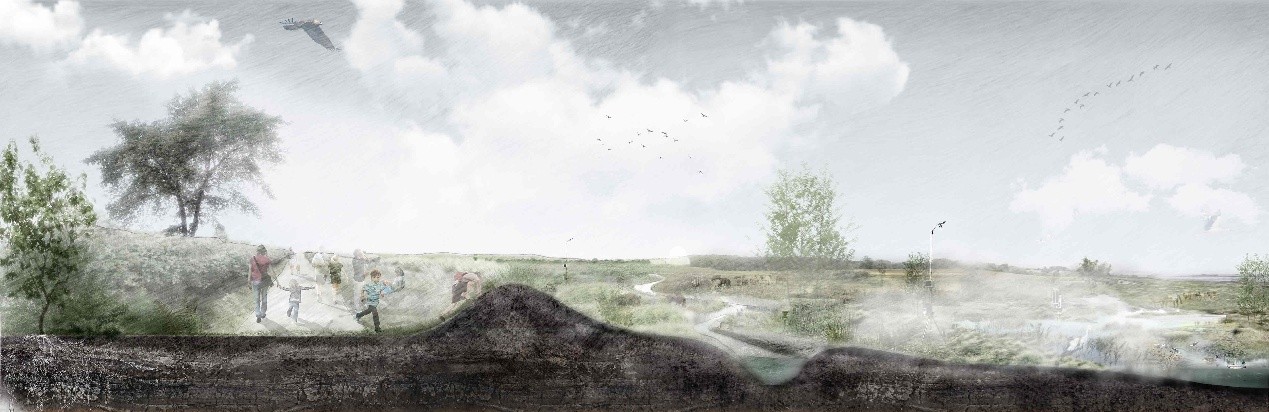
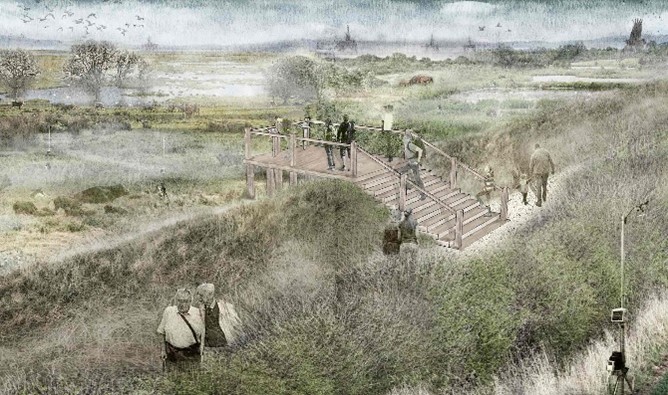
Fangyuan Zheng’s Alness Memorial Geopark Sequence proposes a spatial design solution that balances the needs of local residents with tourism appeal. The artist seeks to address the issue of rural tourism focusing on “serving outsiders” while neglecting local livelihoods.

Figure 2: Fangyuan Zheng, Alness Memorial Geopark Sequence, 2021, Digital Painting and Modeling, Variable dimensions

Figure 3: Fangyuan Zheng, Alness Memorial Geopark Sequence, 2021, Digital Painting and Modeling, Variable dimensions

Figure 4: Fangyuan Zheng, Alness Memorial Geopark Sequence, 2021, Digital Painting and Modeling, Variable dimensions


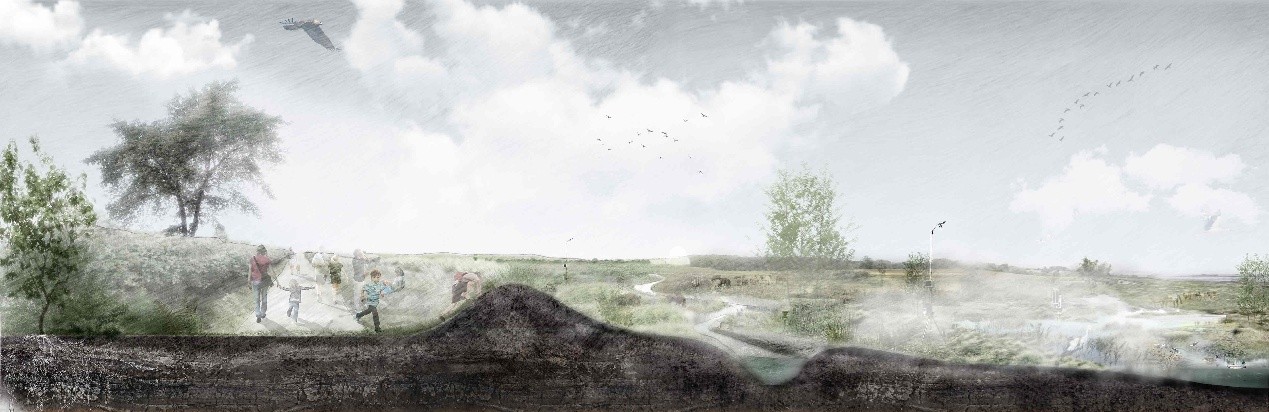
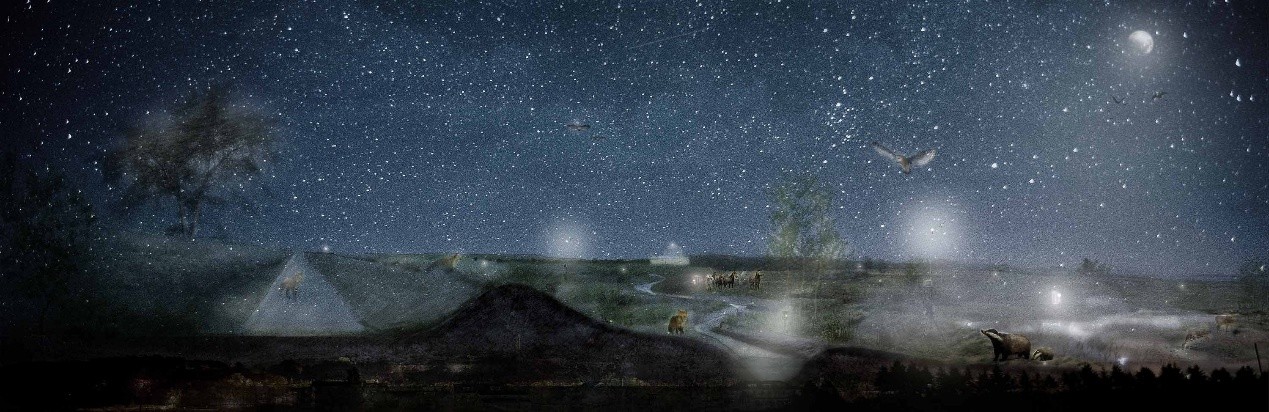
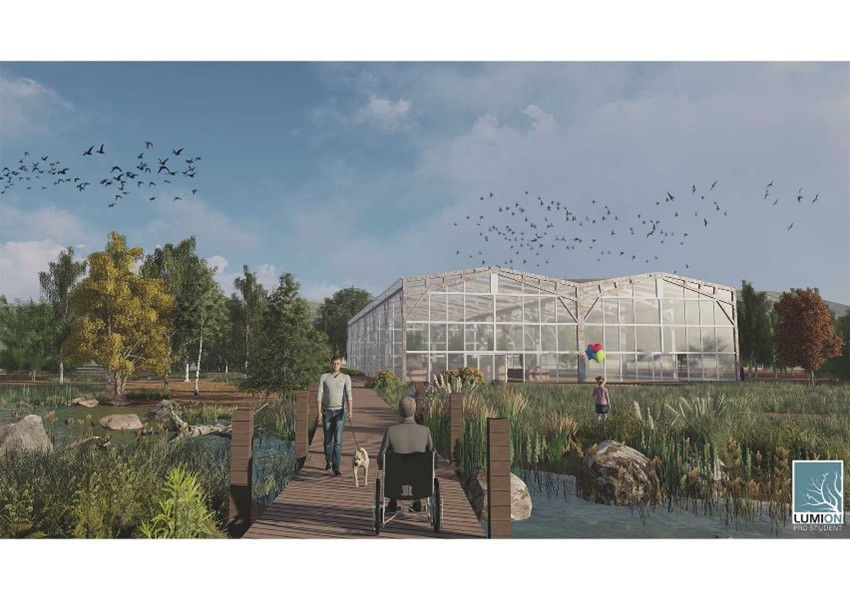
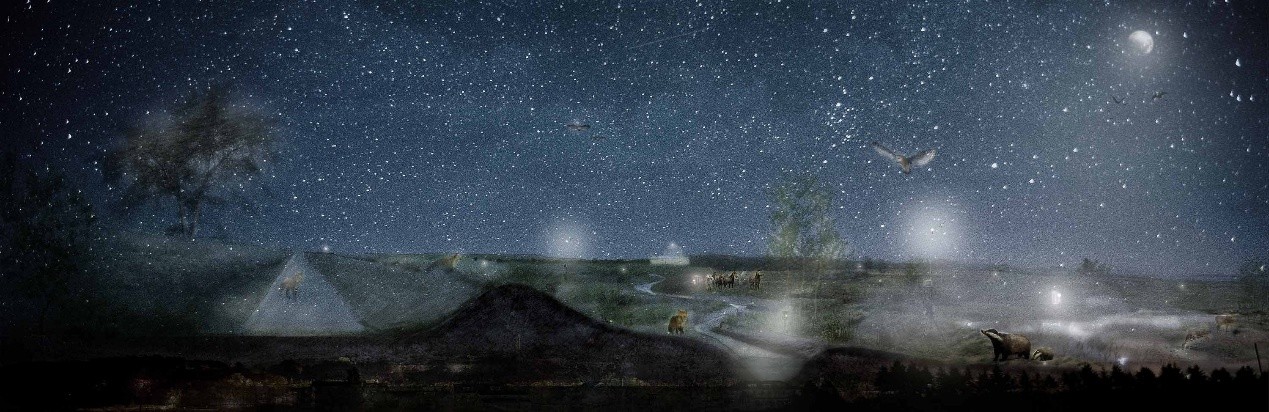
Kate Saldanha’s Intelligent Wilderness addresses the damage caused by industrial sites to agricultural and natural environments. Through landscape design, the artist reestablishes a balanced relationship between agricultural production and wild ecosystems.

Figure 5: Kate Saldanha, Intelligent Wilderness, 2021 Digital Painting, Variable dimensions.

Figure 6: Kate Saldanha, Intelligent Wilderness, 2021 Digital Painting, Variable dimensions.

Figure 7: Kate Saldanha, Intelligent Wilderness, 2021 Digital Painting, Variable dimensions.

Figure 8: Kate Saldanha, Intelligent Wilderness, 2021 Digital Painting, Variable dimensions.


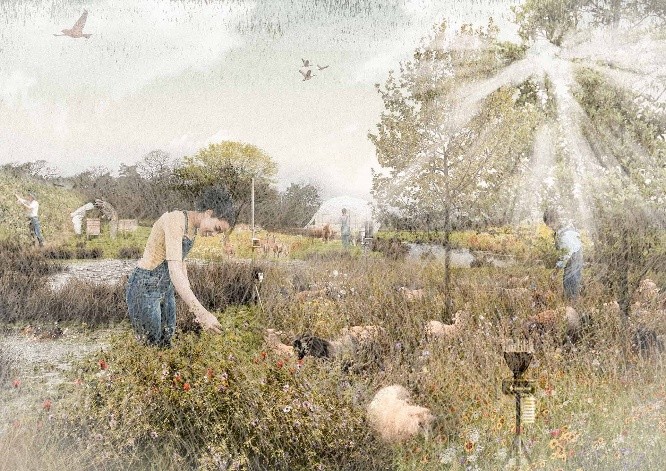
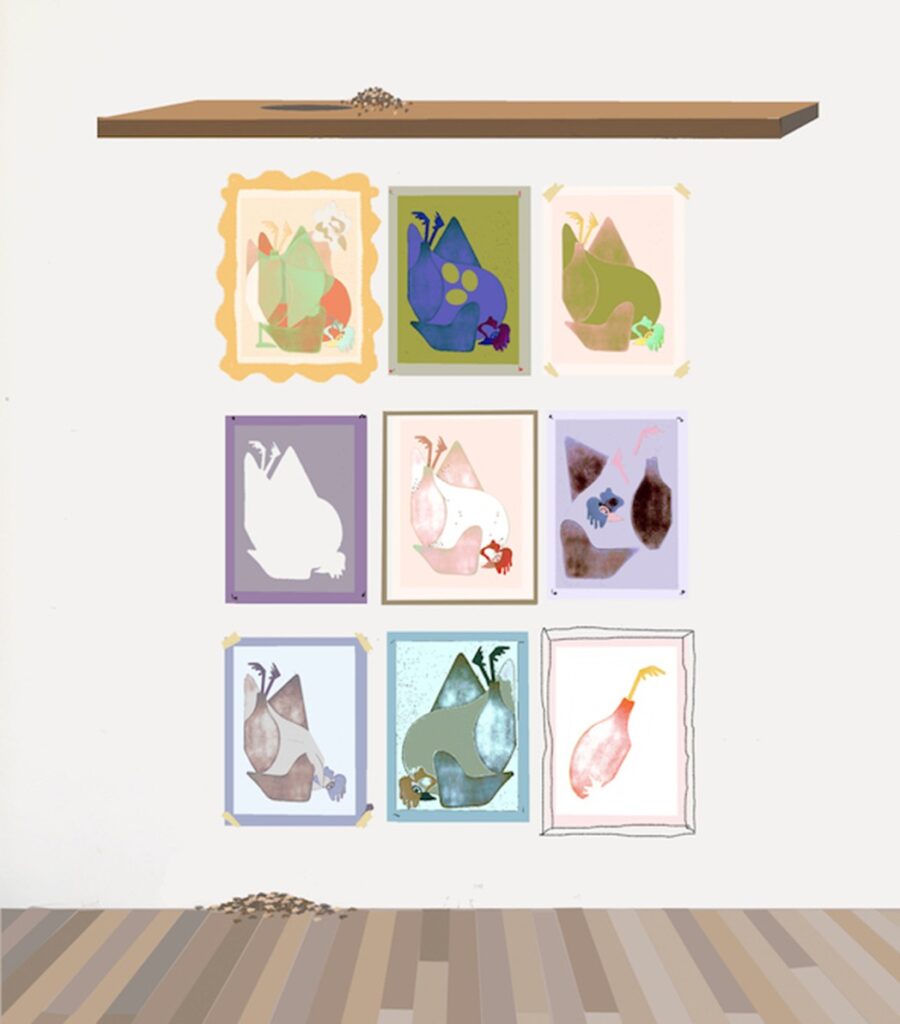
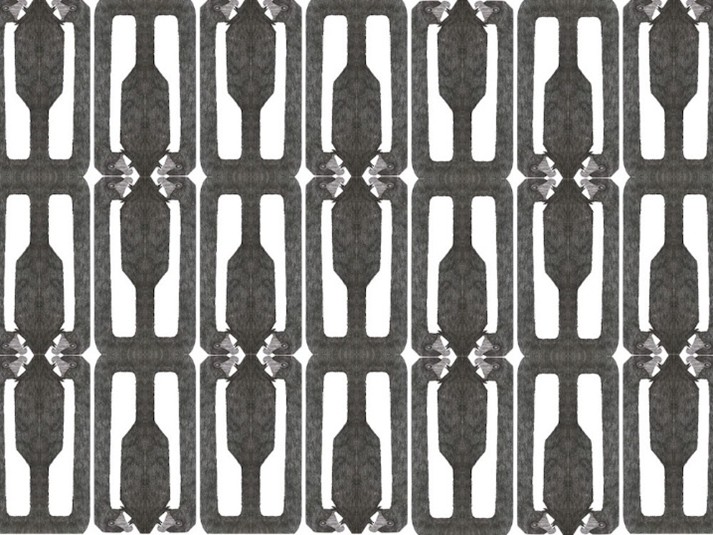
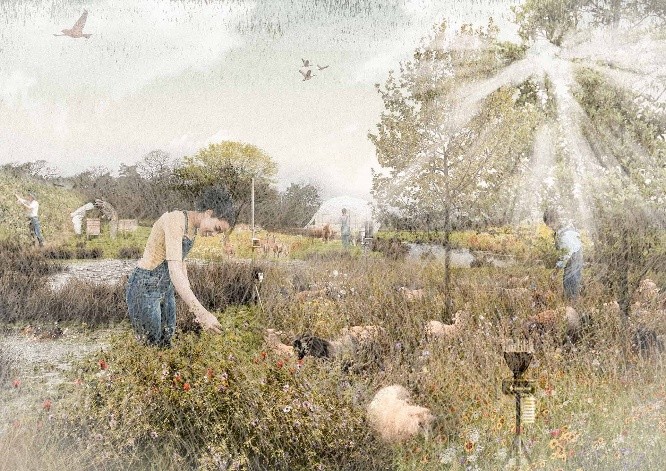
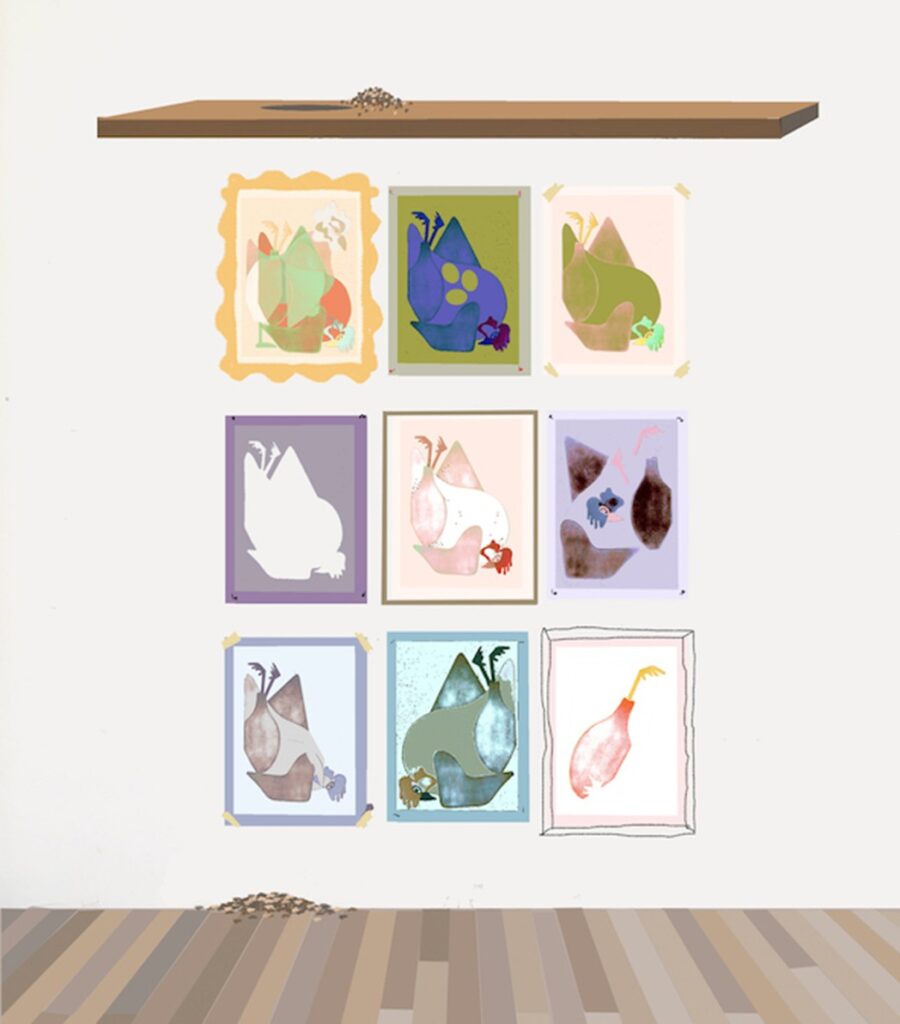
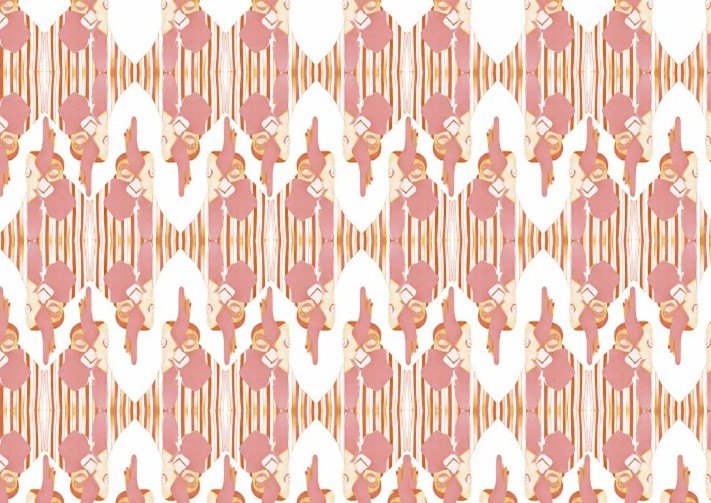
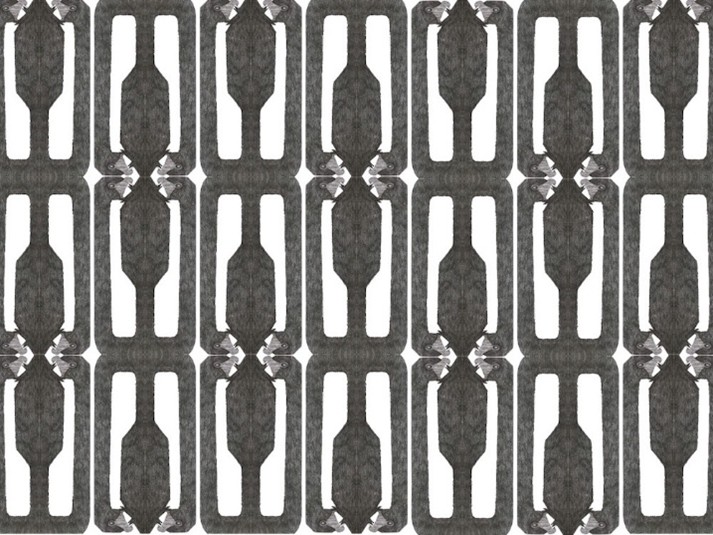
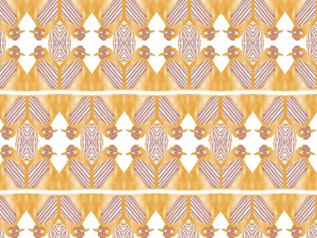
Sara Dobbs’s Cooped. Farmed. Displayed examines how rural areas are “displayed” within consumer culture, exploring the dynamics between agricultural production and exhibition mechanisms.

Figure 9: Sara Dobbs, Cooped . Farmed . Displayed, 2021 digital drawing made from paper collages, Variable dimensions

Figure 10: Sara Dobbs, Cooped . Farmed . Displayed, 2021 digital drawing made from paper collages, Variable dimensions

Figure 11: Sara Dobbs, Cooped . Farmed . Displayed, 2021 digital drawing made from paper collages, Variable dimensions

Figure 12: Sara Dobbs, Cooped . Farmed . Displayed, 2021 digital drawing made from paper collages, Variable dimensions

Artist and Venue Costs

£1,796.00 (Five Days, Five Years Artist) + £179.60 (Half-Day Five-Year Artist) + £117.20 (Half-day newly graduated artist) + £117.20 (Half-day new graduated artist) = £2,210.00.

By reviewing the 2024 Summerhall pricing for cinema venues and performing the necessary calculations, I estimate that renting a space comparable in size to the Sciennes Gallery for a 24-day arts festival would cost approximately £4,000. I anticipate the cost for a ten-day booking would be around £1,600.


Exhibition Souvenirs

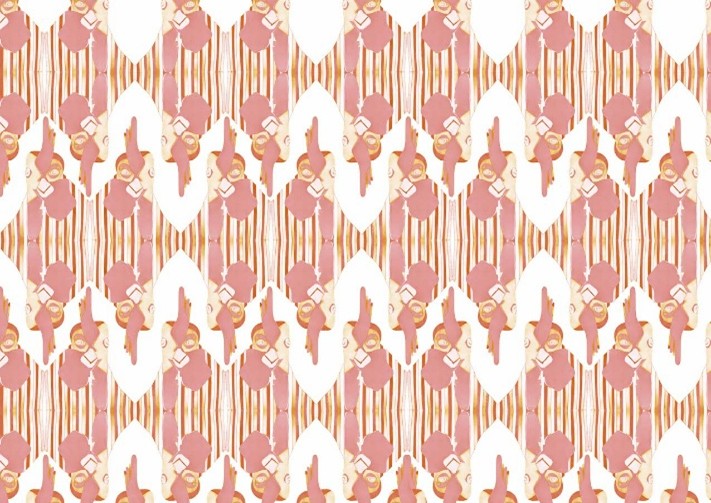
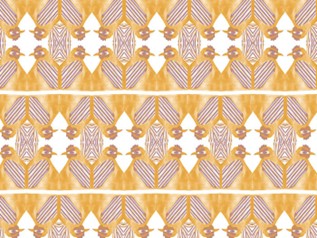
Canvas bags, silk scarves, and hats


References

Kolb, Ronald, Camille Regli, and Dorothee Richter. “Centres ⁄ Peripheries– Complex Constellations.” Notes on Curating 41 (June 2019): 3-11.

Kathrin Bohm & Wapke Feenstra, “Introduction” in MyVillages (eds.), The Rural (Whitechapel Gallery, 2019), pp. 16.

Art to Mountains and Rivers: Exhibition of the 2023 Anji Youth Art Creation Camp by the Academy of Arts & Design, Tsinghua University” Opens – Academy of Arts & Design, Tsinghua University

Fangyuan Zheng | Edinburgh College of Art Graduate Show 2021

Kate Saldanha | Edinburgh College of Art Graduate Show 2021

Sara Dobbs | Edinburgh College of Art Graduate Show 2021

Recommended Rates of Pay (RRoP) | Scottish Artist Union

Summerhall Arts, Summerhall Festival Information Pack 2024 (Edinburgh: Summerhall, 2024), 7–8, https://www.summerhall.co.uk/wp-content/uploads/2023/11/Summerhall-Festival-Information-Pack-2024.pdf


Week 5: More Feasible Artwork and Fee

Through discussions in the Week 5 lecture and tutorial, I realized I needed to select more practical artworks. This means my artists must be students from Edinburgh College of Art, along with other art students and emerging artists. Therefore, I chose the following works as affordable exhibition options. Their common theme is “art design transforming rural areas rather than industrial production.” For instance, Intelligent Wilderness seeks to reestablish the balance between human agriculture and wilderness within the ruins of industrial legacies. The specific works to be selected will depend on the Sciennes Gallery’s venue conditions.

Works That Raise Questions:

Yuhang Liu: Concrete Bamboo[1]

This artwork was created by a young artist from the Tsinghua University Academy of Fine Arts as part of the China Anji Yu Village Youth Co-creation Project.

Figure 1, Yuhang Liu, Concrete Bamboo, 2023, 180 × 100 × 70 cm, Weathering steel, mirror-polished stainless steel.

Works Focused on Problem-Solving:

1. For Rural Tourism

Fangyuan Zheng: Alness Memorial Geopark Sequence[2]

This is a graduation project by a student from the Landscape Architecture program at ECA. Her design, Rendering of runway wetland park, represents an excellent measure I believe could be implemented in coastal rural areas worldwide to both entertain local residents and attract tourism. It offers a tangible solution to the problem I have identified: outward-focused tourism development that fails to align with the daily needs of local residents. I propose displaying her work—with permission—as an archival piece within the exhibition stand or cabinet.

Figure 2: Fangyuan Zheng, Alness Memorial Geopark Sequence, 2021, Digital Painting and Modeling, Variable dimensions

Figure 3: Fangyuan Zheng, Alness Memorial Geopark Sequence, 2021, Digital Painting and Modeling, Variable dimensions

2. For Industrial Legacy Wastelands

Kate Saldanha: Intelligent Wilderness[3]

This is also a graduation project by a Landscape Architecture student. The student examines how agricultural areas become wastelands after industrial impact and seeks solutions. It both identifies problems and proposes solutions. He visited The Cromarty Firth, Invergordon Town, and Cromlet Brownfield, aiming to achieve mutual benefit between agriculture and wilderness through the project. I hope to print his work with authorization and display it as a dense series of images on a wall.

Figure 4: Kate Saldanha, Intelligent Wilderness, 2021 Digital Painting, Variable dimensions.

Figure 5: Kate Saldanha, Intelligent Wilderness, 2021 Digital Painting, Variable dimensions.

Figure 6: Kate Saldanha, Intelligent Wilderness, 2021 Digital Painting, Variable dimensions.

Figure 7: Kate Saldanha, Intelligent Wilderness, 2021 Digital Painting, Variable dimensions.

3. Agriculture and Nature (with Souvenir Sales)

Sara Dobbs: Cooped . Farmed . Displayed[4]

This is the graduation project of an ECA Painting undergraduate. I will also present these works as a series on the wall. With her permission, I can transform the patterns from her work into items like scarves and ornaments, donating the proceeds to rural communities in urgent need of development.

Figure 8: Sara Dobbs, Cooped . Farmed . Displayed, 2021 digital drawing made from paper collages, Variable dimensions

Figure 9: Sara Dobbs, Cooped . Farmed . Displayed, 2021 digital drawing made from paper collages, Variable dimensions

Figure 10: Sara Dobbs, Cooped . Farmed . Displayed, 2021 digital drawing made from paper collages, Variable dimensions

Figure 11: Sara Dobbs, Cooped . Farmed . Displayed, 2021 digital drawing made from paper collages, Variable dimensions


After reading the Fair Pay: Rates of Pay Signposting Guide provided by my tutor in the tutorial, I calculated the expenses for my selected artworks[5]. I referenced the Recommended Rates of Pay on the Scottish Artists Uniowebsite to determine daily artist fees for varying work durations[6]. I further refined my exhibition schedule and estimated the necessary working hours for each artist involved in my project.


My overall installation time should be limited to five days, while the exhibition duration should be approximately ten days. For Yuhang Liu, I require him to bring his artwork to the venue for assembly and planning. Therefore, I will pay him approximately five days’ worth of wages. Liu is an artist with over five years of professional experience who currently teaches at Guangxi Arts University. Thus, I need to pay £359.20 × 5 = £1,796.00. The other three are 2021 graduates from Edinburgh College of Art, some of whom have five years of professional experience. For example, Kate Saldanha is a landscape architect with prior work experience[7]. For Zheng and Dobbs, I could not find any information regarding their involvement in art creation or architecture-related work. Therefore, I propose calculating their wages based on graduate rates. This brings the total artist fees to £1,796.00 + £179.60 + £117.20 + £117.20 = £2,210.00.


I have emailed Summerhall to inquire about the financial aspects of booking the Sciennes Gallery venue and am awaiting their response. By reviewing the Festival Information Pack 2024, Summerhall pricing for cinema venues and performing the necessary calculations[8], I estimate that renting a space comparable in size to the Sciennes Gallery for a 24-day arts festival would cost approximately £4,000. I anticipate the cost for a ten-day booking would be around £1,600.


[1] Art to Mountains and Rivers: Exhibition of the 2023 Anji Youth Art Creation Camp by the Academy of Arts & Design, Tsinghua University” Opens – Academy of Arts & Design, Tsinghua University

Comprising two parts, the lower section depicts a familiar “landscape” of China’s urbanization process—concrete-poured columns—while the upper section features a tall, slender bamboo stalk crafted from welded metal. In other words, it presents a natural landscape constructed by human industry. The contrast and conflict between this industrial feel and nature make the work thought-provoking, expressing the artist’s reflection and questioning of the drawbacks exposed in the urbanization process of rural areas under the influence of industrial civilization.

[2] Fangyuan Zheng | Edinburgh College of Art Graduate Show 2021

[3] Kate Saldanha | Edinburgh College of Art Graduate Show 2021

[4] Sara Dobbs | Edinburgh College of Art Graduate Show 2021

She explores the intersection of patterns in food systems and art. She considered patterns within food systems, how communities form around food, and how artistic production mirrors patterns in farming, fishing, hunting, and foraging.

[5] Creative Scotland, Fair Pay: Rates of Pay Signposting Guide (Edinburgh: Creative Scotland, August 2022), 3.

[6] Recommended Rates of Pay (RRoP) | Scottish Artist Union

Recommended Sessional Rates Day rates are based on an 8-hour day, minimum ‘call’ is for a 4-hour session. Additional hours over 8-hours should be at a minimum of the appropriate hourly rate (see above). New Graduate Artist £234.40 p/day (£117.20 p/ ½ day) 3+ Years’ Experience £290.40 p/day (£145.20 p/ ½ day)  5+ Years’ Experience £359.20 p/day (£179.60 p/ ½ day)

[7] Kate Saldanha | LinkedIn

[8] Summerhall Arts, Summerhall Festival Information Pack 2024 (Edinburgh: Summerhall, 2024), 7–8, https://www.summerhall.co.uk/wp-content/uploads/2023/11/Summerhall-Festival-Information-Pack-2024.pdf


Week 4: Adapting Theme and Venue

After reading the Week 4 materials and discussing exhibition venues with my tutor, I developed a curatorial concept based on the Introduction//Rural Art is… framework. Although I later asked JL if the exhibition could be held outside Edinburgh, she confirmed this possibility. However, she noted that teachers would require more detailed explanations to understand China’s geo-cultural context. I later asked two classmates for their opinions, and they both agreed that my new curatorial concept would be more suitable for an exhibition in Edinburgh.


To determine the venue, I also visited four small exhibitions in Summer Hall’s four galleries after class. I believe Summer Hall’s Sciennes Gallery is well-suited for my exhibition as a first-time curator with a limited budget.


Therefore, I relocated the exhibition to the Summer Hall Sciennes Gallery in Edinburgh. My target audience shifted to the public of Edinburgh, including international students worldwide. Most of them come from urban backgrounds, so I redefined the exhibition’s purpose to reveal the truth about how cities exploit rural areas. Such an exhibition encourages city residents to reflect on urban exploitation of the countryside, preventing them from viewing rural areas solely as vacation destinations attached to cities[1].


In other words, I shifted the exhibition’s theme to critical rural art[2]. I hope to use a small village near Xiong‘an, China as a starting point, prompting viewers to consider through a microcosm: Has the plastic recycling industry in Hugezhuang Village impacted local agricultural development? Do these industries truly serve the local residents, or are they primarily serving the Xiong’an as the new political center? Do plastic recycling plants and sewage treatment facilities—which seem distant from the lives of locals—bring more benefits or drawbacks to the community[3]? Has the migration of young people to work in Xiongan led to a decline in Hugezhuang’s youth population, hindering labor supply and economic growth? In the era of modernization, are rural areas being drained by surrounding metropolises?


I also found some collective, artists and artworks that could be used for exhibition.

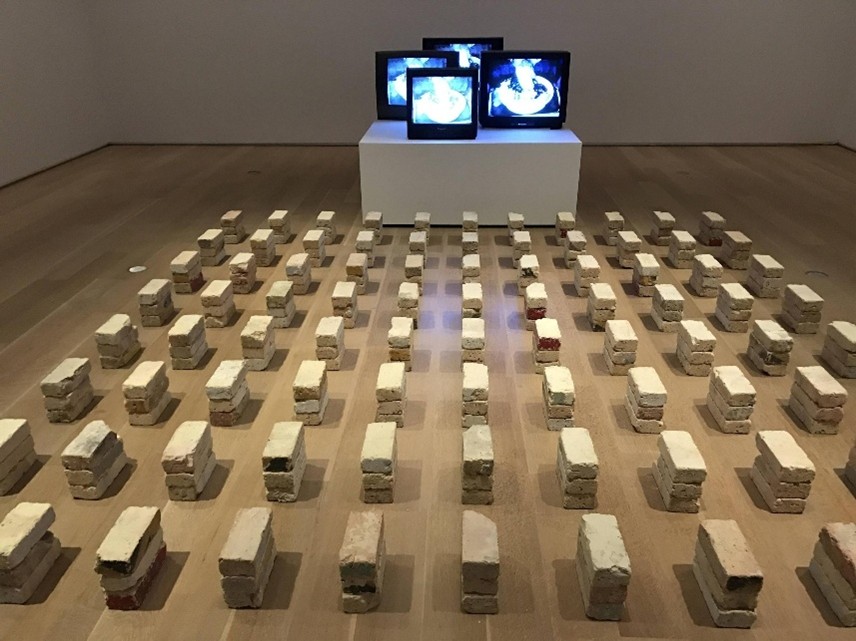
Peili Zhang: Document on Hygiene No.3[4]

Figure 1, Peili Zhang, Document on “Hygiene” No. 3, Single-channel video, Silent, color, 24’45”, PAL.


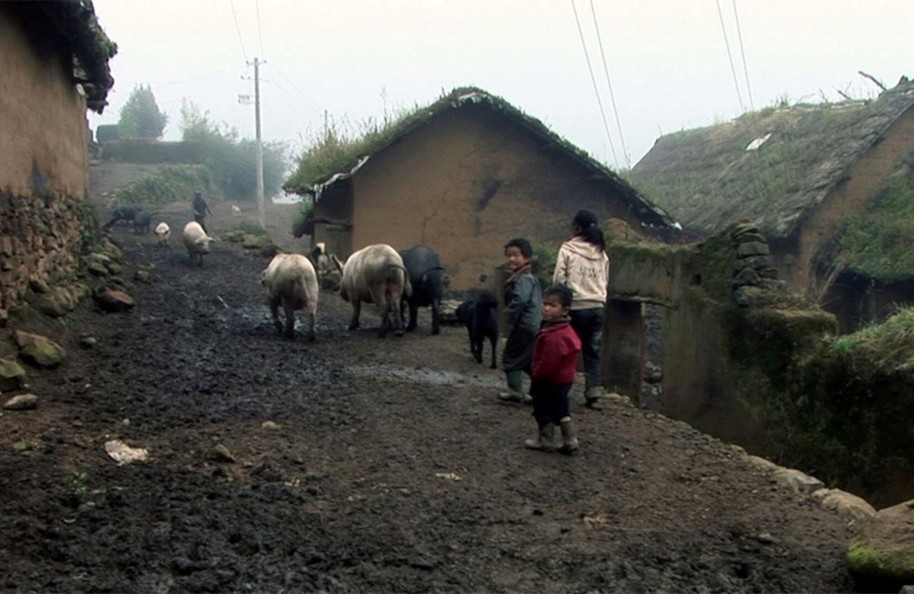
Wang Bing Tie Xi Qu / Three Sisters[5]

Figure 2, Wang Bing, Tie Xi Qu / Three Sisters, video artwork, dimensions variable, in Mandarin with Chinese and English subtitles


MyVillages Collective[6]: Printed Publications, Wall Archives, Desktop Reading Areas, Posters, Maps, and Text


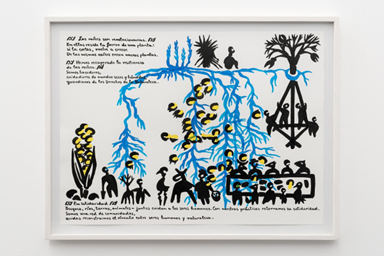
Marjetica Potrč[7]:

Figure 3: Marjetica Potrč, The Resilience of Roots, 2024, ink on paper, 56 x 76 cm, 22 x 29 7/8 in

Figure 4: Marjetica Potrč, The Rights of a River, 2021, ink on paper, group of 10 drawings, each 29.7 x 21 cm, framed 36.7 x 28 cm, 14 1/2 x 11 in, and The Life of the Lachlan River, 2022, ink on paper, group of 10 drawings, each 29.7 x 21 cm, framed 36.7 x 28 cm, 14 1/2 x 11 in, courtesy of Fragmentos, Espacio de Arte y Memoria, photo by Juan Velasco

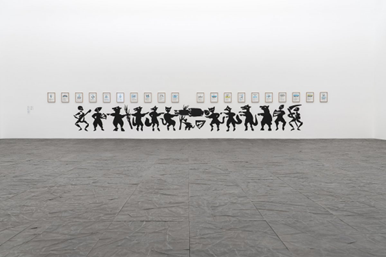
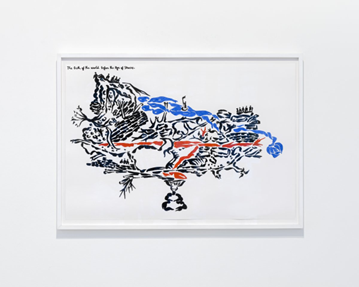
Figure 5: Marjetica Potrč, The World in the Age of Stories (Part 1: The Birth of the World Before the Age of Stories), 2020. Acrylic paint on wall. Walldrawing from original drawing ‘The World in the Age of Stories (Part 1: The Birth of the World Before the Age of Stories)’ (2020).

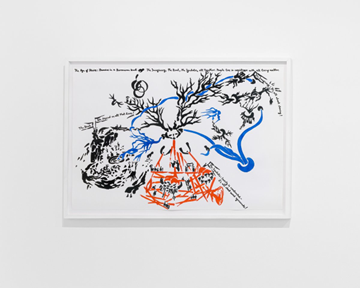
Figure 6: Marjetica Potrč, The World in the Age of Stories (Part 2: Humans in a Borromean Knot), 2020, ink on paper, 76 x 112 cm, 29 7/8 x 44 1/8 in, framed 85 x 119 cm, 33 1/2 x 46 7/8 in


[1] Kathrin Bohm & Wapke Feenstra, “Introduction” in MyVillages (eds.), The Rural (Whitechapel Gallery, 2019), pp. 16.

An endless stream of images of the rural enters our imaginations through multiple screens and printed matter. This intense objectification of the rural is alarming and splits our roles into spectators and dwellers. The transition from an agricultural and mining economy to a service, and above all non-land-based, economy has fixed our view of the landscape. We see the rural environment as an image that serves us. We build the picture that we long for.

[2]Kathrin Bohm & Wapke Feenstra, “Introduction” in MyVillages (eds.), The Rural (Whitechapel Gallery, 2019), pp. 14.

……perhaps it’s time to introduce the term critical rural art, as part of a collective ambition to emancipate art from its urban hegemony and to introduce a new dialectical dynamics into the current consideration of cultural production.

[3] Kathrin Bohm & Wapke Feenstra, “Introduction” in MyVillages (eds.), The Rural (Whitechapel Gallery, 2019), pp. 15.

The rural is equally shaped by industrial production both within the rural and the cities. Industrial and technological revolutions/infrastructures in urban areas offered overcrowded and economically weak rural communities a new home, causing depopulation and a new urban working class, while industries that rely on ground and soil resources dig up rural landscapes and spit them out as hubris and holes.

[4] Peili Zhang: Document on “Hygiene” No.3, single channel video, silent, color, 24’45”, PAL, (卫)字3号/Documenton“ Hygiene” No.3 — ZhangpeiliART

Recording the process of washing a chicken: a live chicken is placed in a basin, and constantly scrubbed with soap and water for 150 minutes, until the end of the cassette. The camera angle does not change for the duration of the video. No one knows what a chicken feels when being washed in a basin, because chickens lack the ability to express themselves, or we believe that they cannot express themselves. Even so, why is our previous judgment correct?

[5] UCCA×LEAP×CIFA THREE SISTERS SPECIAL SCREENING + Q&A WITH DIRECTOR WANG BING | UCCA Center for Contemporary Art

Three Sisters was filmed in a village in northeast Yunnan, and treats the lives of three sisters struggling to get by without parents or other support. The film won the Venice Horizons Awards at the Venice Film Festival in 2012.

[6] Myvillages

Myvillages is an international artist-led collective and non-profit cultural foundation, established in 2003 by Kathrin Böhm, Wapke Feenstra, and Antje Schiffers, that promotes cultural production in rural settings by linking local knowledge, communal practices, and artistic interventions across global village networks.

[7] Marjetica Potrč


Week 3: Practice of curatorial ethics

Before the third week’s lecture, I read Curating as Ethics and gained an understanding of ethical issues within curatorial practice[1]. A crucial component highlighted was the application of cultural elements[2]. Meanwhile, A Call To Arms: Strategies For Change detailed curators’ practical actions against the straight white male-dominated mainstream art world and their motivations[3]. This article focused more on the treatment and opportunities afforded to non-white, male, heterosexual artists. A classmate shared his concern about whether exhibited artworks might contain explicit misogynistic or racist content, even if displayed for oppositional or satirical purposes. This prompted me to consider issues largely overlooked in these texts[4].


During the group discussion in class, I exchanged views with that student. Ultimately, the discussion returned to the constraints imposed by practical conditions, such as artist’s security and the policy permissions. In Talbot Rice Gallery curator’s presentation, he mentioned that curators must consider the artist’s feelings, as controversial exhibitions risk directing the audience’s attention solely towards the controversy rather than the artwork itself.


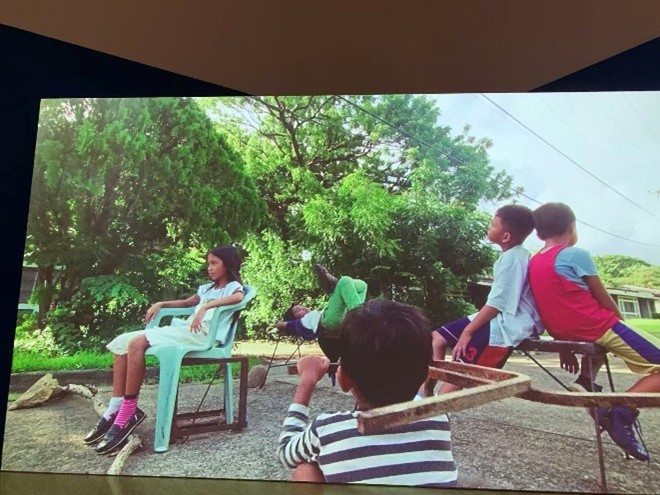
However, after class, I visited the Talbot Rice Gallery to view this teacher’s exhibition, The Children are Now. Yet I discovered that one artworks had uttered racially discriminatory words about Chinese people[5].


Figure 1: A controversial scene from Ane Hjort Guttu (b. 1971, Norway)’s video workFreedom Requires Free People (2011), which contains racist language directed at Chinese people.


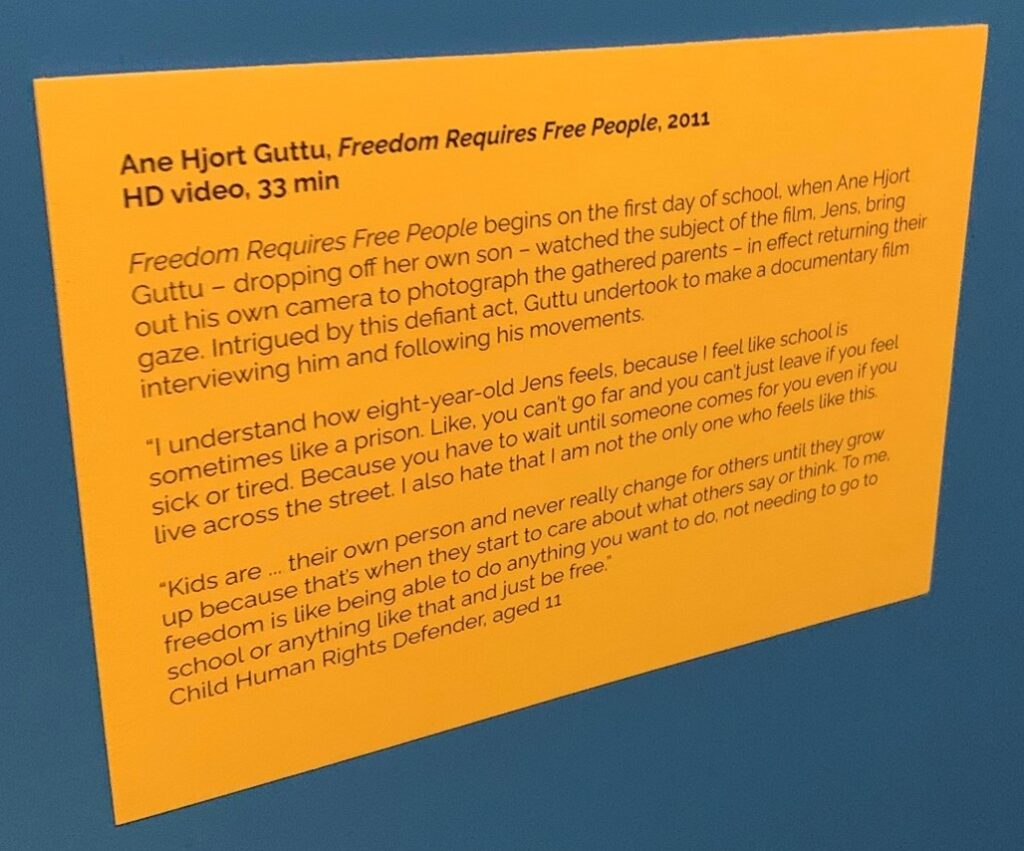
The film depicts a boy who uses discriminatory language, but portrays him as a character who yearns for freedom and is unwilling to be constrained by school. He hit teachers and disturbed other pupils’… I noticed the label framed children and adults as opposites, overlooking how rule-breaking children can also affect their peers. The label reflected the artist’s accommodating boy’s behaviour, which I feel uncomfortable.


Figure 2: The exhibition label for Ane Hjort Guttu’s (b. 1971, Norway) video workFreedom Requires Free People (2011), which I photographed in the gallery


Curators must strengthen their vetting of artworks. The repeated use of discriminatory language within such pieces, coupled with the artist’s ambiguous lack of explicit opposition, creates a profound sense of disconnection from the exhibition’s theme (group exhibition) . I have learnt that I must more meticulously review the content of every artwork in my own exhibitions.


I believe the exhibition’s anti-colonial content was not sufficiently thorough, and I need to improve this in my own exhibition. I consider multilingual subtitles essential for artworks, requiring at least the language spoken by the actors and English subtitles. As this film is anti-colonial and contains strong satire of Eurocentrism, For instance, textbooks labelled ‘English Changes the World’ are burned in flames, yet the subtitles remain solely in English.


Figure 3, Tuan Andrew Nguyen, Arrival of the Boat People, 2020.

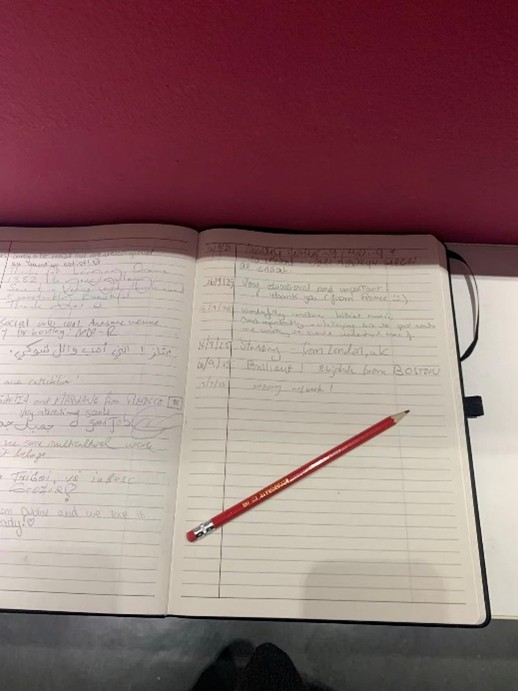
Figure 4: I noticed numerous comments written in languages different from English in the feedback book at the Talbot Rice Gallery, indicating that a significant portion of the audience prefers writing in their native language rather than in English. The exhibition should therefore accommodate the needs of this audience by providing non-English language subtitles in long video artworks.


[1] Martinon, Jean-Paul. Curating as Ethics. Minneapolis and London: University of Minnesota Press, 2020, x.
The most common example of this kind of ethics with regards to curating is, as mentioned earlier, museum and curators’ codes of ethics: short texts that put forward sets of supposedly rational principles that museums and/or curators should follow.

[2] Martinon, Jean-Paul. Curating as Ethics. Minneapolis and London: University of Minnesota Press, 2020, xxii.
On the other hand, it takes the cultural elements explored here equally seriously, not as illustrations for philosophical arguments but for their intrinsic cultural characteristics (as demonstrated, for example, in “Images”).

[3] Reilly, Maura. Curatorial Activism: Towards an Ethics of Curating. London: Thames & Hudson, 2018, 215.

As is evident in the preceding pages, many curators are working tirelessly to develop strategies to counter the persistent under-representation, silencing, and erasure of numerous artists throughout the world. Theirs is not affirmative-action curating, it is smart curating. Theirs is a practice rooted in ethics, and, as such, their exhibitions function as curatorial correctives to the exclusion of Other artists from the master narratives of art history and the contemporary art scene itself. These curators have taken immense strides forward in challenging hierarchies and assumptions, initiating debate, and circulating new knowledge.

[4] Reilly, Maura. Curatorial Activism: Towards an Ethics of Curating. London: Thames & Hudson, 2018, 220.

Publishers should be more self-aware and curb overt declarations of sexism/racism in their pages.
[5] The Children are Now | Talbot Rice Gallery

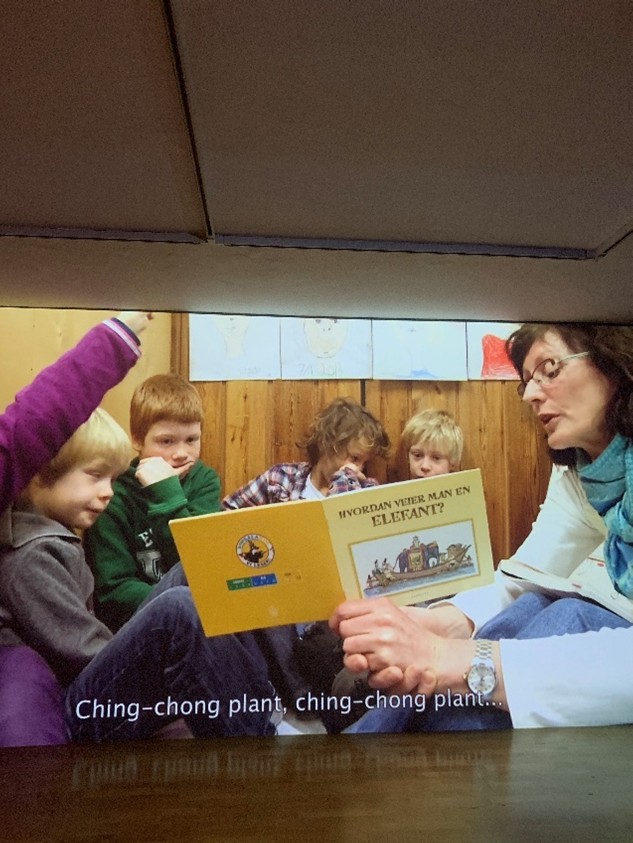
Ane Hjort Guttu (b. 1971, Norway) will present two films. Freedom Requires Free People (2011), follows eight-year-old Jens Flakstad Vold through his everyday life at school and his reflections on his experiences as a pupil. The result is an insight into an astute, critical mind, questioning what it means to achieve freedom within institutional settings. Conversation (2021) follows up with Jens ten years later, to reflect on his early quest for autonomy as well as his memory and experience of the making of the first film.


Week 2: Public Engagement and Feedback

During the preparatory work and class discussions in the second week, I read the article Mapping the Contexts of Contemporary Curating: The Visual Arts Exhibitionary Complex[1] and clarify the standard categories of art exhibitions (site-specific works, topics originating outside art, and events/participatory activities), exhibitionary formats (discursive, educational, paracuratorial, open-plan, participatory), curatorial style (infrastructural activism, collective, activist, creative commons, curating as medium). Moreover, I emphasised performative and participatory events that public desire for. This was previously overlooked by me, and is also relatively absent within the art world[2]. Consequently, during post-class exhibition visits, I focused particularly on these issues of public interactivity and public demand.


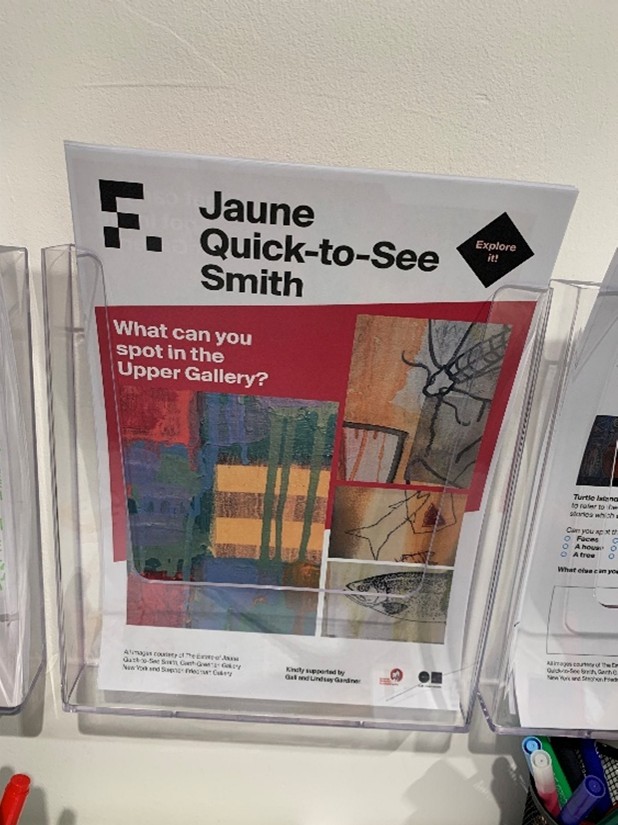
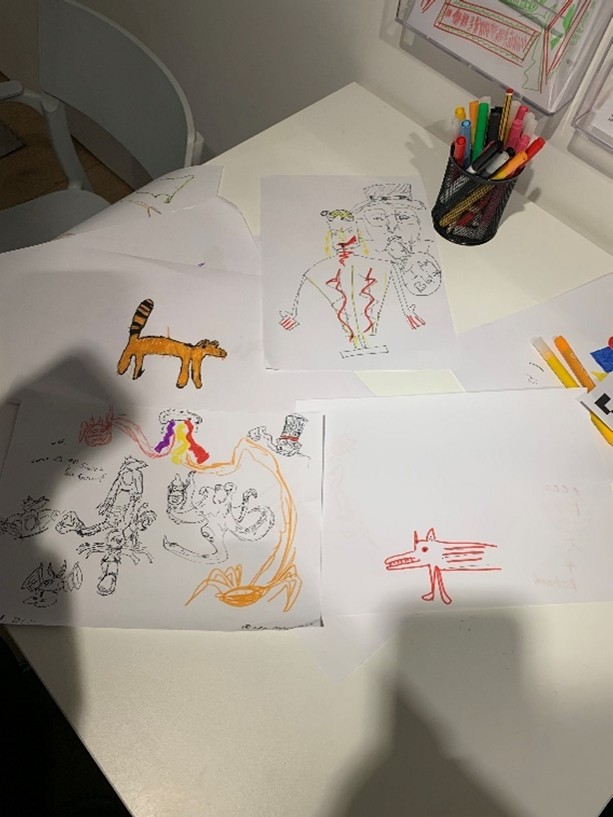
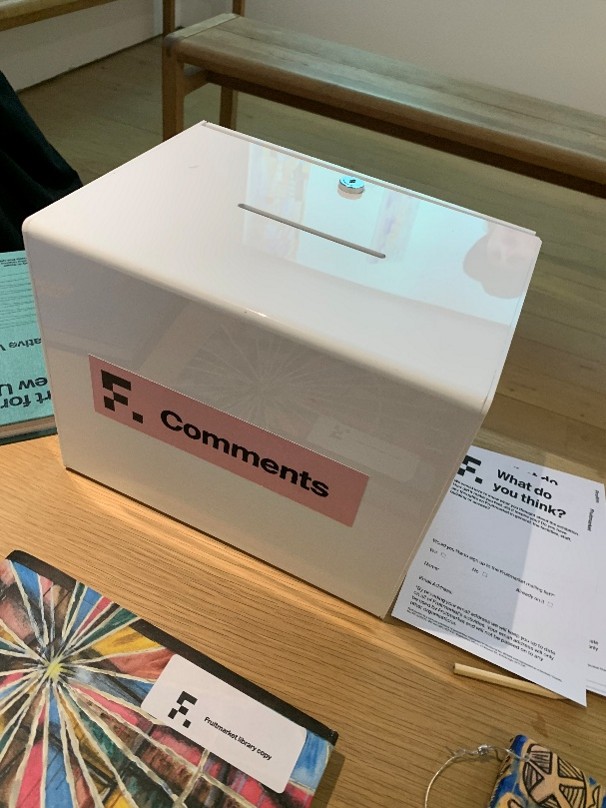
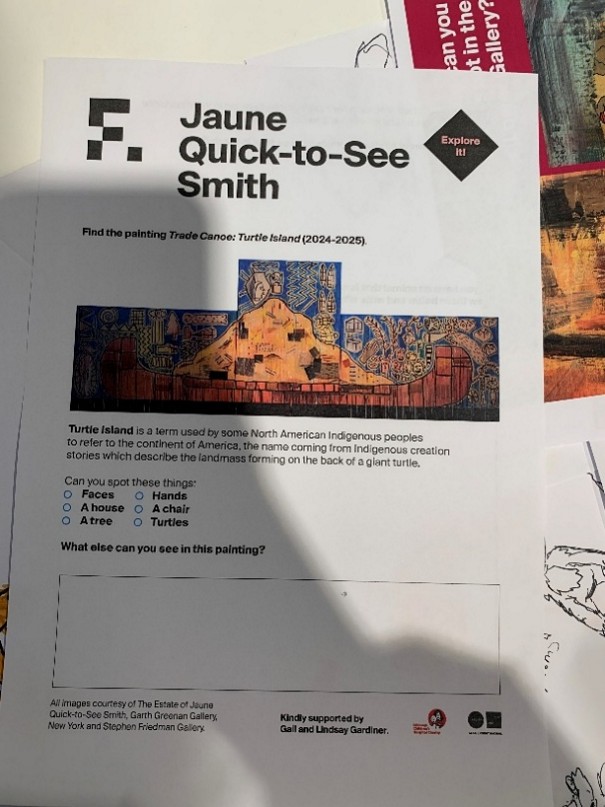
In the second week, I visited the Jaune Quick-to-See Smith Wilding exhibition at Fruitmarket Gallery[3]. After viewing this exhibition, I learnt numerous techniques to enrich my own exhibitions and enhance audience interaction. For instance, setting up a drawing area for children and posing questions such as: ‘Did you spot these images in the exhibition and artworks? Then providing a partial image for them to recall and sketch. Alternatively, not giving a standard image at all, allowing them to use their imagination before seeking out these details personally. This approach not only sparks children’s interest in the exhibition but also offers valuable feedback on how they perceive art through their innocent perspective, thereby informing improvements to the exhibition. I also learnt to set up comment boxes and questionnaires to gather more precise feedback on the exhibition and the artworks.


Figure 1: I found a feedback questionnaire for visitors in the screening area on the second floor of the Fruitmarket Gallery.

Figure 2: This area provides a space for children and visitors to draw, allowing them to sketch images from the exhibition that left a strong impression on them. This is an interactive approach I can learn from.

Figure 3: This comments box is placed on the table in the screening room, where paper and pens are also provided for audience feedback. This type of anonymous, voting-like feedback format is more likely to encourage audience engagement.

Figure 4: This type of questionnaire is engaging and fun, much like a quiz, which helps attract children to participate. On the one hand, it enhances the audience’s impression of the exhibition; on the other, it records their understanding of and feedback on the artists’ artworks, which helps the artists refine and improve their work in the future.


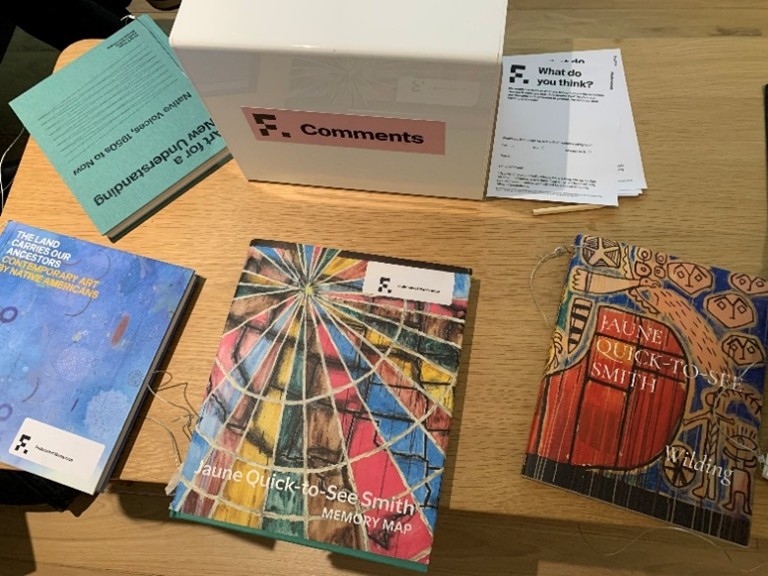
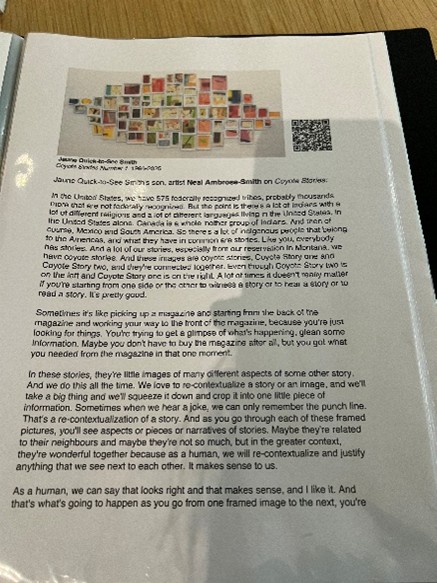
However, some shortcomings of this exhibition also provoked thought. For instance, the tables in the video screening area were placed with numerous lengthy articles, books, and artwork descriptions – material that visitors could hardly be expected to read attentively. Viewing the videos and reading carefully are incompatible activities. Visitors would typically choose to abandon reading such extensive texts, thus rendering the curatorial efforts wasted.


Figure 5: This shows the books displayed on the table; during my observation, very few visitors were reading them.

Figure 6: The exhibition’s artwork descriptions are located on the second floor, where they are difficult to find and too far from the artworks themselves; furthermore, the text is too long to read completely.


[1]  Terry Smith, Mapping the Contexts of Contemporary Curating: The Visual Arts Exhibitionary Complex, Journal of Curatorial Studies, Vol. 6, Number 2, 2017, 177.

……curators seek to adapt not only to the wishes of artists but also to the demands of the entertainment industries, the public desire for performative and participatory events, and the image hunger of Internetizens.

[2] Terry Smith, Mapping the Contexts of Contemporary Curating: The Visual Arts Exhibitionary Complex, 179.

……curatorial thinking about publics, audiences, participants and collaborators is rather less developed than it is when it comes to professional roles, types of exhibitions, exhibitionary formats, and curatorial styles.

[3] Jaune Quick-to-See SmithWilding – Fruitmarket

Jaune Quick-to-See Smith wanted the exhibition to engage with the history and politics of land stewardship. Smith was as interested in who owns, controls and cares for the land in Scotland as she was in land rights in the US, part of her dedication to justice and visibility for Native American people.


Project Book

Xinger Gao


Week 1 My Exhibition Inspiration

I hope my exhibition takes place in so-called “peripheral areas. [1]” While the dichotomy of Center–Periphery may seem outdated, it remains undeniably linked to structural violence. This violence can be revealed through art and culture[2]. Through my exhibition, I aim to fulfill culture’s power to show truth[3]. Simultaneously, I hope my exhibition will attract artists and intellectuals to join the urban cultural development of this region. This could break the cycle where only cultural centers attract capital and talent, using these resources to achieve further growth[4]. I also intend to select artworks more closely connected to the people to challenge artistic concepts determined by the higher societal class[5]. For example, displaying local cultural heritage and folk artworks.

I wish to curate my exhibition in the form of a small visual arts organization (SVAO) [6]. SVAOs are structurally small, non-profit spaces that are dedicated both to the production and to the dissemination of contemporary art. They are characterised by an interest in the local community in which they are located and in diverse urban issues ranging from new technologies to the social art practices in their cities. I hope my exhibition venues can include both indoor and outdoor spaces, with indoor areas suitable for displaying text and outdoor areas suitable for showcasing large-scale public art installations.


Therefore, I anticipate that my exhibition could be held in regions bridging rural and urban areas within China. The artworks I select will, as much as possible, be created by locally born artists[7]. Materials and mediums will prioritize locally specific resources, such as reed weaving crafts and clay sculptures reflecting local culture. Alternatively, they may relate to high-tech industries closely tied to the community, like plastic recycling and recycled plastic artifacts[8]. I aim to focus on the daily lives and livelihoods of local communities, using art to promote their pillar industries and unique cultural heritage[9]. This approach will create employment opportunities and increase income for local residents, while also educating audiences about production techniques and craftsmanship[10].


[1] Ronald Kolb, Camille Regli, and Dorothee Richter, “Centres ⁄ Peripheries– Complex Constellations,” Notes on Curating 41 (June 2019): 3.

[2] Kolb, Regli, and Richter, “Centres ⁄ Peripheries,” 6.

Nevertheless, art and culture have the possibility to produce “truth,” to reveal and to comment, and they are able to act to a certain extent as a counter-hegemony or, as Adorno and Horkheimer have unmasked so-called cultural industry, art and culture are able to confuse and affectively involve people in false ideas about their conditions.

[3] Kolb, Regli, and Richter, “Centres ⁄ Peripheries,” 5.

But culture also has the power to show the truth, which means in this sense always also the truth about production, relations of production processes, and economics. Or, in other words, the concept of hegemony makes it thinkable that counter-hegemony is also possible.

[4] Kolb, Regli, and Richter, “Centres ⁄ Peripheries,” 7.

The research undertaken in Art in the Periphery of the Centre (2015) by Christoph Behnke, Cornelia Kastelan, Valérie Knoll, and Ulf Wuggenig11 draws the hypothesis that cultural centres have organically attracted, over the years, groups of artists and intellectuals who have built the cities’ cultural profiles, despite the economic situation.

[5] Kolb, Regli, and Richter, “Centres ⁄ Peripheries,” 7.

his idea was already expressed in the ‘70s and ‘80s by avantgarde theorists, such as Peter Bürger in The Theory of the Avant-Garde (1974), 13 in which he extensively refutes the idea of “art as an institution,” claiming that art’s production and distribution in institutional structures are conditioned by ideas that are determined by the higher societal class—which essentially biases our perception and reception of art. For Bürger, joining Marx’s ideas, the institution gets away from the “praxis of life” and is fundamentally detrimental to the meaning of art. Therefore, they say it needs to be closer to the people and to collective craft.

[6] Ana Edurne Bilbao Yarto, Micro-Curating: The Role of SVAOs (Small Visual Arts Organisations) in the History of Exhibition-Making (Notebook for Art, Theory and Related Zones, 2018), 120.

In the beginning there is thus a kind of community center or hang-out for friends from the art field. In the regions I am talking about these activities are assuming a quasi-institutional status that often goes hand in hand with an expansion of their activity. They then start to fundraise internationally, to set up residencies, offer research possibilities, invite foreign curators and artists, organize film programs, edit magazines and so on. I call these spaces with quasi-institutional character Small Visual Arts Organisations, hereafter SVAOs.

[7] Bilbao Yarto, Micro-Curating, 127.

In some cases, SVAOs were established with the aim of giving unknown local artists a space to make their work visible or to promote their work beyond regional boundaries by connecting them to a larger art international community.

[8] Bilbao Yarto, Micro-Curating, 127.

Most significantly, they all share a strong interest in engaging with the local communities where their buildings are located, as well as in tackling local urban issues, including social art practices or new technologies in their cities.

[9] Bilbao Yarto, Micro-Curating, 133.

In some cases, SVAOs were established with the aim of giving unknown local artists a space to make their work visible or to promote their work beyond regional boundaries by connecting them to a larger art international community.

[10] Bilbao Yarto, Micro-Curating, 133.

……the interest of SVAOs in: Processes over End Products; Networks and Sustainability; Engagement; and Research and Knowledge Production. This means that they share an interest in process-based artistic practices, in research-oriented activities, in arts education and in fostering strong levels of engagement with their publics, mainly their local publics.