Week 4 — Making Invisible Boundaries in Edinburgh’s Public Space More Visible
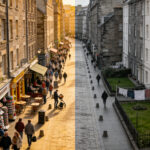
Following this week’s collective discussion, I continued to explore how invisible boundaries in Edinburgh are made in everyday life. They are generally not imposed explicitly. More often, they are produced through repeated habits, time patterns, and ordinary ways of using space, until they start to feel natural. Which is why they are difficult to recognize.
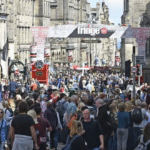
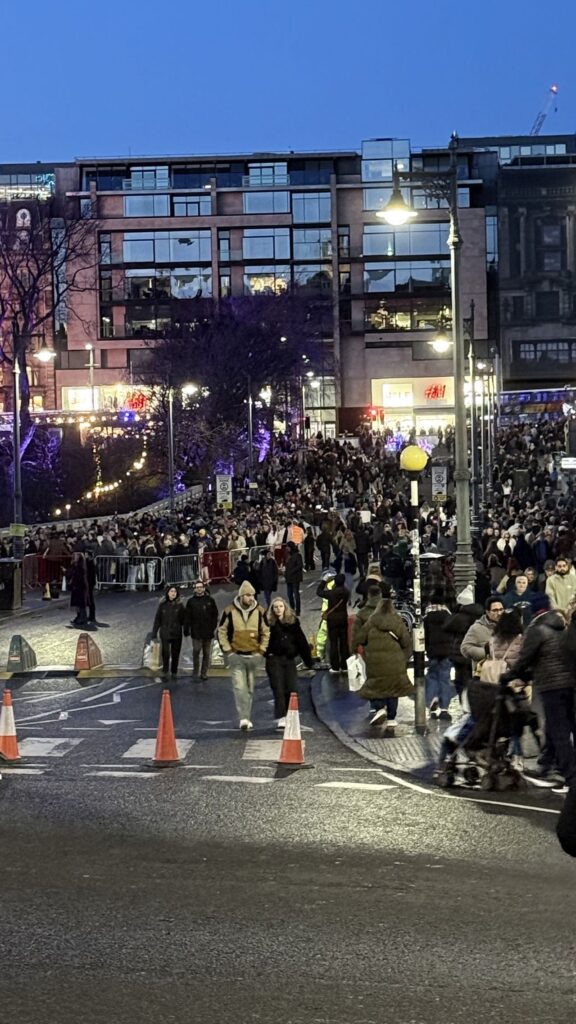
This was clear to me when I started to closely observe people’s everyday use of space. In the Royal Mile and Princes Street, where the tourist presence is significant, local inhabitants tend to avoid the “busy” hours and instead move to other areas for recreation or relaxation. During festival periods, squares, streets, and pedestrian areas are reorganized by performances, tourist flows, and temporary structures. As a result, how these areas are accessed is transformed. After repeating the same use pattern a couple of times, unbalanced space use can be mistaken for being a matter of choice. These barriers, therefore, are not invisible because they don’t exist, but because of their ubiquity.
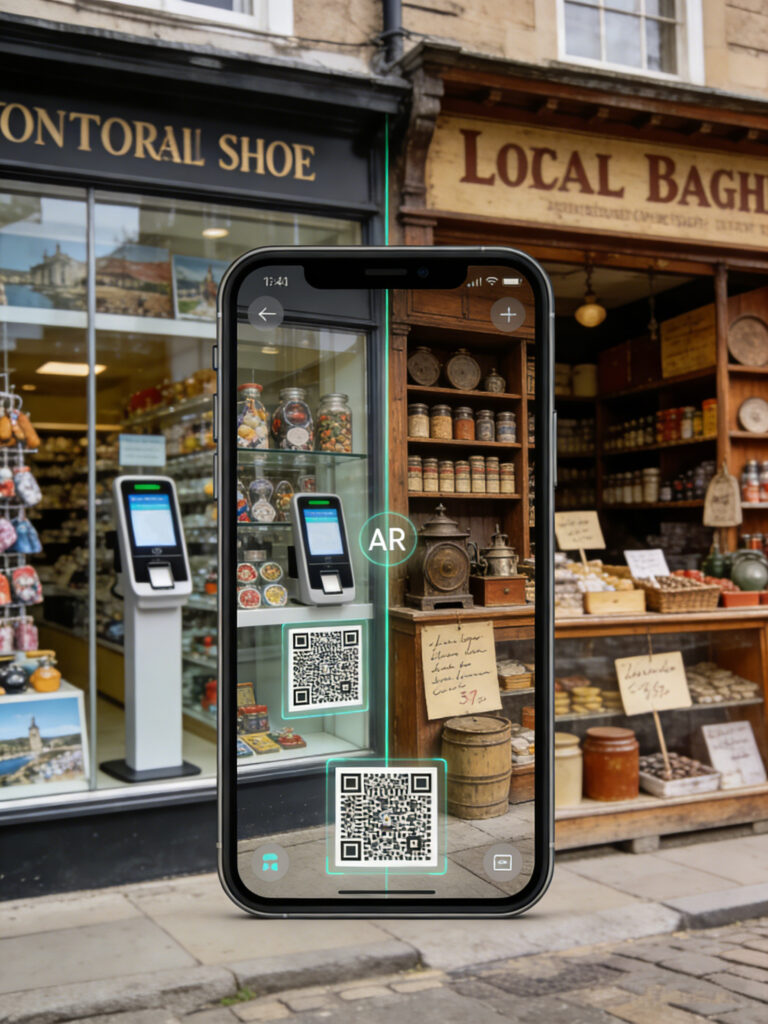
I also started thinking of creating a light AR element. I did not want to use technology simply to make the project more up-to-date. I was interested in whether different surfaces at the same location could be recovered. So, if I made an augmented street scene, I might be able to see today’s retail tourist scene and a trace of previous life. This natural and fixed place could, then, be viewed as the outcome of commercial interests, choreographed movement, and controlled visibility. In this context, AR could be used to undo the idea of “this area has always been like this”.
We also had a private meeting with the collective about the title and manifesto, and that helped me to understand the public stance of the project better. I don’t want high-profile commercial activity confused with the public. It might be crowded and commercial, but that does not necessarily follow that it will also be of equal public value. Nor do I want differences in rates of use, which vary by hour, day, or season, to be treated as an inherent part of public space. More importantly, I do not want the project to equate the problem with that of residents and tourists. Of more concern is the relationship between capital, management, and circulation that results in spatial hierarchy. Otherwise, there would be a risk of reproducing exclusions within the exhibition.
References
City of Edinburgh Council. City Centre Public Spaces Manifesto Update Report. 2 June 2015. https://democracy.edinburgh.gov.uk/Data/Transport%20and%20Environment%20Committee/20150602/Agenda/item_77_-_city_centre_public_spaces_manifesto_update.pdf.
Kester, Grant H. “Dialogical Aesthetics: A Critical Framework for Littoral Art.” Variant 2, no. 9 (Winter 1999/2000).