Week 1 – From Description to Structure
The Anthropocene, the Capitalocene, and A Billion Black Anthropocenes together provided a layered critical framework for the ecological crisis I am concerned with this week. The Anthropocene shows that human activity has shaped a global crisis. The Capitalocene challenges the idea of “humanity as a whole” and instead treats capitalism itself as a major historical structure of ecological destruction. Yusoff then powerfully connects geological extraction, colonialism, and racial violence. A clear and important insight follows from this: curating cannot operate on only one level.
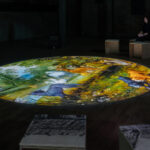
Because of this line of thinking, my way of viewing Sarah Wood’s Project Paradise changed. What now seemed especially important to me was not only the content of the work, but also its mode of presentation. The work takes the form of a floor projection, and viewers enter it from an overhead angle into a space composed of archival images, drone footage, history, and memory. From this, I drew the conclusion that exhibition form is not simply a support for content. It actively shapes how content is experienced and understood.
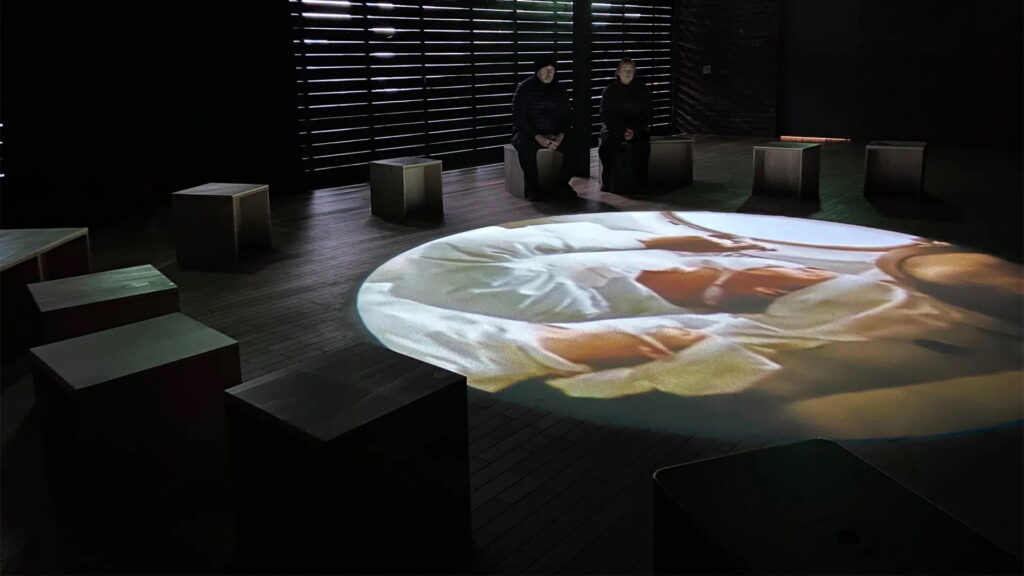
Using these three concepts, I was also able to reread the exhibition more critically. Fruitmarket introduces Project Paradise mainly through ecology, landscape, memory, and extraction. This is a useful point of entry, but it also naturally leads to more fundamental questions: which histories are made visible, and which structural or racialised dimensions remain underdeveloped? This was the first time I understood very clearly that the same curatorial work can open into different layers of meaning depending on the theoretical lens through which it is read. From this, I gradually began to understand that curating is not only about displaying material, but also about organising how that material is read.
During the first collective discussion, everyone introduced their own background and areas of strength. I could see that group members had different kinds of experience in installation, editing, communication, and modeling, and many of these were areas in which I am not yet strong. This helped me understand the purpose of the collective. Learning in this course will not develop through theory alone, but also through collaboration. For me, the collective is therefore an excellent site for building practical experience.
References
PAUL J. CRUTZEN, EUGENE F. STOERMER and WILL STEFFEN. “‘The “Anthropocene”’ (2000).” In The Future of Nature, edited by Libby Robin, Sverker Sörlin, and Paul Warde, 483. Yale University Press, 2013.
Fruitmarket Gallery. “Sarah Wood: Project Paradise.” Edinburgh, December 9, 2023–January 21, 2024. https://www.fruitmarket.co.uk/archive/sarah-wood-project-paradise/.