Critical Reflection
Introduction
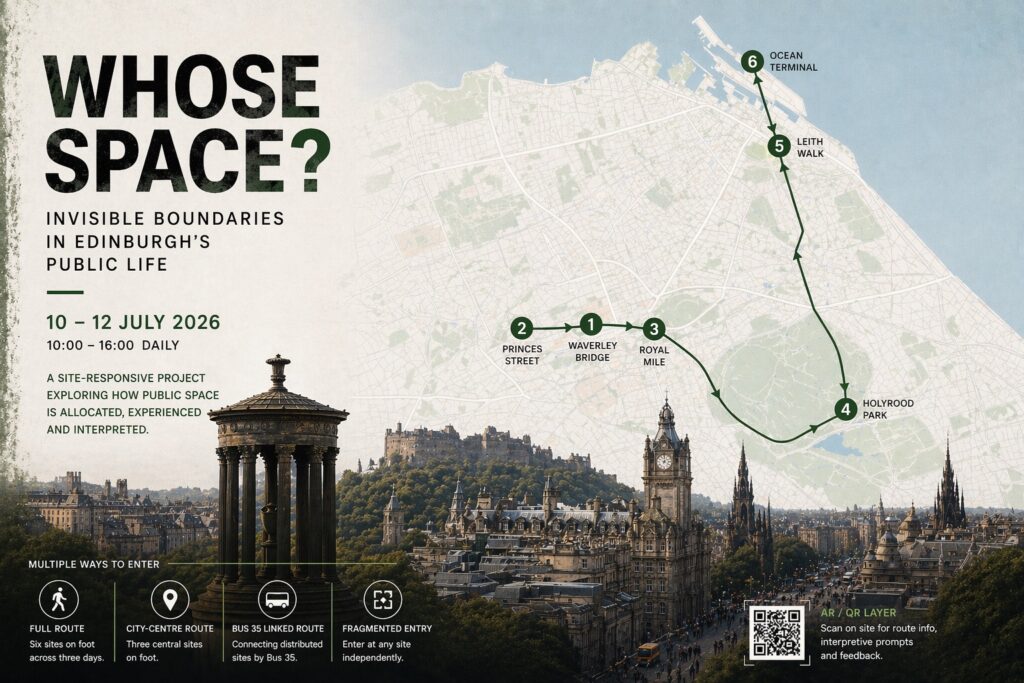
This critical reflection examines how my speculative curatorial project moved from an uncertain initial idea towards a curatorial proposal focused clearly on the problem of “invisible boundaries” in Edinburgh’s public space. What began as an interest in curatorial forms beyond the white cube gradually developed into a site-responsive, public-facing proposal exploring how movement, accessibility, tourism, and everyday use together shape unequal urban experience.
The reflection traces several key moments that reshaped the project’s method and direction. It first considers how early uncertainty developed into a more consciously curatorial mode of thinking, then shows how feedback and the curatorial pitch helped reorganise the project’s structure. It goes on to discuss how fieldwork and route testing led me to rethink viewing in public space, before using my experiences of collective work, exhibition practice, and peer review at Summerhall to show how they developed a stronger sense of collaboration, critical judgement, and a more concrete understanding of curatorial conditions. The project did not develop through the smooth refinement of a fixed idea. Rather, through a series of revisions, a conceptual interest became a more precise judgement about structure, modes of entry, and public conditions.
From Uncertainty to Curatorial Positioning
In the first fortnight of the course, my approach to curating was not so much defined by a project as defined by a change in looking. At that time, I did not have a particular proposal and I didn’t yet know quite what the purpose of the blog was. I did have a growing awareness that curating today does not only start with a pre-determined exhibition object or theme. Rather, it seemed to be more about form, conditions, organisation, and relations. In the beginning, my work was experimental. I took notes during visits and sought to define what my vital curatorial questions might be. This seemed unfocused. But in retrospect, I needed to go from simply describing the work to thinking about its organisation, its spatial and viewer relationships.
My tutors’ early blog responses furthered this. I realised the nature of the blog is not a journal of weekly impressions but rather a portfolio that should display the process of a project from initial concept to its realisation. Week 2 made this clearer to me, especially with the concept of a curatorial platform as a structure based on a coherent theme and principles. (Bacon 2026a) This was a shift in seeing curating as the arrangement of relationships, form, and experience, rather than just the presentation of a static object.
The Week 3 workshop helped me put the idea into practice. My conversation with a Talbot Rice curator using Ai Weiwei’s project at Tate illustrated the idea that you can respect a project, but that does not necessarily make it curatorially successful. Some projects are politically strong and well-known, but they don’t necessarily work on all scales, budgets, or for all institutions or for all visitors. It was the first time that I thought more as a curator, rather than an audience member. Curating slowly began to become for me a practice of judgement. It is not just to select what is interesting or intriguing, but to consider what might work in certain circumstances. In this way, my thinking about exhibitions early in this process was akin to the change we often see in relation to When Attitudes Become Form: exhibitions are not made exclusively of objects but by process, open system, and spatial conditions. (Desaive 2013) What was important for me in this instance was not only that it was historical but also that it challenged me to reconsider my project. My SICP started to become for me a proposal that invited process, conditions, and judgments, rather than the simple exhibition I had made only at the end of the process. This reframed the project from the indistinct interest of a theme to a curatorial attitude.
Project Development, Feedback, and Methodological Change
The comments that I received on the blog brought me back to clearly state a problem that was not previously clear to me. A project must have both a good theme and a good form. It also must have a form that opens up the public to that theme. Until this point, I had primarily considered whether the project dealt with a topical and discussable theme. This feedback made it clear to me that this was insufficient. A public curatorial project cannot rely solely on a timely topic. It also needs to be informed about whether its structure supports the presentation of the issue or not.
This is where Irene Campolmi’s writing on curatorial ethics came in handy. Her position assisted me in re-framing the issue of revision. She argues curatorial ethics entail adjusting with care to changing circumstances.(Campolmi 2016) I thus started to think about project adjustment as a methodological and ethical decision. My inquiry became about whether the form of the project might allow its concerns to be open to visitors and whether care might be embedded into the ways of entering, attending, and remaining in the museum.
My approach to artist selection also took on a “responsibility” rather than “recognizability” aspect. Initially, I assessed the fit between an artist and a project in terms of celebrity or public debate, as they both seemed to raise public awareness. As the project became linked to feasibility, I learned that rather than having an artist who was “celebrity enough”, it was more important for their work to suit the project’s spatial constraints, curatorial form, and ethical considerations. Schuppert’s work on the relationship between the artist and curator further clarified this. Who, how, and where artists get paid is an ethical issue. There are also ethical questions as well. (Schuppert 2021) I, therefore, began to think about the appraisals of artists in curatorial terms of responsibility, resources, conditions, and care, not popularity. This also impacted my concept of co-creation. If existing works do not directly map onto the project structure, co-creation can occur in the form of re-arranging relations between artists, works, and project structure.
Refining the Project Through Constraint
The curatorial pitch was an important milestone to understand the difference between “many interesting elements” and “curatorial framework”. My proposal already included public transport, multiple locations, routes, and a variety of public spatial experiences. However, this was not a strong enough structure to support my proposal. The pitch called for them to be clarified for other people; in this, I found a weakness in my own reasoning. I had fallen in love with a number of formal elements because of their novelty.
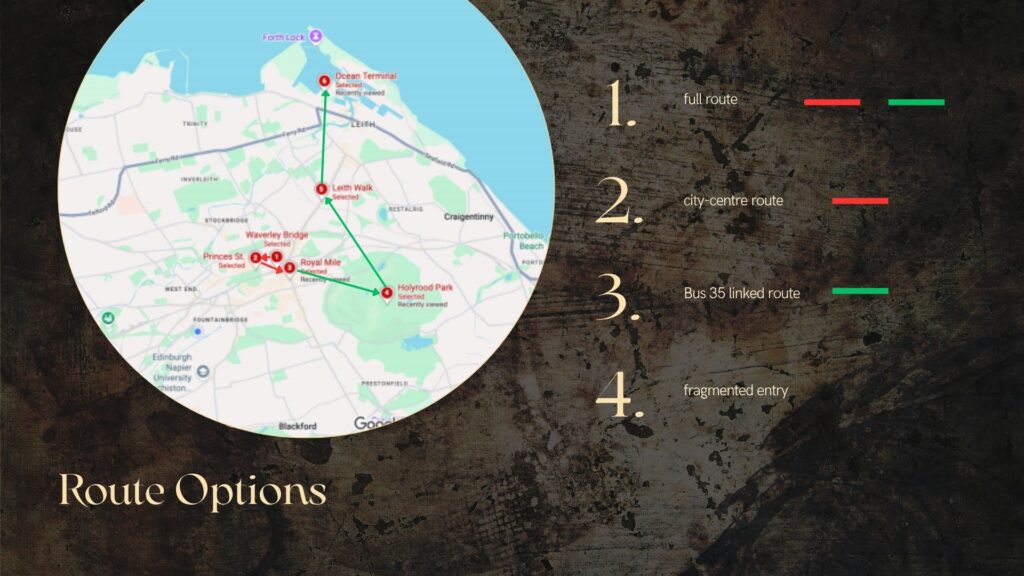
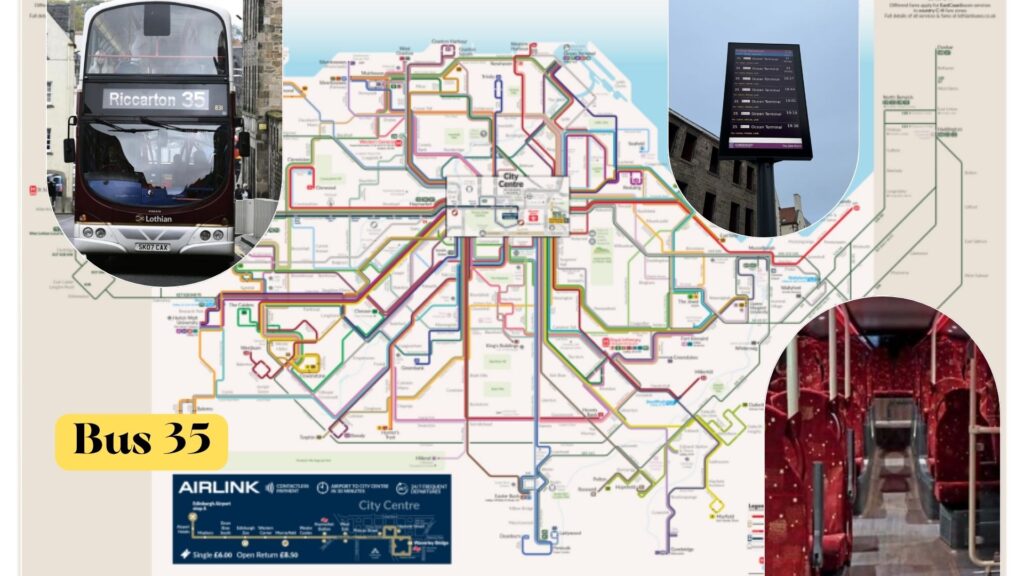
This was best illustrated by my initial insistence that the project had to be based solely on public transport. While giving the project a clear emphasis, this structure proved to be unnecessarily narrow (as later discussion showed) because public transport was only one of the possible elements of the project, rather than a constraining structure forcing all other decisions. The project needed to remain true to diversity in site, route, and vantage.
So, constraint was not always limiting. It was productive. The pitch showed it was not a matter of cutting ambition, but of filtering ambition in terms of reason and fit. According to Schuppert, curators must be taught to say no to aspects of ambition that are disguised as responsibility. (Schuppert 2021) This translated into a methodological innovation. Curatorial judgement demands a discrimination between what is productive for a project and what is merely complex. I saw the need for flexibility as enabling coherence.
Fieldwork, Public Space, and Non-Linear Spectatorship
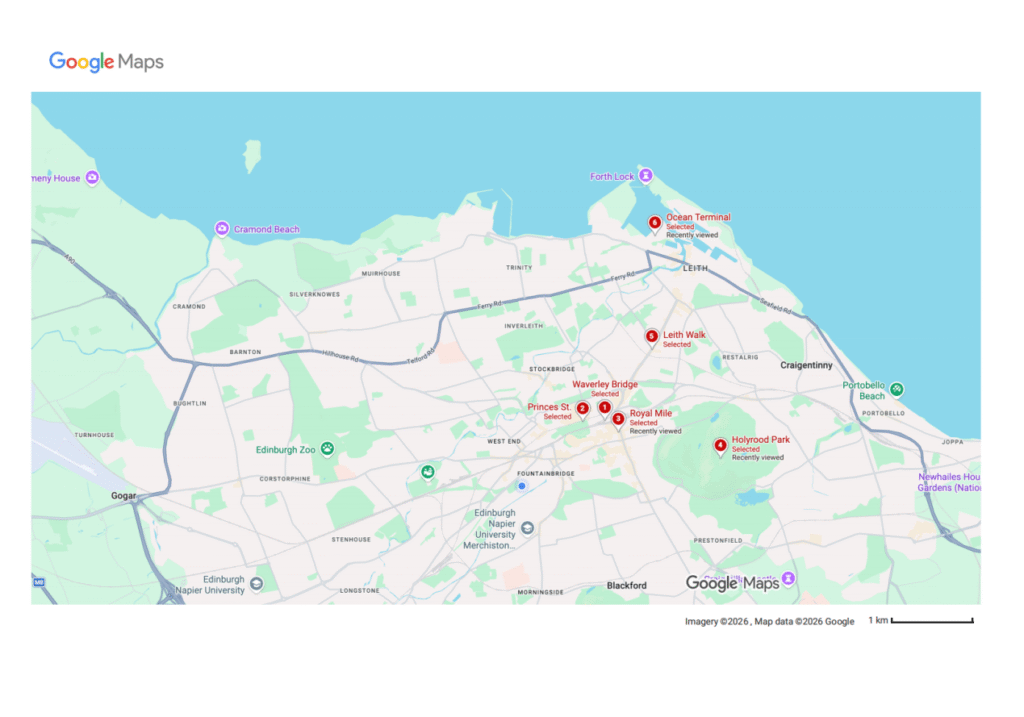
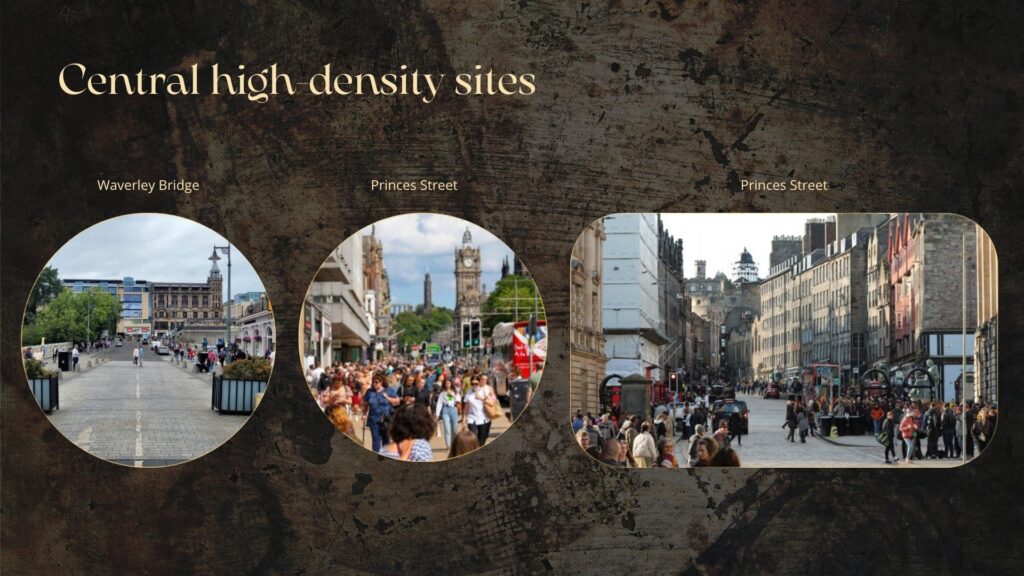
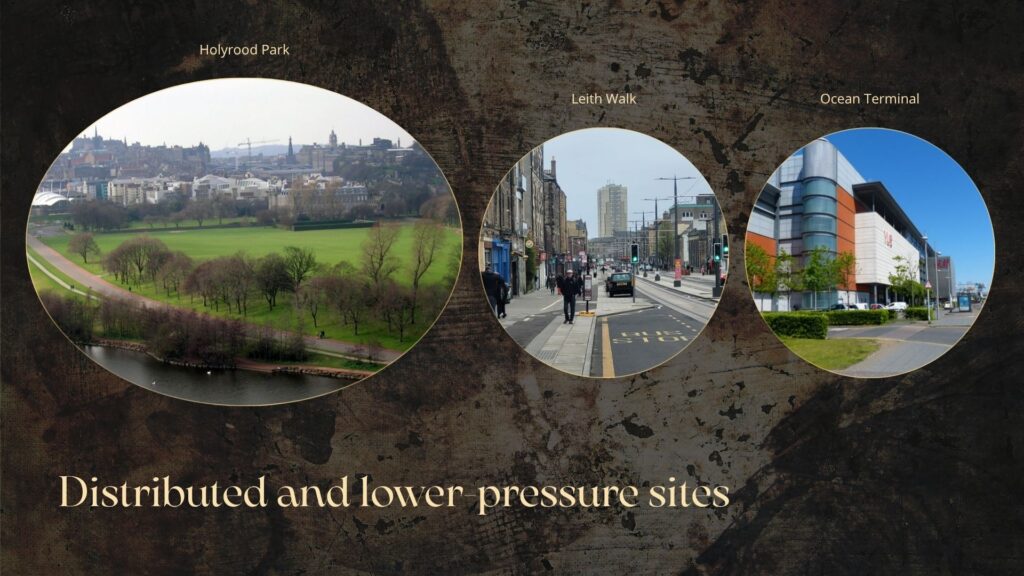
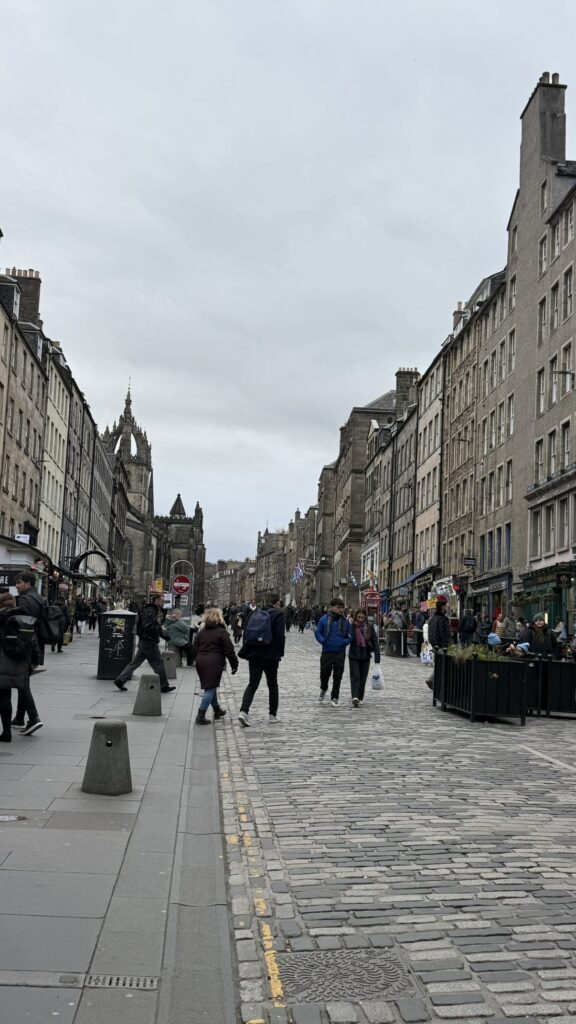
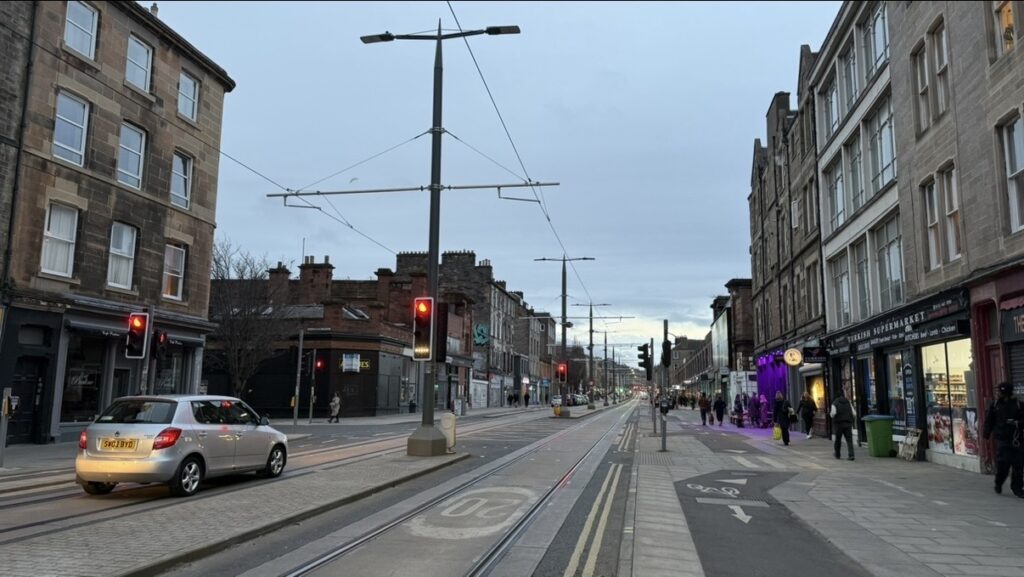
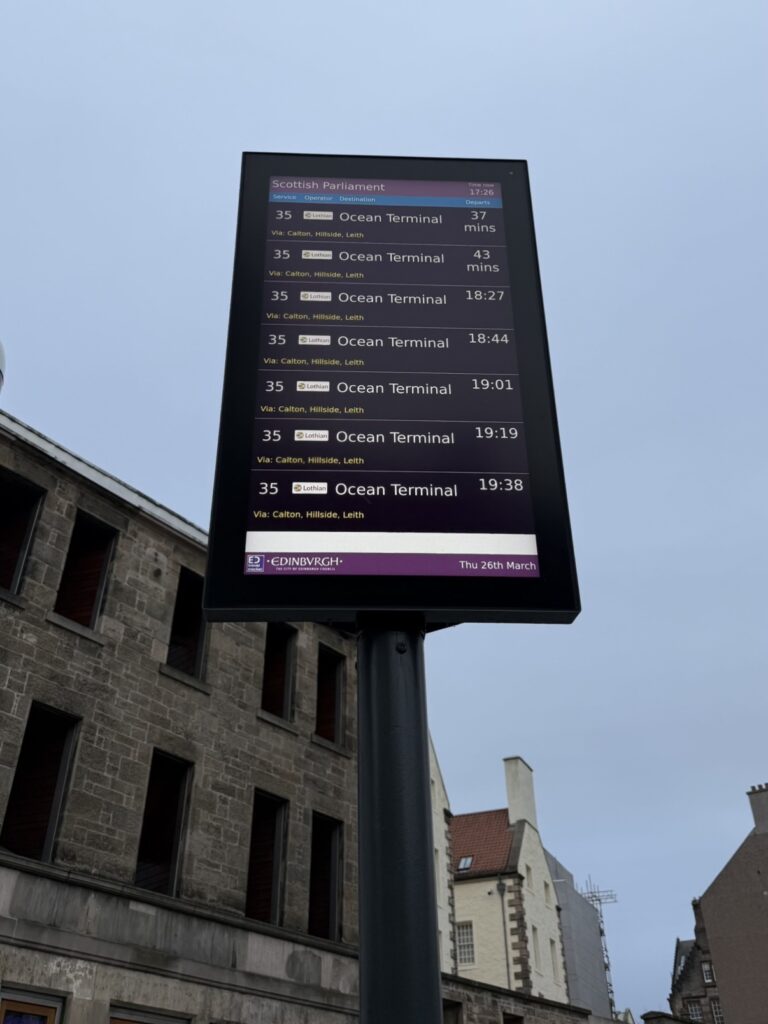
When I walked the entire route proposed in Week 9, I began to understand the difference between the proposal as “structure” and the project as “experience”. The route was coherent on paper. But in reality, the limitations of time and fatigue, accessibility, and a viewing practice difficult to control all came into play. This testing proved two things: the route was too long, and I still had a fairly homogenous idea of the viewer. Terry Smith talks of contemporaneity as multiplicity and disjunctive temporalities, as unevenness. (Smith 2006) It wasn’t until I field-tested the route that this made sense of my observations. If publics experience public space as already uneven, then a project presented in public space cannot approach its audience as equally experiencing the project. As such, the tests meant that I needed to ask myself: can the structure of the project accommodate different public “ecologies” in the city? This is also in line with the Week 10 appreciation of the public as multi-faceted and differentiated, for a variety of temporal, practical, and social needs. (Bacon 2026b)
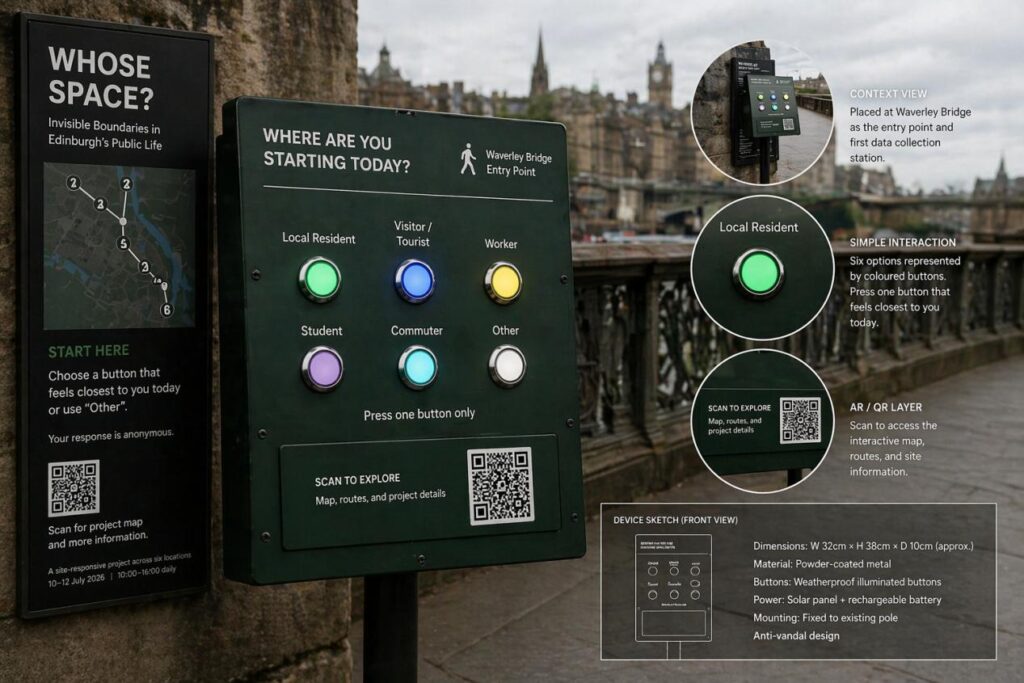
For this reason, I didn’t consider that the main success is “doing the entire route. Instead, I cared more about more than one point of entry, different possibilities for participation, and more diverse spatial distributions of attention. Ultimately, coming to terms with the possibility of knowing only part of the project made it easier to think about the project. Christine van Assche’s model of “sequential progression” versus “spatial narrative” helped me to think through this change. (van Assche 2003)Though my project isn’t a moving image installation, her language helped me to think about route design in more than just a point A to point B sense. More importantly, I have come to understand that entering public space is a methodological and ethical stance. Patterns of use, time constraints, accessibility, and uneven access of the public to a project are all factors to be reckoned with.
Collective Practice, Summerhall, and Curatorial Ethics
Summerhall has altered my view of curatorial practices because it has made manifest that curating is more than a process of conceptual organisation. They require an infrastructure. Scheduling, resource allocation, curatorial assistance, marketing, and artist fees and commissioning methods have a bearing on what projects you can achieve, continue, and present. Artists’ development, non-commercial support, and accessibility for the public can also be embedded into support structures. This led me to critically reflect on my own SICP. The success of a curatorial project cannot be assessed solely according to the power of its idea, but also its support structure should have integrity with its ethical and public standing.
Summerhall also disambiguated the notion of accessibility and care. Public engagement is a certain type of curatorial choice. There, free admission, hanging works at around wheelchair height, multisensory support, plugging into sound-reduction headphones, and using fonts that are good for people with dyslexia are core practices. These bits and pieces allowed me to see that the audience is not a neutral entity but a group made up of people with varying physical conditions, sensory abilities and pathways for engaging. Krasny and Perry’s gestures to “care about” and “care for” helped narrow this down. Care is only real when it is embodied as conditions that enable a viewer to enter, endure, and make sense of a project. (Krasny and Perry 2023)This impacted my own proposal in terms of consideration for its legibility.
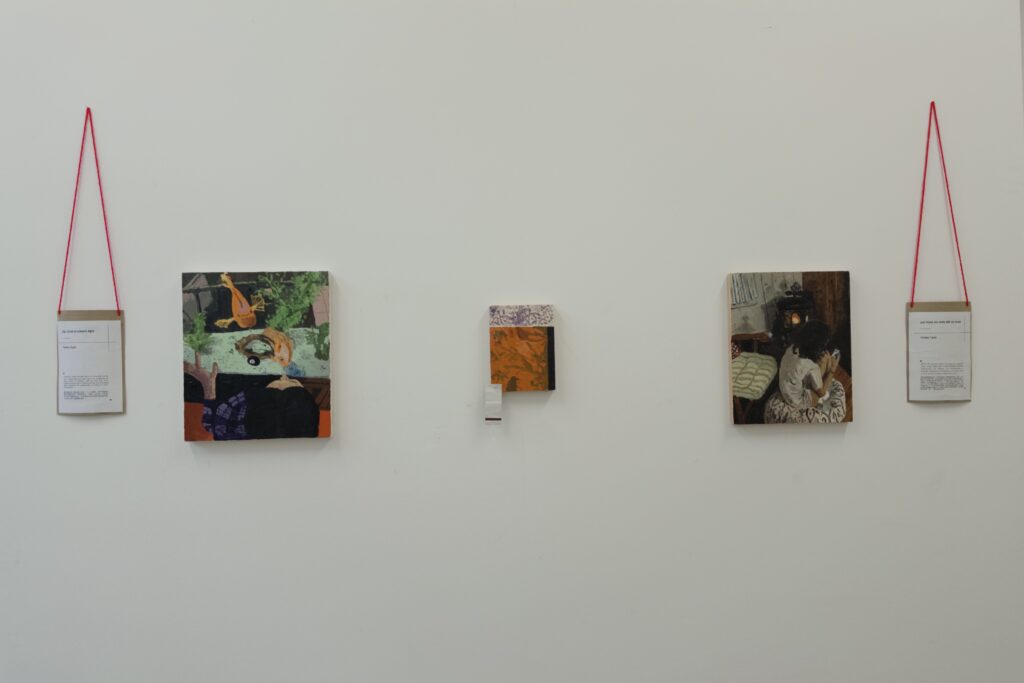
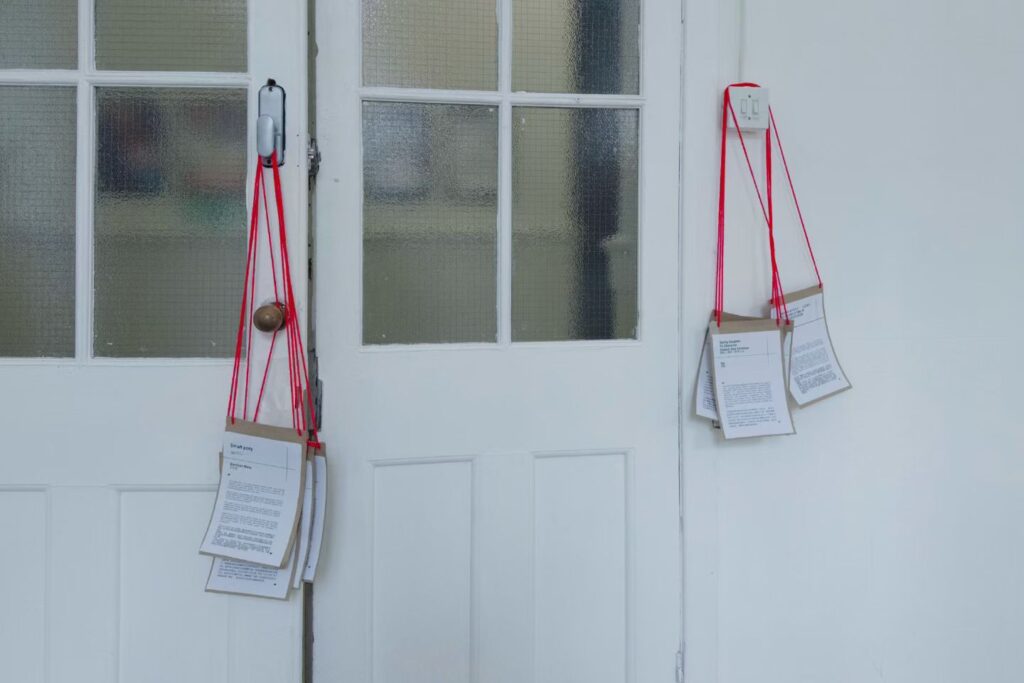
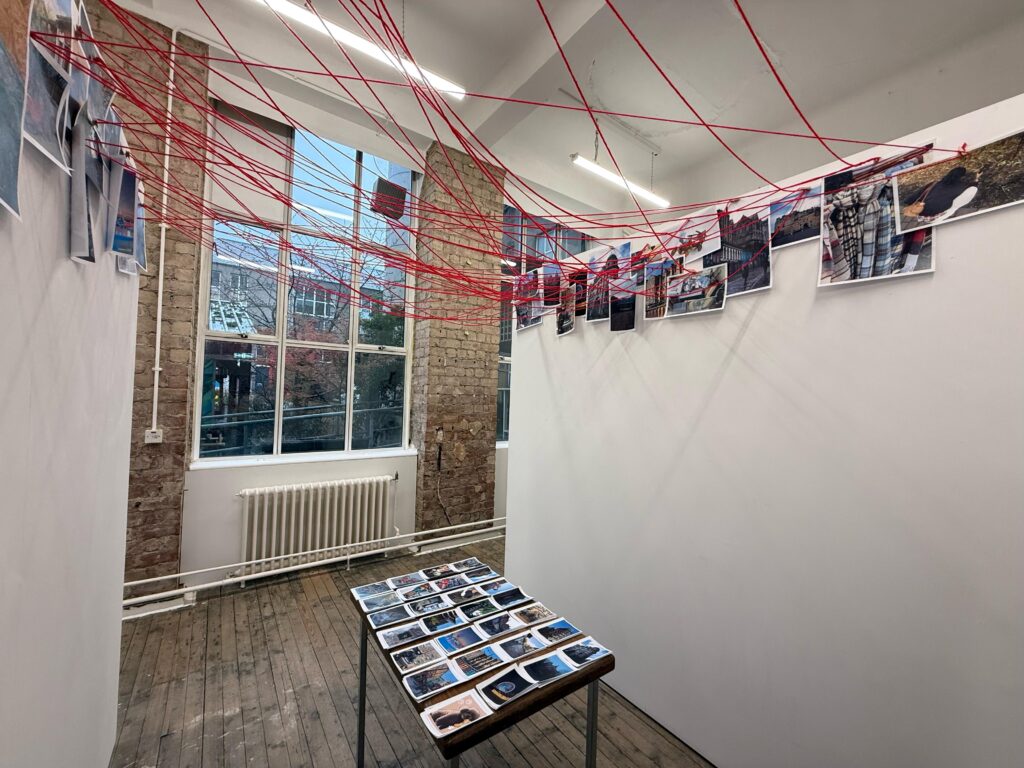
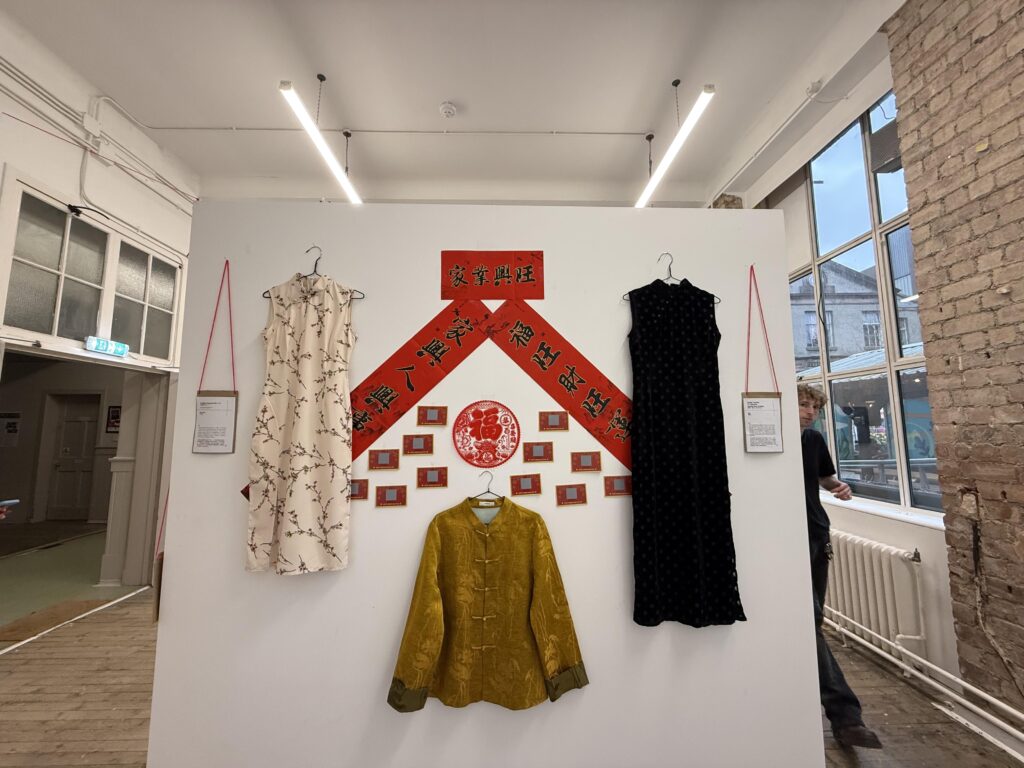
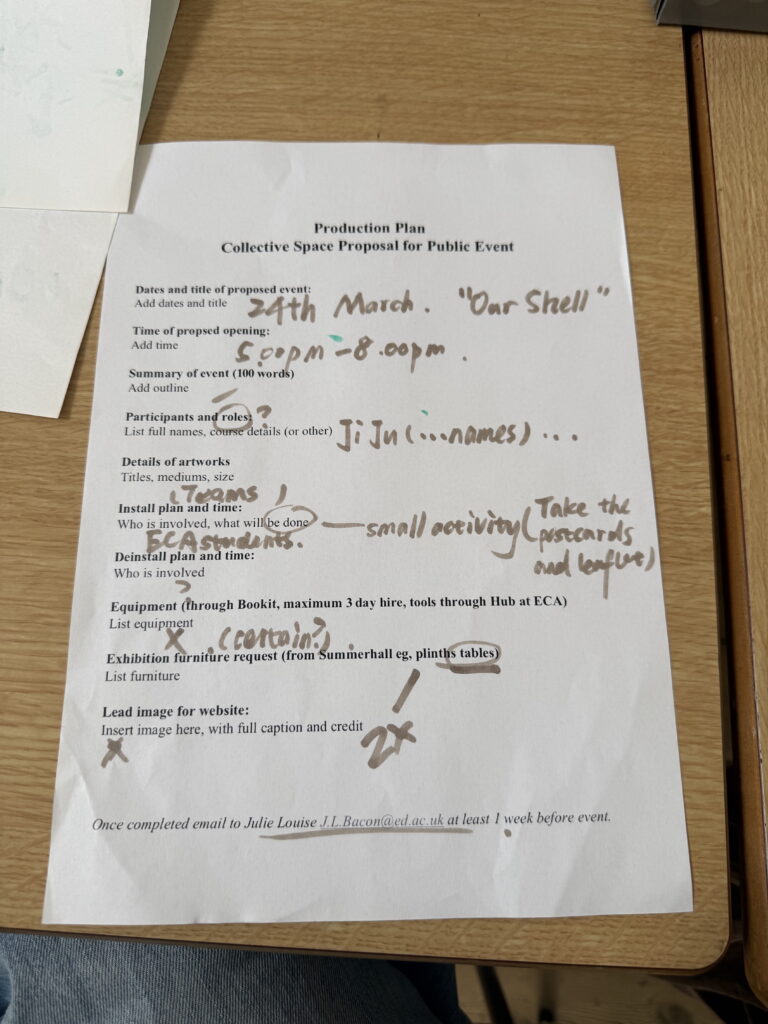
Our collective Our Shell exhibition was important because concepts were taken from the site to fruition. It taught me that inaction is action. My main contribution to the collective was rational organisation. I am good at obtaining disparate ideas, integrating them, and connecting them into a theme that can be more readily discussed. When others were uncertain whether the works needed to be abandoned, or even the whole thing turned upside down, because of the difference between the media and forms, I suggested this difference could be resolved by using the idea of narrative. Rather than imposing formal sameness, the narrative space could be created for the relationship of works through subheadings, grouping, and structure. I also suggested outsourcing the labels of leftover materials and thick letter paper to cut costs, but also allow the exhibition’s style to be represented. Similarly, problems with transportation, projection, and promotion made me aware that the curator’s responsibility is to arrange not only themes or artwork but also the arrangement for viewers to comprehend relationships between works and the pace of the exhibition.
This responsibility was reinforced by peer review, in which I critically read the project of a peer. My main focus was on whether the viewer could experience the project’s concept through the exhibition structure. This taught me to think and pay attention to the pace in the exhibition, the way the work is hung, the entry conditions of the exhibition, and the encounter between curatorial structure and public. It also enabled me to evaluate my project. Among other insights, peer review revealed to me that curating is collaborative, not just as a division of labor. It is also a method for collectively developing judgment by comparing and editing. Peer review, much like the collective curatorial work at Summerhall, demonstrated that the role of curators is not just about creating ideas for public exhibitions but making them work and relevant to the public.
Conclusion
Reflecting on the project, the most important aspect for me was that curating got less abstract. I am no longer thinking about the organisation of ideas. I think even more so of the organisation of conditions. I hadn’t previously thought enough about how to enter a project, understand it, and enable it in practice. And that’s an initial focus. Feedback, fieldwork, group work, and peer review pushed me into doing that. They shifted my attention from just the theme to consideration of the structure, access, rhythm, and responsibility. The project wouldn’t have developed without the organic improvement of a single idea. It evolved through the process of continual revision, which helped to clarify the method.
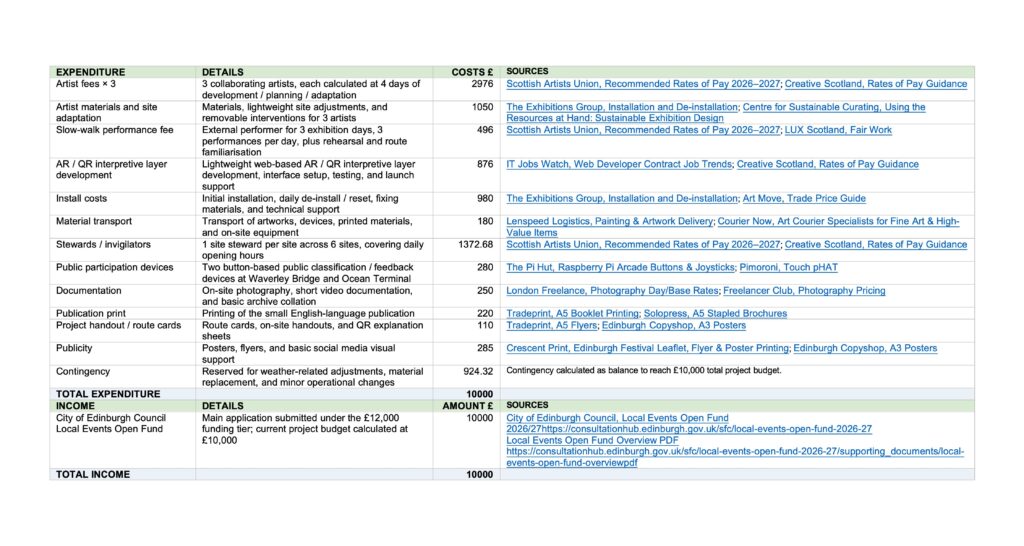
The virtue here is the capacity to shift its structure to fit conditions. It was apparent from early on in the research that structural flaws exist, and to this end, I learned just how to better design a route, activate viewer entry, and play with public space in the context of the whole. That being said, the project also has its limits. I still rely partly on ‘serendipitous’ artist research, and my thinking about budget, technical strategies, and dissemination only really started to come into focus in the second half of the process. That’s vital, because it reveals what the project is still lacking, as well as what it is doing well.
Ultimately, though, the project has helped me know what I want to do next. I am still most interested in research-based, site-specific, public-sector curatorial practice, and particularly that which joins conceptual research to the material practices of accessibility, display, and viewing. Acord’s definition of curating as practical work seems on point with what I’ve learned: the creation of meaning is in the idea, but also the judgment of moment-to-moment practical situations and material arrangements of the work. (Acord 2010)This project has also allowed me to be much more aware of one thing: public curating requires a great deal of attention to how different publics might respond to a project, and an openness to continue revising that judgment.
References
Acord, Sophia Krzys. 2010. “Beyond the Head: The Practical Work of Curating Contemporary Art.” Qualitative Sociology 33 (4): 447–67. https://doi.org/10.1007/s11133-010-9164-y.
Bacon, Julie Louise. 2026a. Week 2 Platforms & Organisations. Lecture slides, MA Contemporary Art Theory: Curating, University of Edinburgh.
Bacon, Julie Louise. 2026b. Week 10 Publics and Public Programmes. Lecture slides, MA Contemporary Art Theory: Curating, University of Edinburgh.
Campolmi, Irene. 2016. “Institutional Engagement and the Growing Role of Ethics in Contemporary Curatorial Practice.” Museum International 68 (3–4): 68–83. https://doi.org/10.1111/muse.12137.
Desaive, Pierre-Yves. 2013. “When Attitudes Become Form: Bern 1969/Venice 2013.” Flash Art (International).
Kester, Grant H. 2014. Conversation Pieces: Community and Communication in Modern Art. Berkeley: University of California Press.
Krasny, Elke, and Lara Perry. 2023. “Introduction.” In Curating with Care, edited by Lara Perry and Elke Krasny, 1–12. Abingdon: Routledge. https://doi.org/10.4324/9781003204923-1.
Kwon, Miwon. 2002. One Place after Another: Site-Specific Art and Locational Identity. Cambridge, MA: MIT Press.
Leighton, Tanya, and Pavel Büchler, eds. 2003. Saving the Image: Art after Film. Glasgow: Centre for Contemporary Arts.
Schuppert, Mirjami. 2021. “Learning to Say No, the Ethics of Artist-Curator Relationships.” Philosophies 6 (1): 16. https://doi.org/10.3390/philosophies6010016.
Smith, Terry. 2006. “Contemporary Art and Contemporaneity.” Critical Inquiry 32 (4): 681–707. https://doi.org/10.1086/508087.
Steedman, Marijke, ed. 2012. Gallery as Community: Art, Education, Politics. London: Whitechapel Gallery.
van Assche, Christine. 2003. “The State of Things.” In Saving the Image: Art after Film, edited by Tanya Leighton and Pavel Büchler, 94. Glasgow: Centre for Contemporary Arts.