Speculative Individual Curatorial Project
Whose Space?
Invisible Boundaries in Edinburgh’s Public Life
Project Overview
Sites: Waverley Bridge, Princes Street, Royal Mile, Holyrood Park, Leith Walk, and Ocean Terminal, Edinburgh
Project Dates: 10 July 2026 – 12 July 2026
Opening Hours: 10:00am–4:00pm daily
Duration: 3 days
Curator: Hazel Ren
Lead Image
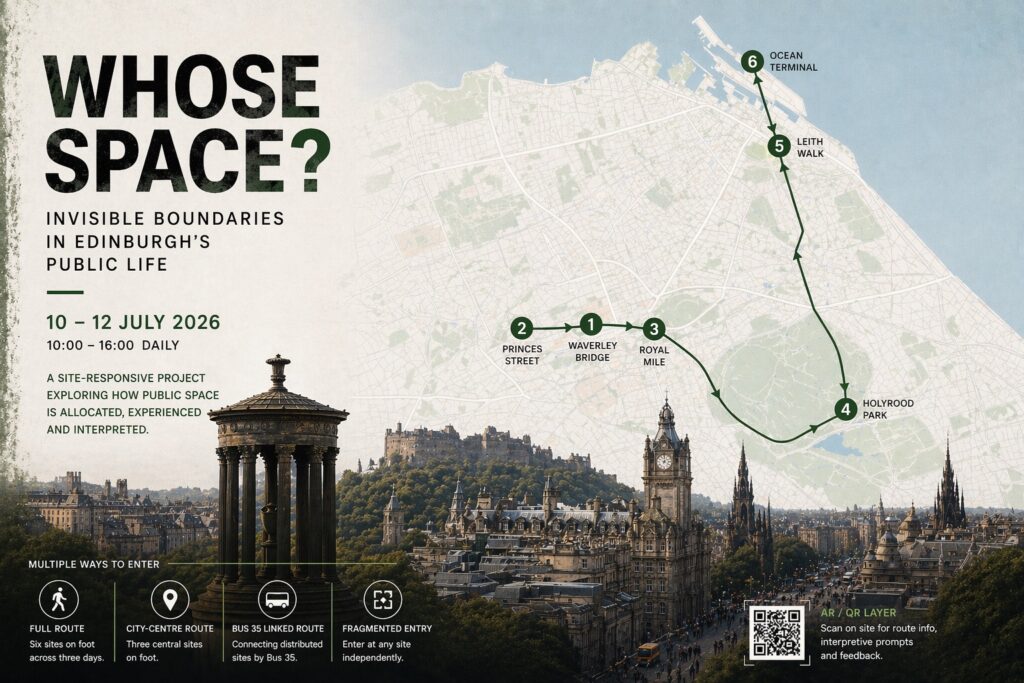
Curatorial Text
Whose Space? Invisible Boundaries in Edinburgh’s Public Life is a three-day public curatorial project distributed across six sites in Edinburgh: Waverley Bridge, Princes Street, Royal Mile, Holyrood Park, Leith Walk, and Ocean Terminal. The project begins with a direct question: in a city that appears open to everyone, who is actually able to stay, who can only pass through, whose presence is naturally accepted, and who remains at the margins?
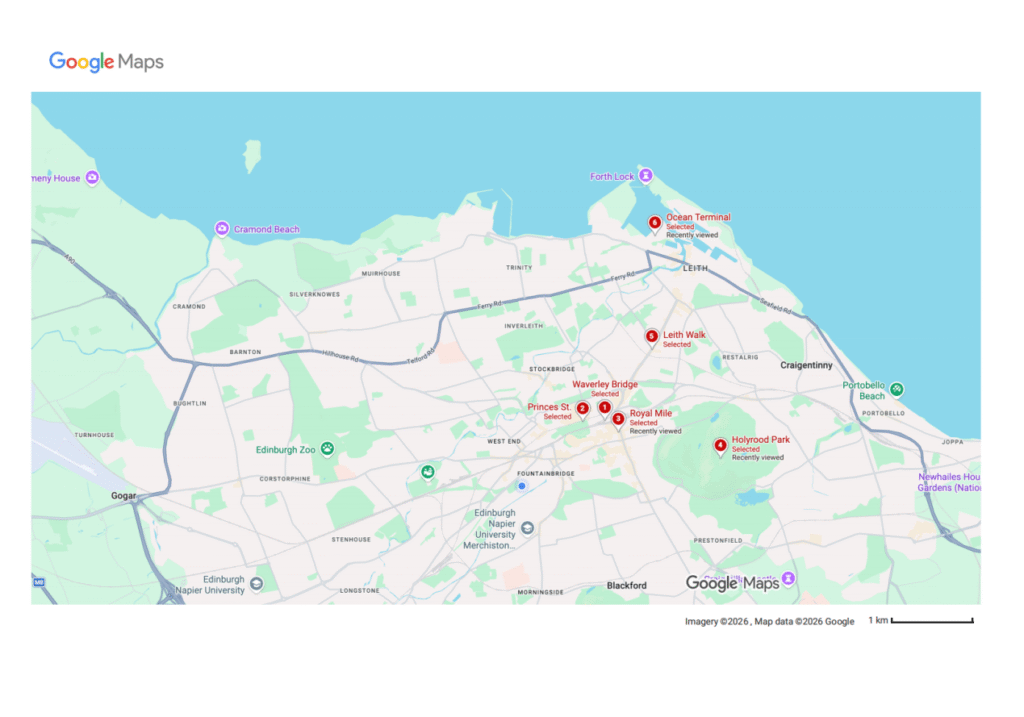
This project examines public space as a structure that organises speed, duration of stay, visibility, and modes of movement. It therefore does not treat public space as a setting, but as a mechanism that actively structures experience. Commercial streets, transport nodes, heritage tourist areas, parks, and redevelopment zones all fall within the scope of “public life”, yet they offer different modes of entry to different groups. These differences are rarely stated directly. More often, they are embedded within everyday routes, consumer logic, and patterns of spatial use.
Through three site-responsive artistic interventions, one slow-walk performance, two public classification and feedback devices, and a light AR and QR-code interpretive layer, the project turns everyday movement into a way of reading the city. It does not treat “residents” and “tourists” as fixed categories. Instead, it focuses on how these positions are continually produced through route, rhythm, density, the tourist economy, public transport, and habitual uses of space. AR remains in a supporting role here, only enabling layered reading and route recognition at selected sites.
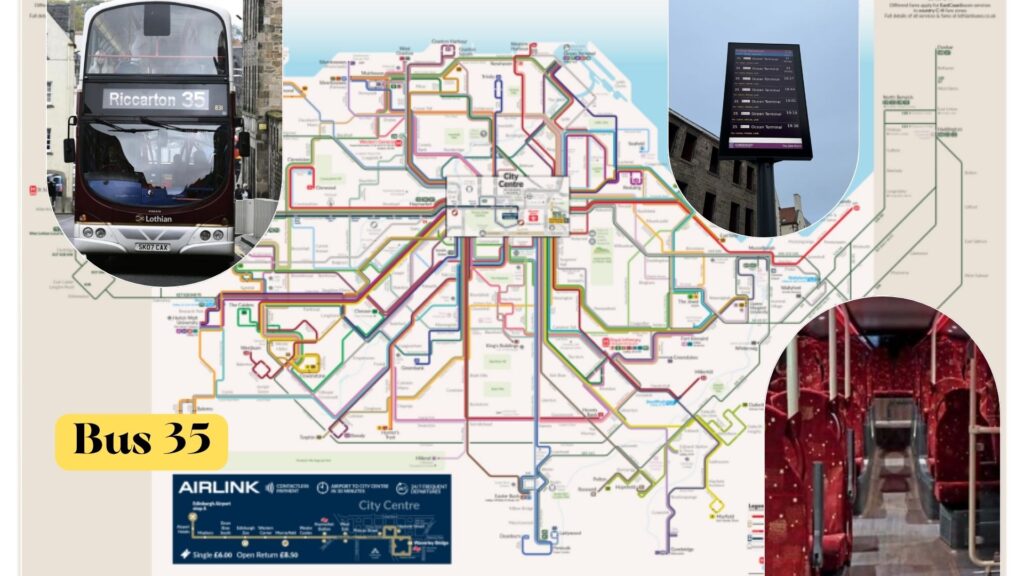
The project adopts a multi-route structure. Viewers may choose the full route, the city-centre route, the Bus 35-linked route, or begin from any single site. In the high-density central areas, movement is on foot, while the more dispersed sites are served by Bus 35 during off-peak hours. Public transport, therefore, becomes a direct expression of changing urban rhythms.
What this project is concerned with is not the number of attractions, but how different spaces are allocated, used, and experienced. It invites viewers to reread Edinburgh. The city is not made up only of a small number of repeatedly viewed landmarks, but of a public network shaped by different speeds, densities, and conditions of entry.
Artists / Participants
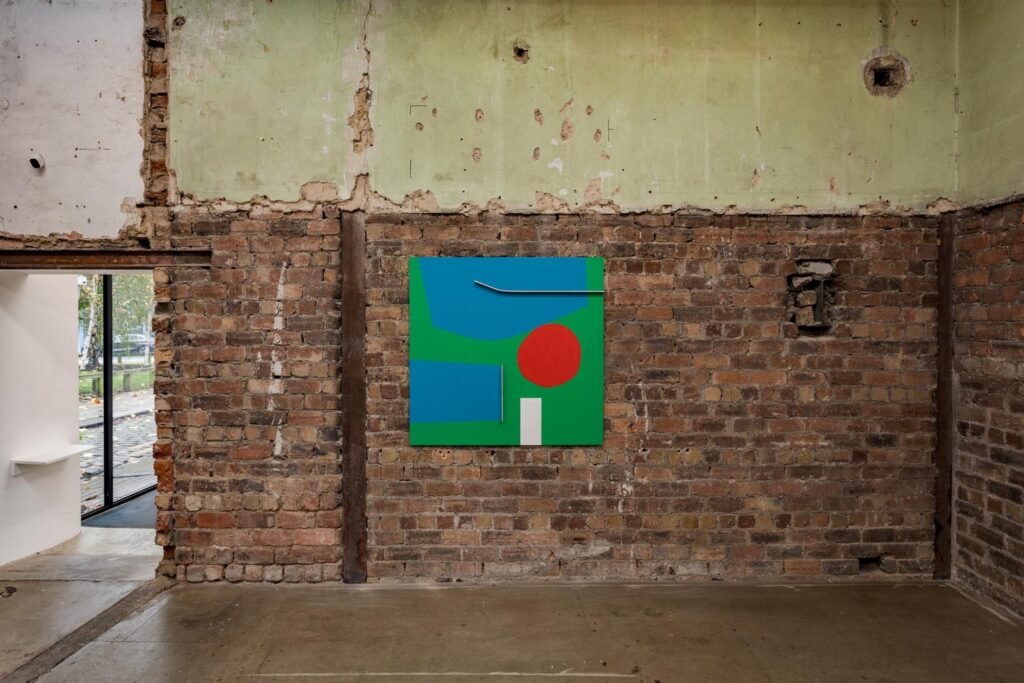
Toby Paterson
Toby Paterson is an artist born in Glasgow and long based there, and a graduate of the Glasgow School of Art. His practice has consistently focused on architectural surfaces, urban visual language, and the ways in which modernist space is viewed and remembered. His work often reconfigures perceptions of urban facades and public structures through painting, relief, and installation. In this project, Paterson responds to Princes Street. The collaboration takes the form of site-responsive co-development, focusing on removable floor graphics, directional prompts, and pause markers. The key issue at Princes Street lies in its commercial frontage, high visibility, and heavy pedestrian flow, and so it requires a visual method capable of dealing directly with urban surfaces and pedestrian order. Paterson’s participation will help the project present more clearly the logic of consumption and the structure of viewing within public space in the city centre.
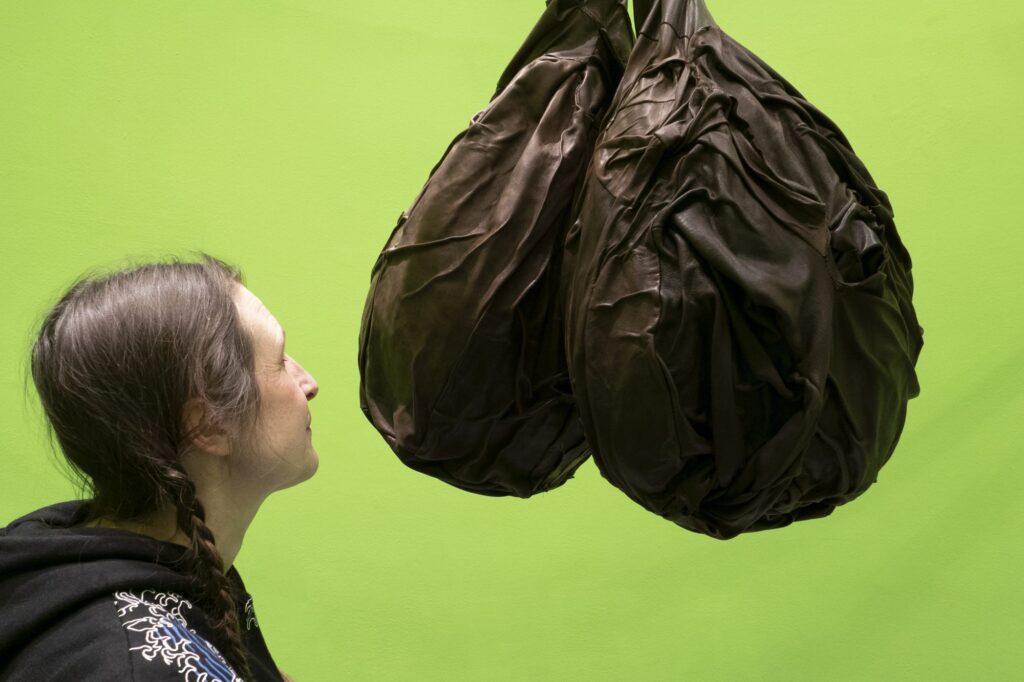
Clara Ursitti
Clara Ursitti is a Canadian-born artist who has long lived and worked in Glasgow. Since the 1990s, she has worked with smell, installation, and intervention-based practice, focusing on the influence of scent on social, psychological, and spatial experience. Her work pays close attention to non-visual perception and often organises bodily experience through a specific site. In this project, Ursitti’s response to Holyrood Park takes the form of low-intensity, site-responsive development, using scent, short textual prompts, and light interventions. Holyrood Park is given the function of rhythmic transition within the project, allowing viewers to move out of the high-pressure flows of the city centre into a slower and more open spatial condition. The value of Ursitti’s method here lies not only in the use of scent as a medium but in the fact that her practice is itself rooted in situation and context, and can therefore genuinely reinforce perceptual slowing-down, allowing bodily experience to become part of the reading of urban structure.
Chris Johanson
Chris Johanson is an artist born in San Jose and now living and working in Los Angeles and Portland. He is often associated with street culture, DIY ethos, painting, text, sculpture, and installation. His work has long engaged with social relations, the environment, and value judgements within everyday life. In this project, Johanson responds to Leith Walk. The collaboration takes the form of text-based, light public intervention developed through co-creation, focusing on the organisation of language, image, and graphic elements. Leith Walk represents a form of urban space shaped by everyday circulation and ongoing movement. What is needed here is not a strong spectacle, but a mode of intervention that makes “passing through”, “staying, “watching, and “ignoring” more legible. Johanson’s participation will help the project establish a clearer reading structure within the rhythms of everyday urban life.
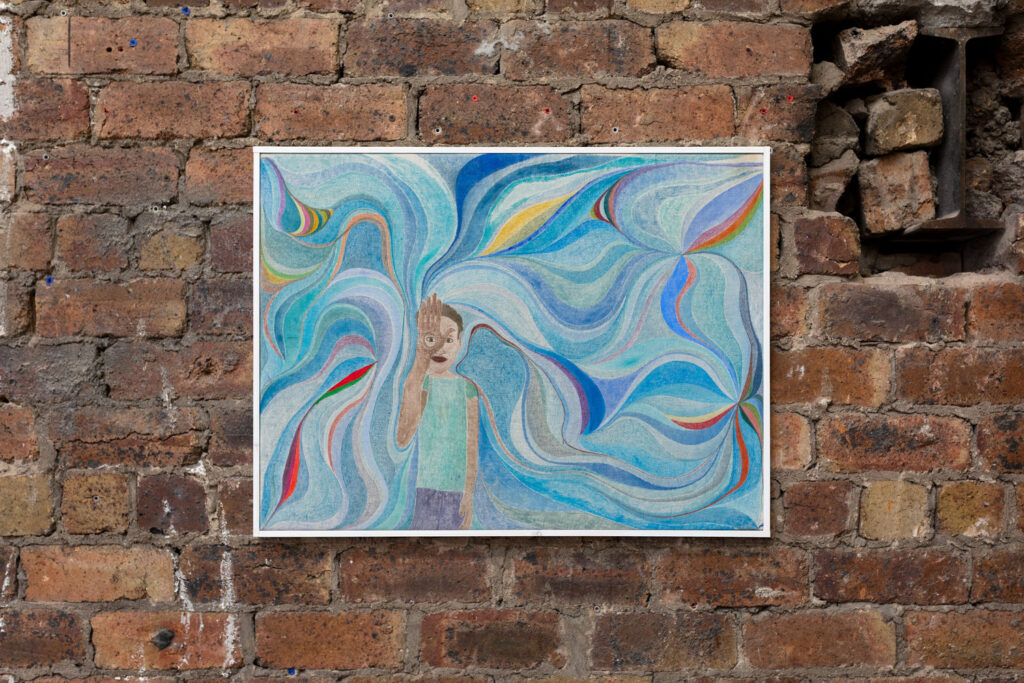
Slow-walk Performer
The slow-walk performance on the Royal Mile will be carried out by one external performer. This role is the project’s only repeated bodily intervention, taking place three times a day as a low-intensity, non-amplified, non-gathering slow-walk performance. The performer will move at a very slow pace along a short, defined route, without blocking the main thoroughfare or generating a large crowd. The collaboration takes the form of performance execution, with emphasis on speed control, route discipline, and site rhythm rather than characterisation. The Royal Mile is the most tourist-dense and strongly directed site within the whole project, making it the most suitable place to turn “slowness”, “waiting”, and an “out-of-time rhythm” into immediate lived experience through bodily speed difference. This role pushes the project’s thinking about speed, duration of stay, and conditions of viewing from text and route structure into a directly perceivable action.
Spaces and Locations
This project unfolds across six different sites in Edinburgh, each corresponding to a different kind of public-space boundary: entry boundary, commercial visibility boundary, heritage tourism boundary, urban/nature boundary, everyday circulation boundary, and redevelopment boundary. Each site performs a different function, and together they form the spatial structure of the project.
1. Waverley Bridge
Boundary type: Entry and Transportation Boundary
Spatial role: Project entry / first public data point
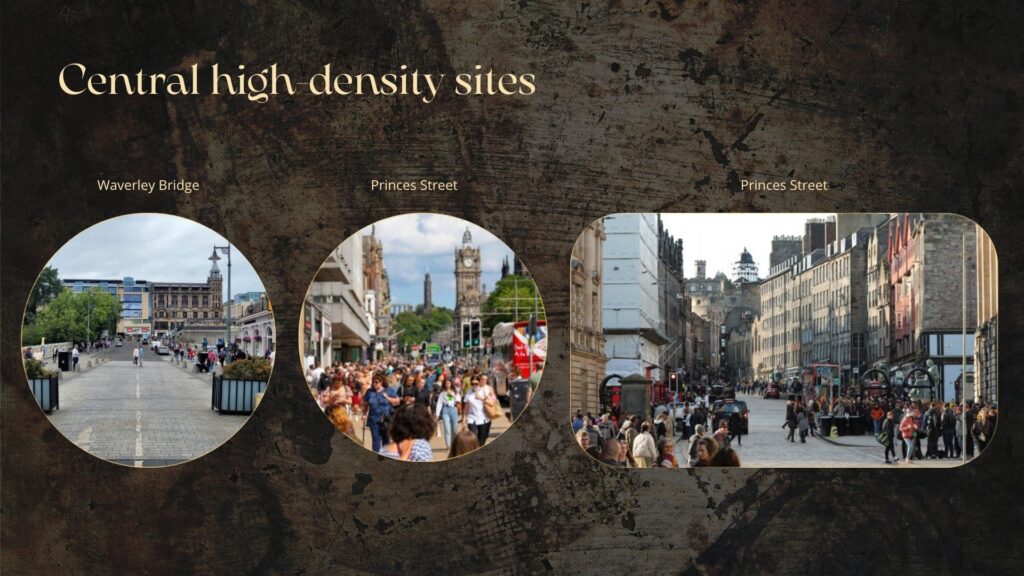
Waverley Bridge is the starting point of the project and functions as both an entry threshold and a transport threshold. Located at the intersection of the city centre, tourist flows, and public transport, it is the most suitable site for addressing the question of how people enter the project.
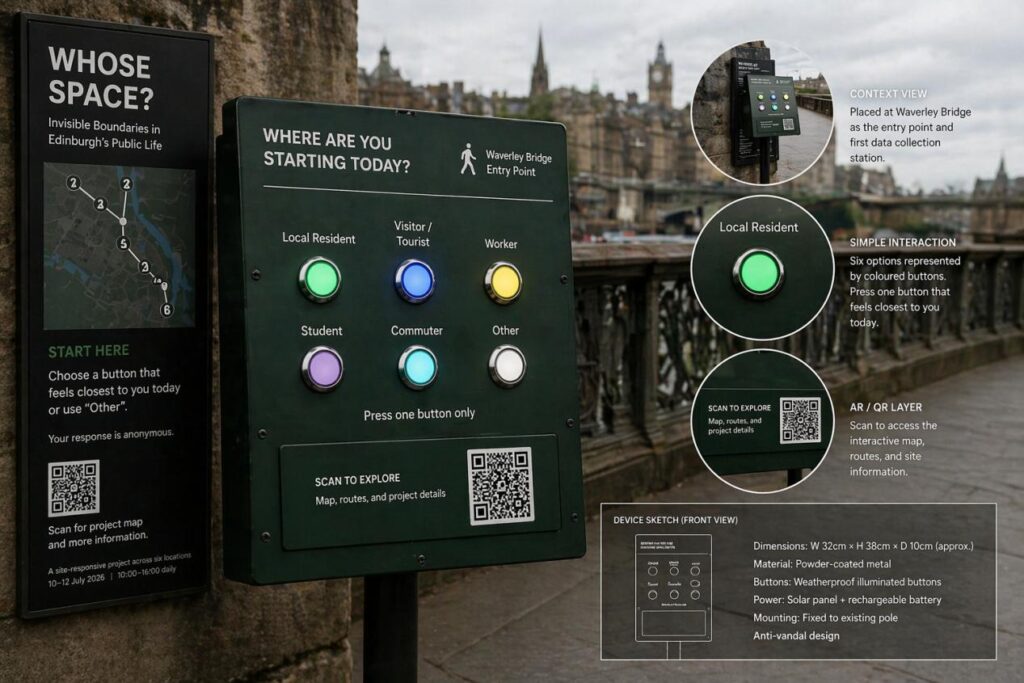
Elements: project information board, six-site map, QR-code entry point, identity classification button device.
2. Princes Street
Boundary type: Commercial Visibility Boundary
Spatial role: High-density commercial site
Princes Street represents a form of central public space organised through commercial frontage, display logic, and heavy pedestrian flow. It is where the relationship between consumption, passing through, and visibility is most concentrated.
Elements: removable floor graphics, boundary lines, pause prompts, and directional markers.
3. Royal Mile
Boundary type: Heritage Tourism Boundary
Spatial role: High-density heritage tourism site/performance intervention site
Royal Mile addresses the historical landscape that is continuously consumed within the tourist city. Through the slow-walk performance, it creates a bodily difference in speed, allowing “slowness, “waiting, and an “out-of-time rhythm” to be experienced directly.
Elements: three daily low-intensity, non-amplified, non-gathering slow-walk performances.
4. Holyrood Park
Boundary type: Urban / Nature Boundary
Spatial role: Rhythmic transition point
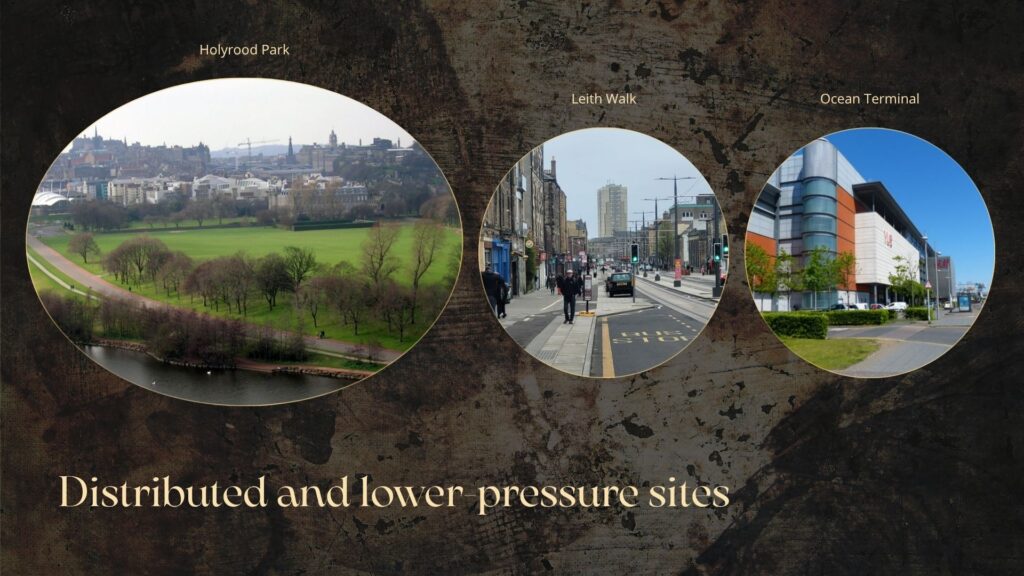
Holyrood Park allows viewers to move from the high-pressure flows of the city centre into a slower and more open spatial condition. Within the project, it functions as a point of rhythmic slowing down and perceptual transition.
Elements: low-intensity sensory intervention, short textual prompts, AR-supported interpretation.
5. Leith Walk
Boundary type: Everyday Circulation Boundary
Spatial role: Comparative site of everyday urban circulation
Leith Walk represents a form of urban space shaped not by tourist spectacle, but by everyday movement and circulation. In contrast to the city centre, it highlights the relationship between circulation, duration of stay, and being overlooked.
Elements: text-based public intervention / light graphic installation.
6. Ocean Terminal
Boundary type: Redevelopment Boundary
Spatial role: Project endpoint / second public data point/feedback site
Ocean Terminal is the final site of the project and the point at which viewers are invited to reassess the whole route. It also represents the spatial logic of redevelopment, waterfront retail, and lower-density movement outside the city centre.
Elements: button feedback device, QR-code questionnaire, project end-point information board.
Route Options
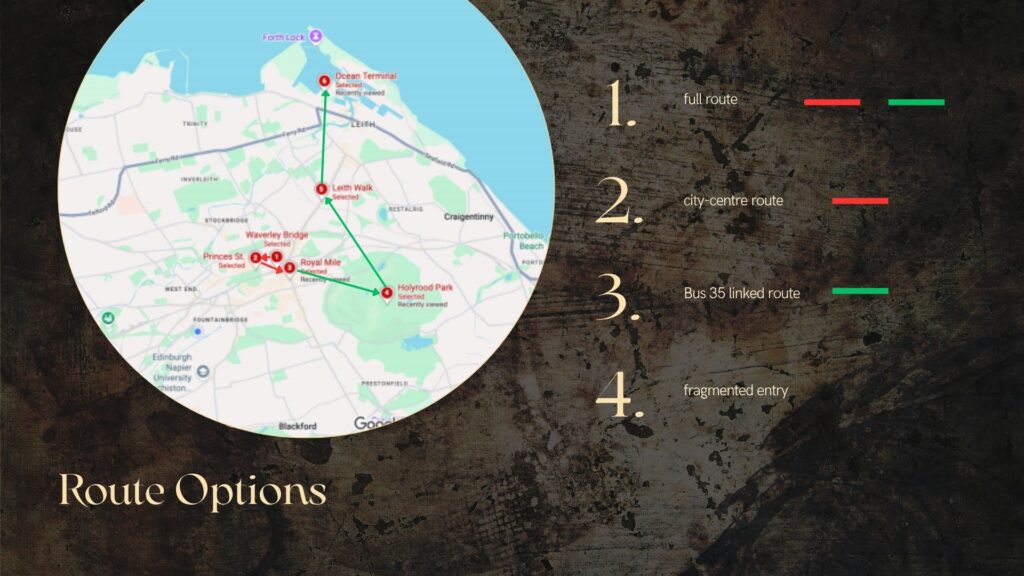
The project adopts a non-linear route structure. Viewers may choose different modes of entry according to time, stamina, and interest. The three route options and the fragmented-entry model all begin from the same core principle: to re-experience Edinburgh’s public space as something allocated, used, and viewed through the connection of different types of boundaries.
1. Full Route
Route: Waverley Bridge → Princes Street → Royal Mile → Holyrood Park → Leith Walk → Ocean Terminal
Mode of movement: walking + Bus 35
Suggested duration: approximately 4.5–5.5 hours
The full route presents the project’s most complete comparative structure. Viewers begin from the city-centre entry and transport threshold, move through the commercial visibility boundary and the heritage tourism boundary, then reach the urban/nature boundary and the everyday circulation boundary, before finally arriving at the redevelopment boundary and the project end-point feedback site. In this way, they experience in sequence how different spaces organise speed, duration of stay, and modes of entry.
2. City-Centre Route
Route: Waverley Bridge → Princes Street → Royal Mile
Mode of movement: walking
Suggested duration: approximately 60–90 minutes
This route concentrates on the project’s strongest high-density spatial conditions. Within a shorter timeframe, viewers experience the relationship between entry boundary, commercial visibility boundary, and heritage tourism boundary, and observe how public space in the city centre is consumed, organised, and accelerated.
3. Bus 35 Linked Route
Route: Royal Mile → Holyrood Park → Leith Walk → Ocean Terminal
Mode of movement: walking + Bus 35
Suggested duration: approximately 90–120 minutes
This route begins from a high-density heritage tourism site and uses Bus 35 during off-peak hours to connect the more dispersed sites, moving in turn through the urban/nature boundary, the everyday circulation boundary, and the redevelopment boundary. Public transport here is not only a means of connection, but also part of how viewers perceive changing urban rhythm.
4. Fragmented Entry
Mode of entry: entry from any single site
Mode of movement: self-directed combination through map, QR-code system, and on-site guidance
Suggested duration: 30 minutes–2 hours
The project does not assume that all viewers enter public space in the same order, at the same pace, or with the same degree of attention. It therefore treats differences in entry conditions as an inseparable part of public-space experience itself. Viewers may begin from any site, and determine the duration of their stay and their onward route according to their own time, mobility, and interests. In this way, the project responds to the uneven ways in which urban space is actually used, crossed, and perceived.
Public Programme
All parts of the public programme are designed as self-guided participation. Viewers may therefore choose their own point of entry, route sequence, and duration of stay during the daily opening hours of 10:00–16:00, using the project map, QR-code system, light AR interpretive layer, and on-site guidance. On-site staff is responsible only for supervising artworks and public devices, maintaining basic order, and carrying out safety observation where necessary. They do not provide guided interpretation.
1. Waverley Bridge Entry and Public Classification Device
Time: daily, 10:00–16:00
Format: project information board, six-site map, QR-code entry point, identity classification buttons
Waverley Bridge is the entry point of the project. It provides access to the project introduction, route map, and guide page. Viewers may also use the button device to select an identity category that feels closest to their own, or define one themselves. This device functions both as an entry explanation and as a first layer of public data collection.
2. Royal Mile Slow-walk Performance
Time: daily at 11:30, 13:30, and 15:30
Duration: 30 minutes per performance
Performer: 1 external performer
Format: low-intensity, non-amplified, non-gathering slow-walk intervention
The slow-walk performance at Royal Mile is the project’s only repeated bodily intervention. The performer will move very slowly along a short, defined route without blocking the main passage or generating a large crowd. The three daily performances make it possible for viewers entering the project at different times to encounter this intervention. Through a minimal difference in speed, it turns “slowness”, “waiting”, and an “out-of-time bodily rhythm” into an immediate site experience.
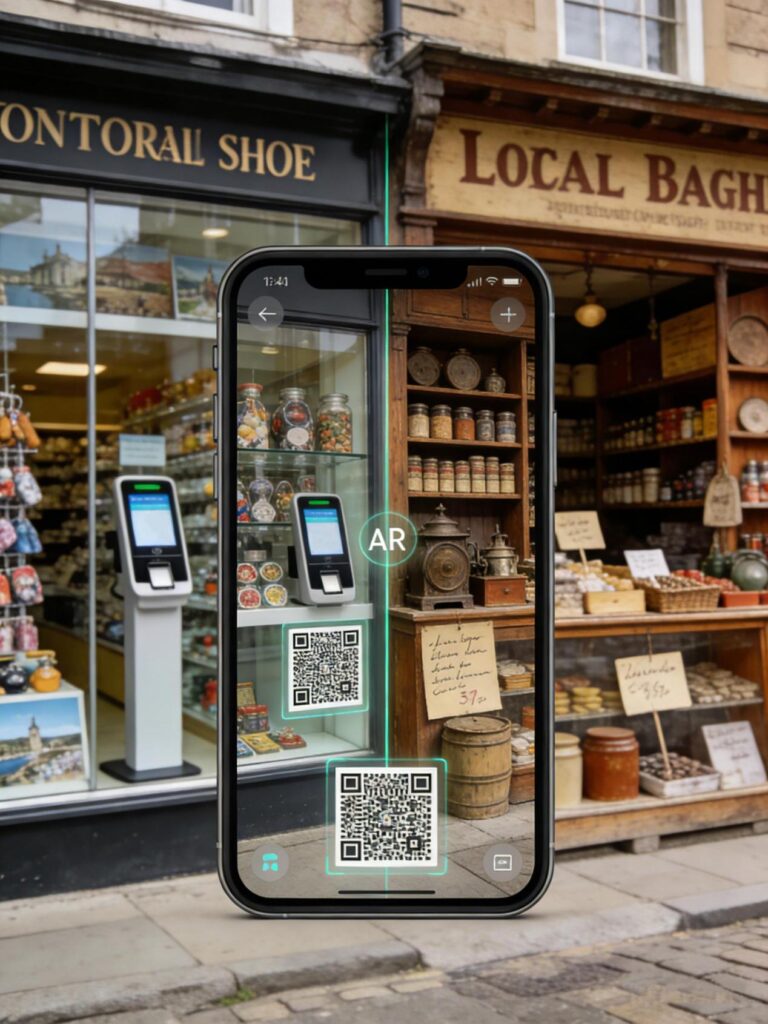
3. AR / QR Interpretive Layer
Time: daily, 10:00–16:00
Format: light digital interpretive layer
The AR and QR-code system provides layered reading, route recognition, and short interpretive information at selected sites. Its function is to support self-directed entry and comparative viewing. It does not operate as an independent display, nor does it replace the direct spatial experience of the site.
4. Ocean Terminal End-Point Feedback and Project Archive Device
Time: daily, 10:00–16:00
Format: button feedback + QR-code questionnaire
Ocean Terminal is the project’s endpoint and also the site at which a second layer of public data is generated. Viewers may select options such as “the site where I most wanted to stay”, “the site where I least wanted to stay”, “the site that felt most like viewing”, or “the site that felt most like passing through”, and may also submit short written feedback through a QR-code form. This device records viewers’ judgements on different spatial rhythms, modes of entry, and conditions of movement, forming a basic public archive for the project.
Curatorial Rationale
The central concern of this project is how inequality in Edinburgh’s public space is concretely experienced through speed, transport pressure, the tourist economy, commercial frontage, and transport nodes. The project understands public space as a structure that allocates modes of entry, durations of stay, and visibility. The task of curating here is to make these existing but often overlooked spatial orders legible again.
The project’s method is built on prior route testing, site judgement, and research into public-space management: co-created, site-responsive, low-intensity, graded interventions. According to the current guidance of the City of Edinburgh Council on public activity, interventions in public space are treated differently depending on scale, impact on circulation, and pressure placed on site management. The project, therefore, adopts a graded approach according to site conditions. Sites with lower management pressure use lighter, temporary interventions that sit close to the edges of everyday use; high-density, highly visible, and more tightly managed sites use walk-through entry and removable interventions, with time reserved for formal applications where necessary. The form and intensity of intervention must remain aligned with on-site conditions.
Opening hours are set at 10:00–16:00. This is a curatorial judgement made in order to avoid peak commuting hours and minimise the project’s actual load on city-centre circulation and the public transport system. The city centre is experienced primarily on foot, while Bus 35 takes on the linking function between the six sites during off-peak hours. Public transport itself becomes a medium through which viewers perceive shifting urban rhythm. The AR interpretive layer remains in a supporting role, providing layered reading and route recognition only at selected sites.
The project adopts a non-linear, self-guided participation structure. The full route, the city-centre route, and the dispersed Bus 35 route together create the project’s comparative mechanism. All routes are designed according to accessibility principles, allowing viewers to enter the project according to their own time, stamina, and mobility conditions of mobility. Waverley Bridge and Ocean Terminal also function as entry and exit data points. Button-based statistics, questionnaire feedback, and on-site documentation will form a basic public archive to support future iterations.
Artist Development
The artistic interventions in this project take the form of co-created, site-responsive development, rather than full, high-cost commissions. The three participating artists may work with the curator to adjust scale, medium, and mode of public presentation according to specific site conditions, allowing the works to respond directly to real issues of speed, duration of stay, visibility, and everyday use in Edinburgh’s public space.
The development process is divided into five stages: initial site visits, route testing, site evaluation, adjustment of intervention intensity, and negotiation of installation method. The works themselves are developed gradually during the project in relation to each site’s spatial conditions, management pressure, and modes of public entry. This both helps control production and delivery costs, and ensures that the generation of the works remains aligned with the project’s method. For the curatorial side, artist development also functions as a mechanism of revision: through collaboration with the artists, questions of site fit, medium choice, and implementation are made more specific, increasing the project’s practical feasibility and responsiveness to the site.
Publication
The project proposes to produce a small English-language publication as an interpretive booklet. It will include the curatorial text, a map of the six sites, artist introductions, route guidance, QR-code entry points, and a short explanation of public feedback. It is intended both as an on-site guide and as a way for viewers to revisit the comparison between spaces after leaving the project. In this sense, it provides this distributed, temporary public project with a further point of entry for rereading.
The publication is both a tool of communication and a light archive. Because the project takes place in public space, many of its key experiences are brief, dispersed, and heavily shaped by environmental conditions. It therefore requires a medium capable of retaining the project’s structure. The publication, the QR-code system, and the later organisation of public feedback are designed to work together, so that after the project ends, there remains a coherent record that can be circulated and revisited. For this project, it functions both as a guide and as an extension of the archive.
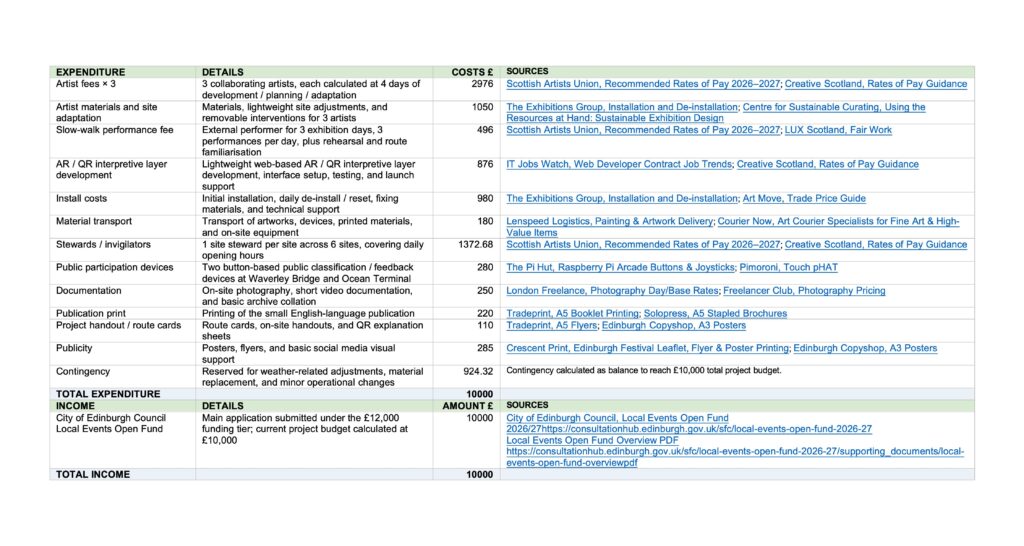
Basic Budget
References
Artists Union Scotland. “Recommended Rates of Pay (RRoP) 2026–2027.” Accessed April 22, 2026. https://www.artistsunion.scot/recommended-rates-pay-rrop-2026-2027.
Baraitser, Lisa. Enduring Time. London: Bloomsbury Academic, 2017.
Bissell, David. “Animating Suspension: Waiting for Mobilities.” Mobilities 2, no. 2 (2007): 277–98. https://doi.org/10.1080/17450100701381581.
Brauner, Maren, and Irene Grillo. “Walking as a Form of Critical Curating.” OnCurating 8 (2011). https://www.on-curating.org/issue-8-reader/walking-as-a-form-of-critical-curating-1132.html.
City of Edinburgh Council. “Event Planning for Public Spaces.” Accessed April 22, 2026. https://www.edinburgh.gov.uk/downloads/download/16258/event-planning-for-public-spaces.
City of Edinburgh Council. Local Events Open Fund Overview 2026/27. Accessed April 22, 2026. https://consultationhub.edinburgh.gov.uk/sfc/local-events-open-fund-2026-27/supporting_documents/local-events-open-fund-overviewpdf.
City of Edinburgh Council. Public Spaces Fees and Charges 2026/27. Accessed April 22, 2026. https://www.edinburgh.gov.uk/downloads/file/39419/public-spaces-fees-and-charges-2026-2027.
Johanson, Chris. “Chris Johanson.” Mitchell-Innes & Nash. Accessed April 22, 2026. https://www.miandn.com/artists/chris-johanson.
Lothian Buses. Service 35 Timetable. 2025. https://www.lothianbuses.com/wp-content/uploads/2025/02/35_25C04v06.pdf.
National Galleries of Scotland. “Toby Paterson.” Accessed April 22, 2026. https://www.nationalgalleries.org/art-and-artists/artists/toby-paterson.
O’Neill, Paul. The Culture of Curating and the Curating of Culture(s). Cambridge, MA: MIT Press, 2012.
University of Edinburgh. SICP Toolkit. Course document, 2026.
University of Edinburgh. Week 10: Publics & Public Programmes. Lecture slides, 2026.
Ursitti, Clara. “Clara Ursitti.” Glasgow Sculpture Studios. Accessed April 22, 2026. https://www.glasgowsculpturestudios.org/clara-ursitti.