Week 3 – Edinburgh as a Mirror: Exhibiting Invisible Boundaries in Public Space
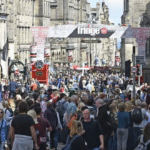
This week’s class on exhibition ethics, together with James’s discussion of curatorial responsibility, helped me clarify the direction of my project. I chose Edinburgh as the site of the project because, from the outset, I understood its public space as a field of clear contestation, shaped by tourism, movement, accessibility, and institutional forms of use. Edinburgh is therefore not an accidental choice for a project about invisible boundaries. The deeper reason is that the pressures within the city have already been made visible in policy discussions. The forthcoming visitor levy is one direct and clear attempt by the city to balance two competing aims: maintaining attraction for visitors while protecting the city’s liveability for local residents. The tension between liveability and the tourist economy offers a strong point of entry for discussing invisible boundaries.
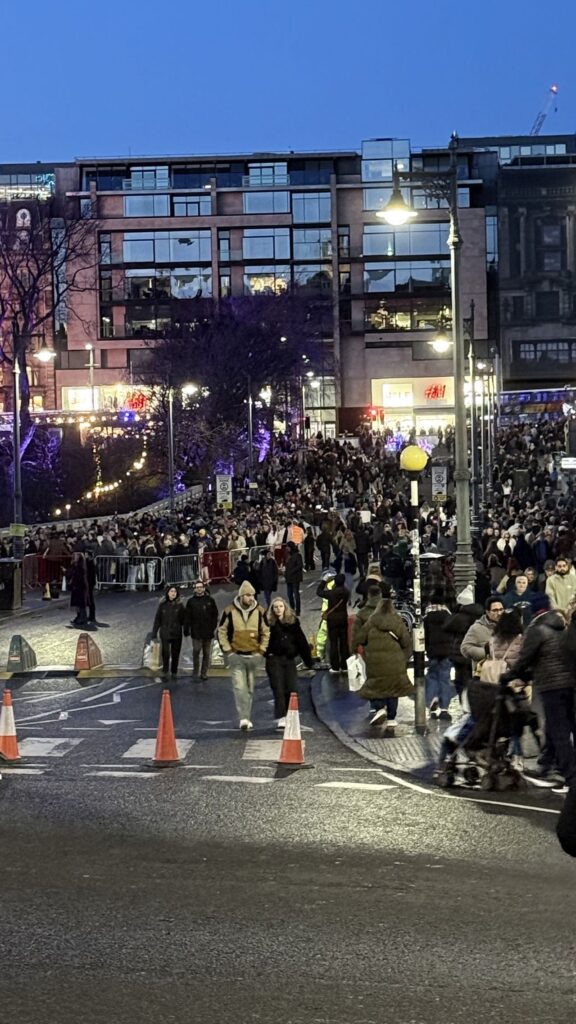
This also helped me answer a basic question: why curate this project at all? What I want to make clear first is that I am not simply trying to criticise tourism or festival culture. What interests me is how public space is organised, who has greater capacity to remain within it, and who becomes marginalised. Edinburgh is not a self-contained case. It operates more like a mirror, reflecting wider questions of spatial inequality.
James’s workshop also helped me understand more clearly why this exhibition format is worth exploring. I began to consider whether Edinburgh’s public transport network could connect a series of exhibition sites, allowing urban transport itself to become an organic part of the exhibition. If audiences enter the exhibition by different routes and spend different amounts of time in different places, then the meaning of the exhibition will not be strictly controlled by a single path. In this sense, the idea continues the non-linear viewing model I had been considering last week, but this week it became more clearly and consciously linked to the politics of public space.
I also developed a more specific understanding of the audience. My primary audience is local residents, because they are most likely to feel the long-term effects of changing accessibility, crowding, and belonging in public space. At the same time, I do not want to reduce the issue to a simple opposition between residents and tourists. Tourists also matter, because they usually encounter Edinburgh through pre-set routes and standardised city images, and I want to interrupt that familiar way of looking. Students, researchers, and disabled people are also important publics, because accessibility is never only an economic issue; it is also shaped by bodily conditions, time pressure, and many other factors. Different people experience public space differently, so the framework of the audience itself must recognise that difference.
References
City of Edinburgh Council. “About the Edinburgh Visitor Levy.” Accessed 14 April 2026. https://www.edinburgh.gov.uk/business/visitor-levy-edinburgh.
City of Edinburgh Council. “The Scheme for the Edinburgh Visitor Levy.” Accessed 14 April 2026. https://www.edinburgh.gov.uk/business/scheme-edinburgh-visitor-levy.
City of Edinburgh Council. City Centre Public Spaces Manifesto Update Report. 2 June 2015. https://democracy.edinburgh.gov.uk/Data/Transport%20and%20Environment%20Committee/20150602/Agenda/item_77_-_city_centre_public_spaces_manifesto_update.pdf.