WEEK 3 Reading + project thinking
WEEK 3 Reading + project thinking
Curatorial Ethics and the Production of Value
Reading Jean-Paul Martinon and Maura Reilly this week helped me rethink the ethical dimension of my curatorial project. At first, I understood artistic value mainly through visibility and recognition: why some works become central while others remain marginal. However, these readings made me realize that value is not only produced through aesthetic judgement or institutional validation. It is also shaped by curatorial responsibility.
Martinon describes curating as a form of “midwifery,” suggesting that the curator does not simply organize existing objects but helps create the conditions in which something new can appear. [1]This idea shifted how I think about exhibition space. If curating is not only about fixing meaning, then exhibition design can become a way of showing how value is formed, rather than simply presenting works as already valuable.
Reilly’s discussion of curatorial activism also made this issue more political. She argues that curatorial decisions are never neutral because they operate within unequal systems of visibility, access, and recognition. [2]This helped me understand that value is not an innocent category. It often reflects wider structures of power, including whose work is supported, circulated, and remembered.
These ideas are directly connected to the development of my curatorial project, which focuses on how artistic value is constructed. I am interested in how exhibitions can make this process visible. Rather than arranging artworks according to fixed hierarchies, I want to explore how different works can be placed in relation to one another to show how value changes across contexts.
At this stage, I have begun researching specific artworks that can help me examine this question: Marcel Duchamp’s Fountain, Merlin Carpenter’s The Opening: The Black Paintings #4, and Jean-Michel Basquiat’s Untitled (1982). These works are not just examples of valuable art objects. They each reveal a different stage in the production of artistic value.
Duchamp’s Fountain challenges the idea that value belongs naturally to the art object itself. As an ordinary porcelain urinal, it only becomes legible as art through selection, framing, and institutional discourse. [3]In this sense, the work is useful for my project because it exposes how artistic value can be produced through context rather than material uniqueness.
Carpenter’s text-based painting points to another form of value production. By turning the language and situation of an exhibition opening into the subject of the work, Carpenter draws attention to how the art world itself produces visibility, meaning, and value. [4]His work helps me think about exhibitions not as neutral containers but as active systems that generate artistic significance.
Basquiat’s Untitled offers a different case. Produced in 1982, the painting now has a strong position within the global art market, but its later auction history also shows how value can shift dramatically over time through circulation, ownership, scarcity, and public attention. NPR reported that the work sold for $110.5 million in 2017, becoming one of the most expensive works by an American artist at the time. [5]This makes the painting useful for thinking about how marginal or street-based practices can later be absorbed into museum and market systems.
Together, these works allow me to map value not as something inherent, but as something constructed through framing, positioning, circulation, and validation. This research stage is therefore helping me develop a clearer curatorial method: instead of presenting artistic value as already established, the exhibition should reveal the systems that produce it.
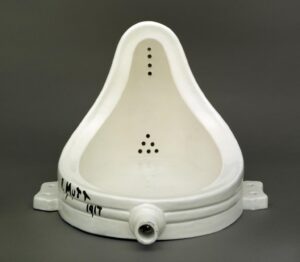
Title: Fountain
Artist: Marcel Duchamp 1887–1968
Date: 1917
Medium: Porcelain
Dimensions: unconfirmed: 360 x 480 x 610 mm
Image source: Tate collection
Link: https://www.tate.org.uk/art/artworks/duchamp-fountain-t07573
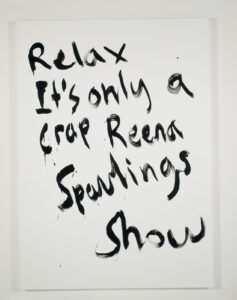
Title: The Opening: The Black Paintings#4
Artist: Merlin Carpenter
Date: 2007
Medium: oil on linen
Dimensions: 84 × 60 inches
Image source: Courtesy of Reena Spaulings Fine Art, NY
Link: http://www.reenaspaulings.com/MC.htm
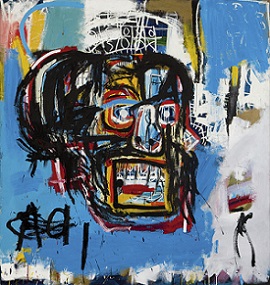
Jean-Michel Basquiat’s Untitled was produced in 1982. The Los Angeles Times says that until shortly before Thursday’s auction, it hadn’t been shown in public since a private collector bought it for $19,000 in 1984
Title: The Opening: The Black Paintings#4
Artist: Jean-Michel Basquiat
Date: 1982
Medium: Acrylic, spray paint and oilstick on canvas
Dimensions: 183.2 cm × 173 cm (72 1/8 in × 68 1/8 in)
Link: https://www.npr.org/sections/thetwo-way/2017/05/19/529096175/at-110-5-million-basquiat-painting-becomes-priciest-work-ever-sold-by-a-u-s-arti
Footnotes
[1] Jean-Paul Martinon, The Curatorial: A Philosophy of Curating (London: Bloomsbury, 2020).
[2] Maura Reilly, Curatorial Activism: Towards an Ethics of Curating (London: Thames & Hudson, 2018).
[3] Tate, “Marcel Duchamp: Fountain 1917, Replica 1964,” accessed May 1, 2026, https://www.tate.org.uk/art/artworks/duchamp-fountain-t07573.
[4] Reena Spaulings Fine Art, “Merlin Carpenter,” accessed May 1, 2026, http://www.reenaspaulings.com/MC.htm.
[5] Merrit Kennedy, “At $110.5 Million, Basquiat Painting Becomes Priciest Work Ever Sold by a U.S. Artist,” NPR, May 19, 2017, https://www.npr.org/sections/thetwo-way/2017/05/19/529096175/at-110-5-million-basquiat-painting-becomes-priciest-work-ever-sold-by-a-u-s-arti.
Bibliography
Kennedy, Merrit. “At $110.5 Million, Basquiat Painting Becomes Priciest Work Ever Sold by a U.S. Artist.” NPR, May 19, 2017. https://www.npr.org/sections/thetwo-way/2017/05/19/529096175/at-110-5-million-basquiat-painting-becomes-priciest-work-ever-sold-by-a-u-s-arti.
Martinon, Jean-Paul. The Curatorial: A Philosophy of Curating. London: Bloomsbury, 2020.
Reena Spaulings Fine Art. “Merlin Carpenter.” Accessed May 1, 2026. http://www.reenaspaulings.com/MC.htm.
Reilly, Maura. Curatorial Activism: Towards an Ethics of Curating. London: Thames & Hudson, 2018.
Tate. “Marcel Duchamp: Fountain 1917, Replica 1964.” Accessed May 1, 2026. https://www.tate.org.uk/art/artworks/duchamp-fountain-t07573.