week11draft
展览、公共活动的目标受众(在上周或许已经提到一嘴),因此可以延伸到思考安排一些公共活动,档案(summerhall有展示柜(照片)、展览周边(可以在summerhall自带的boutique售卖)思考这些周边是怎么制作,是否要额外准备资金。
以及无障碍设计
展览、公共活动的目标受众(在上周或许已经提到一嘴),因此可以延伸到思考安排一些公共活动,档案(summerhall有展示柜(照片)、展览周边(可以在summerhall自带的boutique售卖)思考这些周边是怎么制作,是否要额外准备资金。
以及无障碍设计
Yande, I am very happy to enjoy your blog.
The exhibition “A Certain Absent” designed in your blog makes the audience unable to see clearly and incompletely through blurred, delayed and fragmented images, thus slowing down the viewing pace and rethinking “how do we see and understand images”.
Your concept was not like this at very beginning, but was reconstructed through continuous revision, which showed the progressiveness and consistency of your curatorial thinking when you read your blog step by step.
第2周以“自画像与时间性”为起点,第4周发展为“I–We–They”结构,第7周在 Hito Steyerl 的影响下转向“可见性机制”,最终在第8周《A Certain Absence》中转向对“可见性条件”的整体探讨。
Your blog concept develops clearly and continuously, not fragmented records. There is real critical reflection.
You have a strong research orientation.
例如,第1周已引入 Ana Bilbao 关于“微策展”的讨论,以及 Carolee Thea 将双年展视为“实验室”的观点,体现出对策展规模与结构问题的初步思考。这一理论线索在后续持续发展:如第5周通过 Amelia Jones 关于“可见性生产身份”的论述,进一步深化对肖像与身份机制的理解。
Your quotations have become the cornerstone of the evolving curatorial concept, showing the depth of continuous research.
Although the theory has a high degree of participation, its transformation into curatorial practice is still limited. This shows that the theory exists more as a conceptual framework than as a specific curatorial methodology.
例如,第5周对 Jones“可见性”理论的讨论,以及第7周受 Steyerl 启发提出的“延迟可见性”,主要停留在概念层面。在第8周《A Certain Absence》中,虽然提出“模糊、延迟与碎片化”三种图像策略,
However, how these concepts specifically affect art selection, spatial arrangement or audience experience has not been fully explained. Suggestions are further clarified: how the theory guides the selection of works of art, space design and audience path. For example, you can refer to the cases in “Curatorial Activism” or “Curating Research” as discussed in Reilly (2018) and O’Neill and Wilson (2015)about how the theory is transformed into a curatorial strategy, so as to strengthen the operability of the theory.
可执行性问题(重点批评)(这个可以通过后面最终版本再调整!!!)
项目在可执行层面仍有明显不足。尽管第10周已引入 Leith Makers 作为潜在场地,并初步考虑空间与灯光,但关键策展要素仍未充分展开。例如,缺乏对目标观众、展览时长、公共项目及空间布局的系统说明;观众动线与整体展览结构亦未清晰呈现。
因此,该项目目前更接近概念性提案,而非完整的可执行策展方案。
建议补充具体框架,如明确受众定位、展览周期,并提供基础平面布局或观众路径。同时,可引入讲座、工作坊等公共项目,以拓展展览的策展维度。参考如 Tate Modern 或 Serpentine 的策展实践,有助于理解展览与公众项目之间的关系。
Blog keeps a continuous record of the collective process of JIJU collective.
例如第3周提出“hermit crab”隐喻,第9周进一步描述“frictions”与分工过程,体现出对协作经验的观察。
But in the whole, these contents mainly stay at the descriptive level, and the connection between collective curation and your personal curation is weak. Maybe you can find the connection with your own projects in the process of collective curation, whether it is the process of conceptual conception or the process of arranging exhibitions, and see what can be turned into personal curation experience. For example, emphasizing temporality and dependent environment from “hermit crab metaphor”, can this cause you to think about the “visibility condition” in your exhibition “A Certain Absent“? It can be further developed into: how the works “reside” in space and how to exist depending on light, position and viewing angle?
I hope my comments and suggestions can help you.
Reilly, Maura. Curatorial Activism: Towards an Ethics of Curating. London: Thames & Hudson, 2018.
O’Neill, Paul, and Mick Wilson, eds. Curating Research. London: Open Editions, 2015.
宣传/艺术市场并不在要求中,因此要把这个发现点转变为展览要吸引什么样子的观众,也就是目标观众是谁。
Curatorial Practice and Identity Transformation with “Shell” as the Core
This week’s study and practice revolve around the exhibition “Our Shell” of JIJU Collective, which is not only the landing of a curatorial project but also an in-depth exploration of identity, space, and sense of belonging.
In concrete practice, I gave full play to my own design background and was responsible for the visual design of posters and booklets.
At the same time, I also participated in the creative conception of the main work.
In addition, in this exhibition, I am not only a curator but also an artist, exhibiting a series of personal lacquer paintings. This dual identity enables me to reflect and integrate the two dimensions of creation and curation.
From execution to reflection: the awareness of problems in the curatorial process
In this relatively complete group curation practice, I have a more concrete understanding of the complexity of the exhibition work.
Firstly, during installation, I found the process more complex than expected. Two frames cracked due to transport damage, requiring a quick fix. This highlighted that curation involves not only concept and design, but also risk management—anticipating issues and preparing contingency plans (Plan B) to ensure the exhibition runs smoothly.
Secondly, during the exhibition, I applied the learning about “archives” in the classroom to practice and took the initiative to record the scene, including the exhibition space, the display of works, and the image collection of audience interaction. These materials not only provide traceable evidence for the exhibition but also provide an important basis for subsequent summary and dissemination.
Finally, I reflected that the most prominent problem lies in the lack of publicity strategies. Because this exhibition belongs to students’ activity to some extent, it is not included in the push and introduction of the official Summerhall exhibition, and the preparation period was short, which led to the audience being mainly confined to the acquaintance network and lacking wider public communication.
This problem makes me deeply realise the key role of publicity in curation, especially when the exhibition goal involves promoting emerging artists, and the communication strategy will directly affect the audience composition, the feedback of works, and the social influence of the project. Therefore, in the practice of curation, publicity needs to be included in the preliminary planning, not as an accessory link.
选择summerhall的原因:在第x周前往summerhall的活动时,发现summerhall环境地理位置不错,既有展览空间也有公共活动空间。在最后说选择的这个summerhall的窗户有这个自然光影的效果,然后对比去看展览时的窗户、JIJU collective的时候的窗户自带的光影效果。(会给作品增添氛围感)。(然后引发思考:户外光线天气不可控,因此可以安装灯光控制透过窗户射进展厅内补光(当光线不足时)
Black box as a method
Spatial transformation: from viewing to practice
In my exhibition design, I try to translate this method into a concrete space, rather than simply copying a closed black box environment. I will control the overall light through shading cloth and artificial lighting so that the exhibition hall presents a unified dark tone; black fabric is not only used to shield excess light but also used as a space material to weaken the boundary of the wall and make the visual attention focus on the work itself.
At the same time, the original two glass windows in the space will be preserved as the source of natural light. This treatment makes the exhibition hall between “controllable” and “uncontrollable”: the overall light environment is artificially constructed, but the change of natural light in a day will continue to intervene, forming a temporal atmosphere change. In addition, only partial lighting is necessary for some works so that the space remains hierarchical in the unified darkness.
On the moving line, Kiki Smith’s constellation installation sculpture will be presented at the entrance, combined with wall illustrations, as the visual starting point for the audience to enter the exhibition. Then enter Song’s work. Then, a “research corridor” to display archival materials and publications, making the curatorial research process itself visible. Then, enter the relevant area of Eryao’s work, establish a cultural background through shadow play materials and images, and finally transition to a completely shaded black box space to play its stop-motion animation.
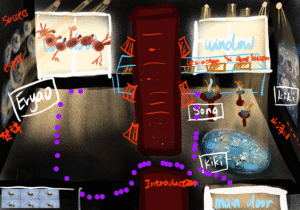
Through this series of spatial arrangements, I am no longer concerned with the presentation of a single work but with how to gradually guide the audience into different levels of viewing experience through the design of light, materials, and paths. The black box is therefore not just a closed space, but a curatorial tool that can be dismantled and reorganised.
From three-tier structure to generation mechanism
In the previous curatorial research, I set the core issue of the exhibition as “How mythical animals operate as a power system”. This framework is mainly divided into three levels: family, country and cosmic cognition. At the country level, represented by Ai Weiwei’s works, mythical animals are placed in the historical and political context. As Roland Barthes put it, myth is not a simple story but a meaningful production system, which operates continuously in different scales and shapes the way we understand the world.
However, when I further promoted the project, I began to rethink what I really valued in Ai Weiwei’s works was not a specific work itself but several core features: scale, material power, and symbolic transformation of visual symbols. Under the constraints of realistic curatorial conditions (such as budget and implementation), simply replacing the works or replacing the original works with images cannot really respond to these core issues. Therefore, instead of focusing on “reproducing a certain work”, it is better to go back to these features and reconstruct the logic of exhibition.
Under this consideration, I chose to replace the original case of Ai Weiwei with Song Weiran’s installation works. This change is not a simple replacement but introduces a new understanding path in the structure. In Song’s works, the microorganisms in the pond are re-imagined as “gods”, while the traditional medium of ceramics is extended to a form similar to the Taoist “golden body”.
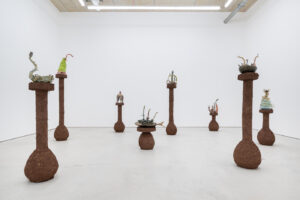
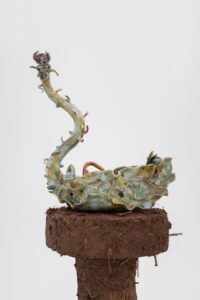
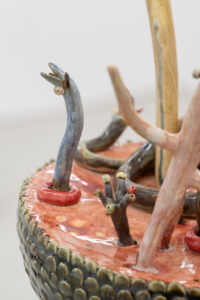
This transformation makes the myth no longer attached to the established history or national narrative but regenerated at the micro level. Compared with the original framework, this work has changed the presentation of “power”. Here, power is no longer a grand oppressive structure but exists in the form of circulation, symbiosis and generation. The relationship among microorganisms, soil, and ceramics constitutes a constantly changing ecosystem, which also transforms “mythical animals” into an ecological entanglement. This echoes Barthes’ view that “myth is the production system of meaning”: meaning is not established but generated in constant transformation and relationship.
The change from Ai Weiwei to Song Weiran does not mean the weakening of politics but the deepening of the understanding of “power”. Power is no longer directly presented through commemorative sculptures or national narratives but turned to a more hidden operation mechanism: growth, dependence and transformation. In this context, myth is no longer a fixed symbol but a continuous operating system, which flows between different scales, constantly generating new meanings and body forms and spanning the relationship network between human and non-human.
预算的时候说清楚因为我们许多作品在国外,运费大概在多少上下。
1.summerhall的选择场地的平面图 2.参考图片和参考文献
Understanding enforceability from cases
The exhibition “Disappearance at Sea” of the Baltic Center for Contemporary Art focuses on the dangerous journey of refugees and immigrants across the Mediterranean and discusses issues such as death at sea, displacement, and border politics. It does not rely on a super-famous work to support the theme but establishes the topic and emotional structure through many artists and different media.
This case made me realise that the depth of an exhibition does not necessarily come from “big-name works”. Sometimes the works of emerging artists with more controllable budgets are more direct in emotional expression and easier to form the audience’s empathy with.
The Choice Logic of Returning to the Core Characteristics of Works
In the previous research, the project hopes to use Ai Weiwei’s “The Animal Head of the Twelve Zodiacs” as an important reference because this work is highly compatible with the exhibition theme: it involves the relationship between myth, symbol, and power, and at the same time, it also transforms political issues into strong visual symbols and creates an obvious sense of power through materials and volume.
However, for the student curatorial project with a budget of about 10,000 pounds, the cost of transportation, insurance, installation, and loan exhibition coordination is too high, so it is difficult to enter the actual implementation stage. At first, I thought about whether I could replace the original work with related videos, but now it seems that this approach only solves the budget problem and does not really solve the decision-making exhibition problem. The video may not be able to convey the most important part of this work. If what I really value is how it builds a sense of power through volume, materials, and visual symbols, then these core characteristics will be weakened after being simply transformed into images.
This also changed my understanding of the artist’s choice logic. Previously, I was more inclined to take the works of famous artists as the direct target, but now I gradually realise that a more effective way is to extract their core characteristics, such as political, dramatic, or empathetic expression of social issues, and then find the works of emerging artists with suitable styles and feasible budgets to carry these characteristics. In this way, Ai Weiwei can still appear as an academic reference in the exhibition wall, research text, or case analysis, which constitutes the theoretical background of the project, but it is not necessary to directly become the object of the final exhibition.
Through this comparison, my curatorial goal gradually becomes clear: to show how mythical animals form power structures on different scales, from family daily life to national history, and then to cognitive system.
通过这种比较,我的策展目标逐渐明朗:展示神话动物如何在不同尺度上形成权力结构,从家庭日常生活到国家历史,再到认知系统。正常推演应该是:先分析已经选择好的eryao的权力与神话动物的关系(家庭权力),然后横向搜索有关权力或者神话动物的展览,引发分析有没有不同尺度的权力去表达,再去找艺术家。最后确定选择好的艺术品清单。eryao定格动画/皮影。aiweiwei这个雕塑群。kiki的装置、插画或者别的。
1.选择艺术家eryao kiki aiweiwei 2.参考图片和文献
Myth and power: the change of research direction
Group Curator: Hometown and the Structure of “Shell”
In the group project of JIJU Collective, on this basis, I put forward the curatorial mode of “image matching”: each person chooses two pictures, one from the original hometown and the other from Edinburgh (as the new “hometown”), and the two need to form emotional or memory connections. For example, I paired the Wukang Building in Shanghai with a similar building in Edinburgh.
In space, we plan to put the images on two opposite walls, and connect each pair of images with red lines, hanging above the audience, forming a structure similar to “shell”, implying the relationship between protection and connection.
At the same time, combined with Yuran’s idea, add a table to the space to display texts and brochures. This part also echoes my research on Publication Studio this week-myth takes effect through repetition, and publishing becomes the medium of this repetition.
注意修改!eryao的作品首先是皮影挂墙作品。然后是blackbox里的定格动画。投影部分可以用相应的文字/诗歌来代替定格动画的画面。以及更新summerhall的平面图和具体租用价格,并且在介绍选择summerhall的时候是因为它种类丰富,有展览也有可以举办公共活动的地方。
This curatorial project explores how traditional mythological imagery can operate within contemporary exhibition frameworks—not as preserved heritage, but as an active narrative structure that continues to organise perception, identity, and social expectation.
Drawing from Roland Barthes’s proposition that “myth is not a story, but a system of communication,” the exhibition approaches myth not as narrative content, but as an ideological mechanism.
At the centre of the project is Eryao’s shadow play work , Wishing Your Child Becomes a Dragon.
The idiom “望子成龙” becomes more than parental aspiration—it means:
Within the exhibition, the dragon operates as a mechanism that normalises these structures across time.
Extending Carolee Thea’s notion of the curator as mediator, this project positions curating as an act of cultural translation rather than preservation.
Tradition is not displayed as authenticity—it is re-articulated within a new perceptual and discursive system.
The exhibition does not “present” myth. It re-structures how myth is experienced.
This site is particularly suitable because:
Rather than retelling this narrative, the exhibition spatialises it. The exhibition was held in three interconnected areas in the environment.
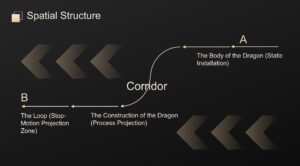
SPOT A
At the entrance, the audience will see the shadow dragon created by Er Yao, hanging on the white wall. The materials of the works are clearly visible: leather fragments, joints and other structure. The first meeting was quiet, almost like a museum. The curatorial text at the entrance introduces the cultural meaning of the dragon and the idiom “望子成龙”, which provides an easy entrance for international audiences. The tradition here is readable.
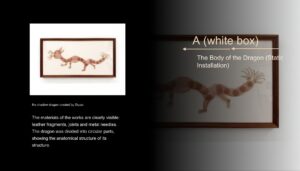
Corridors
From this still dragon body project, the audience enters a narrow corridor. In this transitional space, the single-channel projection displays the stop-motion animation sequence frame by frame.
Dragons slowly assemble themselves through obvious repetition. Limbs can change. The body will get longer. Movement is mechanical, not smooth. The projection scale is slightly enlarged, so that the shadow goes beyond the picture and overflows the wall and floor.
The corridor acts as a compression. The audience must personally experience the transformation of the dragon. Here, myth becomes a process.
Scattered phrases appeared faintly on the wall, almost illegible: “Expectation.” “Success.” “Obedience.” “Future.”
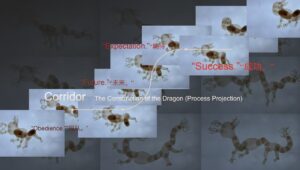
SPOT B
The last area leads to a darker projection space. This one-minute stop-motion animation is played continuously and circularly on a big screen. There are no seats. Visitors are free to come in and out.
The dragon’s movements are unstable. Its segmented body bends awkwardly, becoming less proud and more like a monster. There is no narrative climax. No transformation is complete. The cycle starts again.
The time of this exhibition is cyclical and nonlinear. The lack of a fixed starting point reinforces the concept that cultural expectations are inheritance rather than choice.
Engaging with moving image exhibition theory, particularly the writings of Erika Balsom, this project imagines the exhibition space as a temporal architecture rather than a static display.
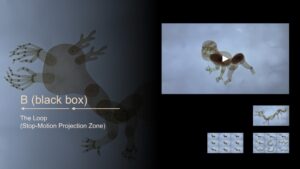
Time in this exhibition is not only media duration. It is cultural persistence—the long repetition of expectation across generations.
If myth influences how we understand the world, and exhibitions influence how we understand myth, then curating is never neutral.
Instead of celebrating the dragon as cultural heritage, this exhibition questions how such narratives shape identity and expectation in contemporary society.
The project, therefore, operates not as cultural nostalgia but as a speculative curatorial method testing how traditional narrative forms continue to organise contemporary life.
图片可以加入关于望子成龙故事背景帮助理解
Contemporary expression and display of traditional narrative: from symbol to experience structure
On the whole, this interview not only deepened my understanding of the works but also gradually shifted my curatorial thinking from “presenting the works” to “constructing the experience structure”. As a curator, I will think carefully about how to reorganise tradition into a contemporary experience that can be perceived, participated in, and reflected through space, media, and viewing methods.
Shadow puppetry as a time medium
From the translation of traditional media to the reactivation of historical works in the contemporary context, and then to myth as a narrative structure that is constantly restated. Along with this clue, the research object gradually converges from generalised traditional images to mythical images and then further focuses on mythical animal images.
During a discussion session with students from Contemporary Art Practice (CAP), I was introduced to the work “Wish Your Child Becomes a Dragon” by the Chinese artist Eryao. In this exchange, the artist presented how shadow puppetry could be reconfigured through stop-motion animation and digital imagery. This encounter made me realise that the transition from traditional media to contemporary moving image is not only a formal transformation but also a shift in how narrative and temporality are constructed.
Shadow puppetry is not only a traditional folk art or a static cultural heritage but also a medium established by light, projection, manipulation and duration. The image of the dragon is not a fixed object but is watched and perceived in the process of movement, flashing and disappearing.
Dragon myth in digital communication
Curators in the post-media era should not only discuss the exhibition but also discuss how the works circulate. Ben Cook and others proposed in Distribution After Digitisation (2014) that digitalisation has changed the propagation path of images and redefined who can watch and how to watch. For shadow play, this means that it is no longer limited to live performances but has entered the digital screen, network platform and exhibition space, becoming a dynamic image that is constantly translated and re-circulated.
In Eryao’s project, the dragon myth has become a narrative structure that has been repeatedly activated in the digital image era. It bears not only the imagination of traditional culture but also the intergenerational expectation and growth pressure of Chinese families. It also shows how the dragon continues to become a symbol of identity building, social expectation and cultural memory in the display of dynamic images and digital communication from the traditional media of shadow play. From this, we can find that the myth of curation is not only presenting the content but also planning a way of watching about time, media and communication.
Therefore, I chose Eryao’s work not only because it employs shadow puppetry and dragon imagery but also because it concretely demonstrates the process I am investigating: from traditional medium to moving image to digital circulation and finally to myth as a contemporary narrative structure.