Week 12 | Final Synthesis — The Curatorial Gaze as Care

1.From Scale to Intimacy

This semester has been a journey of recalibrating my curatorial gaze. In Week 1, I was preoccupied with institutional scale and the cold authority of grand galleries. However, the ECA exhibition confirmed that successful curation is not about filling space, but about managing relationships. Whether through the Ji Ju Collective’s “Our Shell” or my individual project “Awareness,” I have learned that a curator’s role is that of a translator, one who mediates between the silent history of objects and the loud expectations of the public.

The core of my learning lies in the synthesis of collaboration and materiality. The Ji Ju exhibition, “Our Shell,” taught me the ethics of flawed cohesion that curating is often a series of concessions that ultimately create a shared home for diverse voices. This collective experience laid the groundwork for my individual proposal, where I treat everyday materials as weighty presences.

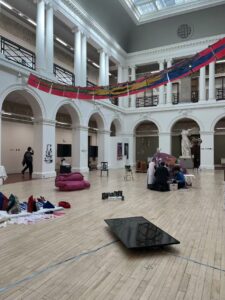
Reflecting on the ECA exhibition’s Sculpture Court, I now see the site not as a fixed container, but as a relational field. My proposal to use Custom Lane for “Awareness” reflects this. It is a move away from the “White Cube” toward a space where materials like Jiang Miao’s carvings or Guo Puyi’s modules can accompany the public in their daily lives. Curating is no longer about organizing objects for me; it is about maintaining relationships between people, materials, and the spaces they temporarily inhabit.

2.Final Reflection

Looking back, my initial posts were too diary-like. Through tutor feedback, I realized that a curator must be a researcher, not just an observer.

My final project serves as a manifesto for my growth. I’ve moved from writing to myself in a diary to demonstrating the depth of my learning through critical synthesis. The “Awareness” I propose is my own curatorial shell: a structure of attention that values friction over smoothness. Moving forward, I see myself as a transitive curator who, like the hermit crab, finds strength in the temporary and the material, rather than the permanent and the institutional. I now embrace this flaw. 

My proposal does not seek to provide a perfect spiritual therapy but a site for friction and reorientation. As I conclude this blog, my curatorial gaze is no longer a distant observation, but an active, ethical commitment to linking life and making visible.


Week 11 | Material Encounters — Inspirations from the ECA Exhibition

1.Mundane Agency

Visiting the recent exhibition at ECA Sculpture Court provided a vital reality check for my project.

First, the small figures crafted from Sainsbury’s receipts (Fg.1) perfectly illustrate materials as carriers of labor and memory. By transforming disposable waste into fragile human forms, the artist forces a bodily pacing. Viewers must lean in, slowing down to recognize the ghosts of consumerism. This mirrors my intent for Guo Puyi’s modular works: to show that materials are not just tools, but vibrant matter. 

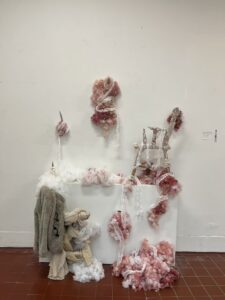
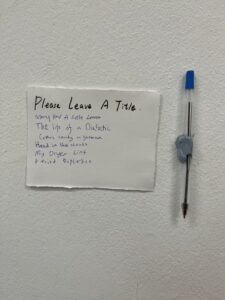
Secondly, the pink, fluffy installation accompanied by the interactive note “Please Leave A Title” (Fig. 2 & 3) highlights the decentring phase of awareness. The names left by the audienceranging from “Cotton Candy Nightman” to “Period Explosion” demonstrate how a material’s texture triggers subjective reorientation. Maybe, participation is not just about doing, but about becoming aware of one’s position within a relational network. This reinforces my strategy for Suyon Huh’s tension-based works: the material discomfort acts as a catalyst for the audience to move from being soothed to being pulled back to reality.

2.Interactive Authorship

The “Please Leave A Title” installation (Fig. 3) highlights the “Decentring” aspect of my proposal. By inviting the audience to name the work, the curator shifts the power dynamic from didactic teacher to facilitator. This strengthens my plan for a 30-minute guided walk-through, where the goal is not to provide answers but to foster collective bodily pacing. The materials resembling lint or “period explosions”force a visceral reorientation, echoing Miwon Kwon’s idea that the site of art is increasingly found in the transitive relationship between the producer and the audience (Kwon 2002).

3.Critical Reflection

Reflecting on the ECA show, I noticed a risk: the playfulness of materials can sometimes overshadow their agency. My project must avoid being merely whimsical.

A critical reflection triggered by the ECA visit is the danger of stifling the material. In my proposal, I categorized works into three rigid sections. However, the ECA hall’s open layout (Fig.4) suggests that friction and companionship often coexist in the same breath.


Paper pulp figures on coffee cups next to a large Sainsbury's receipt.

Fig.1 Consumer Debris: Reclaiming agency from commercial objects.

A messy textile installation with pink and white materials on a white wall.

Fig.2 Tactile Friction: Exploring the raw materiality of everyday fibers.

A handwritten note "Please Leave A Title" with a blue pen taped to the wall.

Fig.3 Audience Agency: Direct participation in curatorial narrative.

Wide view of ECA Sculpture Court with contemporary art in a classical space.

Fig.4 Institutional Scale: Contemporary disorder vs. classical structure.


Note:

Kwon, Miwon. One Place after Another : Site-Specific Art and Locational Identity. Cambridge, Mass. ; MIT Press, 2002.


Peer Review for Han Qiu

Han Qiu’s blog represents a sophisticated evolution from an art history student to a critical curator. Her work is characterized by a rigorous synthesis of sociopolitical theory and digital ethics,  treats the exhibition space as a site for urgent socio-political inquiry.
 

1.Strengths: 

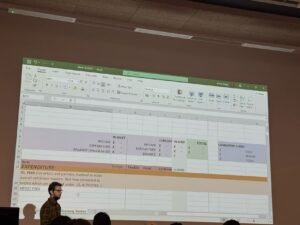
Professional Operationality : The Week 6 Pitch is a standout. Including a detailed budgetand a multi-layered public program (AI Identity workshop, Data Ethics Lab) is a masterstroke. It demonstrates that curating is a production of social relations and financial logistics, not just selecting pretty things.

Ethical Depth: The Week 9 post on “Anti-ableist practice” is a heavy-hitter. She argues that representation without material change is meaningless, showing demonstrating a deep commitment to accessibility .pushes . This pushes the boundaries of curating into the realm of social activism, reflecting deeply on accessibility and structural exclusion.She focuses on “fixed fees” for artists and “accessibility” in proves that she understands the curator’s role as a responsible mediator, not just a content selector.

Theoretical Grist: Qiu doesn’t just mention names; she synthesizes theories like Foucault’s Panopticon or Ana Bilbao’s SVAOs to justify her curatorial choices. Qiu’s move from “Algorithm Gaze” to “Anti-ableist Practice” shows deep intellectual growth.

Narrative Cohesion: The blog transitions naturally from institutional critique to technological critique and finally to accessibility, forming a logically self-consistent research loop.


2.Areas for Further Strengthening

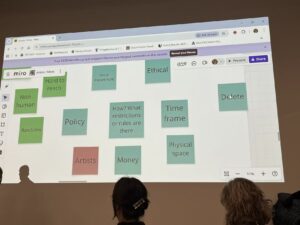
Visual Annotation :While the blog images are evocative, they lack visual critical annotations. As a curator, Qiu should mark up these images to show the reader exactly what her curatorial gaze is identifying.

The Sensory Gap: The blog is intellectually dense but could be more grounded in sensory experience. For a physical exhibition at Summer hall, how do we make the “Algorithmic Gaze” feel visceral? More diagrams on lighting, sound, and audience flow would bridge this gap.

Deeper Cross-disciplinary Dialogue: In the Week 5 dialogue with CAP students, the author could further analyze how artists reciprocally shape the curatorial logic, rather than  recording the conversation process.

Metaphorical Connection: The link between AI surveillance and the Ji Ju collective theme could be tightened. How does an algorithm inhabit or displace a migrant body?


3.Lessons & Reflections for My Project

Digital vs. Material: Qiu’s digital “shell” (the algorithm) perfectly complements my focus on physical “shells” (materiality). It’s a reminder that as “sojourners,” we inhabit both physical and data-driven structures.

Real-World Survival: Her focus on funding sources, Creative Scotland, is a reality check. It has pushed me to be more realistic about the logistics and costs of my own artist selection.

Archive as Care:  Her concept of “writing in the margins” in week 8  encourages me to embrace fragmentation. Instead of forcing a perfect linear logic, I can allow my blog to be a research site that evolves, much like the Ji ju spirit of movement.

Research vs. Conclusion: Qiu’s view of the exhibition as an evolving research site rather than a finished product challenges my own goal-oriented approach to exhibition-making.


Week 10 | JiJu Collective : Weaving “Our Shell” at Summerhall

The culmination of Week 10 saw the opening of Our Shell at Summerhall, Edinburgh, a group exhibition curated by and featuring the Ji Ju Collective. Moving beyond a mere display of objects, the project functioned as a critical inquiry into the “hermit crab” condition: the constant negotiation of identity, memory, and domesticity within the precarious “shells” of a migratory life.

1.Collective Action as Method: From Theory to Site

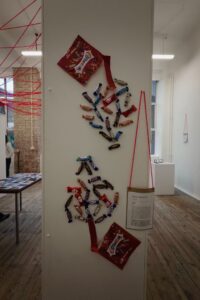
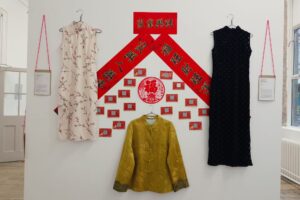
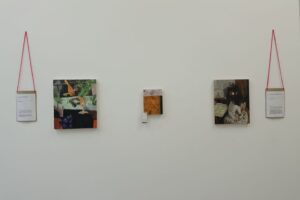
Our exhibition navigated the tension between cultural roots and the “temporary shells” we inhabit while living abroad. By using red threads to physically connect disparate works, from traditional Qipao to contemporary paintings, we transformed a static gallery room into a living, interconnected organism.

This approach resonates with Miwon Kwon’s discourse on the evolution of site-specificity. She argues that the “site” has shifted from a fixed physical location to a discursive, mobile network:

The final ‘site’ or frame for art reception and dissemination in this appraisal is no less than the artist–producer and the sometimes transitive and site-less communities of the early 21st century. “(Kwon 2005, 372)

By framing our collective as a “site-less community,” we demonstrated that curatorial practice can create a sense of belonging that is not tied to a specific geography, but to shared experience and “material as a way of thinking.”

2.The Ethics of the “Ordered Appearance”

While the final exhibition presented a unified narrative of “belonging,” the behind-the-scenes reality involved intense negotiation. Reflecting on this, I found Jean-Paul Martinon’s perspective on curatorial ethics particularly grounding:

“Curating is famous for an ordered appearance that on quick inspection is always flawed. Exhibitions always give the impression of cohesion when in fact what is exhibited is often the result of many compromises, concessions, and trade- offs between institutions,funders, lenders, contexts, and/or artists.” (Martinon 2020, xxii).

This “flawed cohesion” was evident in how we balanced individual artistic voices within the Ji Ju Collective. For my final project, I will embrace these “compromises” not as failures, but as an ethical method of sourcing and displaying artists, ensuring that the tension between different materialities remains visible rather than smoothed over.

3.Inspiration for My Personal Project

The success of Our Shell has deeply informed my final curatorial proposal. Specifically, the way we utilized red threadas a low-cost, high-impact spatial device demonstrated to me how “publicness can be negotiated within economic constraints.” For my personal project, I will further develop this “relational materiality”using physical connections to guide the audience’s gaze and bridge the gap between “art jargon” and lived reality. Seeing how viewers engaged with the “Sweetness within the Shell” (the candy installation) confirmed that accessibility is best achieved through familiar, tactile objects.

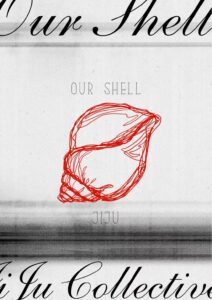
Bilingual poster for "Our Shell" exhibition with a red shell sketch.

The Visual Identity: The red shell symbolizes the “temporary home” we occupy.

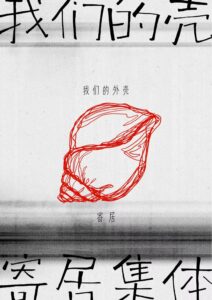
Bilingual poster for "Our Shell" exhibition with a red shell sketch.

The Visual Identity: The red shell symbolizes the “temporary home” we occupy.

Bilingual poster for "Our Shell" exhibition with a red shell sketch. Bilingual poster for "Our Shell" exhibition with a red shell sketch. Celebrations chocolates arranged in tree-like forms on a pillar. Traditional Chinese garments (Qipao/Tangzhuang) displayed on a white wall. Small paintings with labels hung by red strings.

Notes

1.Kwon, Miwon, and Scott Townsend. Review of One Place after Another: Site-Specific Art and Locational Identity. Visual Communication (London, England) 4, no. 3 (October 2005): 372–75.

2.Martinon, Jean-Paul. 2020. Curating As Ethics. Minneapolis: University of Minnesota Press. Accessed March 30, 2026. ProQuest Ebook Central.


Week 9 |Curating as Redistribution: Participation, Materiality, and Change

1.From Concept to Situated Practice

Week 9 marks a critical moment where my curatorial thinking is realised through the exhibition Our Shell at Summerhall. The project shifts from a conceptual exploration of “home” towards a situated practice shaped by material, audience interaction, and spatial conditions. Rather than presenting a fixed narrative, the exhibition operates as an open system in which meaning is continuously produced through participation.


2. Participation and the Ethics of Taking

A key curatorial decision in Our Shell is to invite audience interaction, particularly through works that can be altered over time. However, rather than celebrating participation uncritically, the exhibition considers its ethical dimension: what does it mean to take from an artwork?

This question is particularly relevant in my installation, Sweetness Within the Shell, where viewers are invited to take candies. The act of taking is not neutral; it introduces absence, redistribution, and loss. In this sense, participation becomes a form of negotiation rather than simple engagement. 

As Nicolas Bourriaud argues, “in relational art, the audience is envisaged as a community. Rather than the artwork being an encounter between a viewer and an object, relational art produces encounters between people. Through these encounters, meaning is elaborated collectively, rather than in the space of individual consumption. “


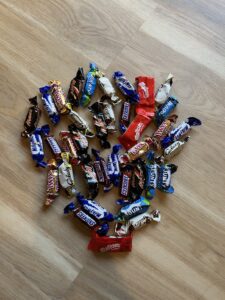
A floor-based installation composed of multiple small, individually wrapped chocolates arranged into a shell-like shape. The candies form an organic, clustered structure on a wooden floor, with different coloured wrappers (red, blue, gold, black, and white) creating visual variation. The arrangement resembles a fragmented shell or organic form, suggesting both accumulation and dispersal.

Sweetness Within the Shell, 2026
Mixed-media installation: wrapped candies, candy wrappers, floor arrangement
Variable dimensions (four shell-shaped units)
Artist: siqixue
Installation view, Our Shell, Summerhall, Edinburgh, 2026

3.Material as a Way of Thinking

The exhibition also reflects a shared curatorial approach among participating artists: a commitment to material as a mode of thinking. This aligns with practices such as Mono-ha. “Founding member Lee observed that an artist’s ability to make things had been nullified by technology. As a result, he rejected traditional ideas of representation in favour of revealing the world as it is by engaging with materials and exploring their properties.”

In Sweetness Within the Shell, candy functions not only as a symbolic object but as an active material. Its consumable nature introduces temporality and instability into the work. As the candies are removed, the installation becomes a site of ongoing transformation, challenging the idea of the artwork as a stable entity.

4.Collective Practice and Curatorial Method

Working within the collective has been central to the development of Our Shell. Curatorial decisions, ranging from spatial arrangement to thematic framing, were shaped through negotiation and dialogue. This reflects a broader understanding of curating as a collaborative and process-based practice rather than an individual authorship.

Importantly, the exhibition format moves beyond a single-artist focus, instead creating a multi-voiced environment that better aligns with contemporary curatorial discourse.


Notes

1. “Relational art,”Wikipedia, accessed March 22, 2026, https://en.wikipedia.org/wiki/Relational_art#cite_note-19.
2. “MONO-HA,” The Board of Trustees of the Tate Gallery, accessed March22, 2026, https://www.tate.org.uk/art/art-terms/m/mono-ha.


Week 8 | Our Shell

1. Naming the Exhibition

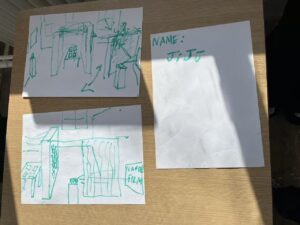
our discussion at Summerhall helped us confirm the direction of our exhibition more clearly. We finalised the exhibition date, selected the works we want to include, and agreed on the title: Our Shell. This title feels closely connected to Ji Ju Collective itself. For us, Ji Ju is not just a group name, but a way of thinking about being together through difference. Our Shell develops this further by suggesting a shared space that can hold different people, materials and experiences at the same time.

The title also reflects the kind of atmosphere we want the exhibition to create. A shell can protect, contain and gather, but it is not completely closed. In this sense, the exhibition is intended as a space of openness rather than a fixed statement. It should allow different works and perspectives to exist together without forcing them into one single reading.

2. Openness Needs Structure

At the same time, our discussion showed that openness in curating is not simple. Wanting to be inclusive does not mean that everything can automatically fit together. We still had to make decisions about which works to include, how they relate to one another, and how the exhibition could remain clear for an audience. This made me realise that collective curating depends not only on sharing ideas, but also on shaping them carefully.

What I found most useful this week was seeing how the theme became more than just a title. It started to act as a structure for thinking about the exhibition itself. Our Shell is not only about protection or shelter, but also about how a collective space can be built through negotiation, flexibility and mutual support.

3.Beyond the Exhibition Space

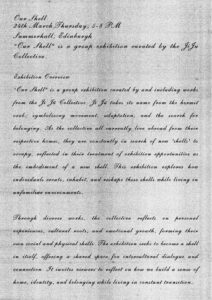
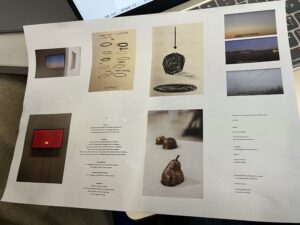
We also planned to produce an exhibition postcard or leaflet. At first this seemed like a small practical decision, but I think it is actually part of the curatorial work.

If the exhibition is temporary, printed material becomes one way it continues beyond the room. At the same time, this raises a more critical question: can a postcard or leaflet really communicate an exhibition built around openness and collective process, or does it risk flattening that complexity into a simple visual identity? I think this is where the project becomes more interesting. Our Shell is not only about what we display, but also about how we mediate the exhibition to others.

Because of this, I started to see exhibition materials not as secondary design work, but as part of the curatorial process itself.

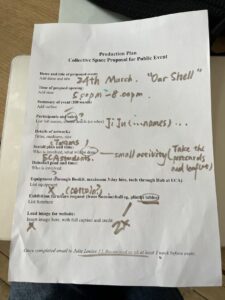
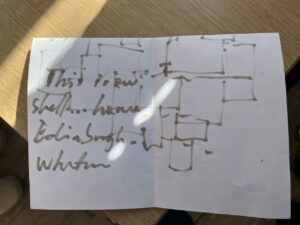
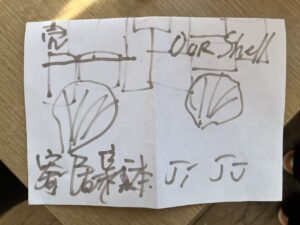
Hand-drawn exhibition plans, layout sketches, and planning notes made by Ji Ju Collective during a group discussion at Summerhall.

Ji Ju Collective discussion materials and planning notes developed during Week 8 at Summerhall, focusing on exhibition selection, event timing, and printed materials for public engagement.

Hand-drawn exhibition plans, layout sketches, and planning notes made by Ji Ju Collective during a group discussion at Summerhall.

Ji Ju Collective discussion materials and planning notes developed during Week 8 at Summerhall, focusing on exhibition selection, event timing, and printed materials for public engagement.

Hand-drawn exhibition plans, layout sketches, and planning notes made by Ji Ju Collective during a group discussion at Summerhall.

Ji Ju Collective discussion materials and planning notes developed during Week 8 at Summerhall, focusing on exhibition selection, event timing, and printed materials for public engagement.

Hand-drawn exhibition plans, layout sketches, and planning notes made by Ji Ju Collective during a group discussion at Summerhall.

Ji Ju Collective discussion materials and planning notes developed during Week 8 at Summerhall, focusing on exhibition selection, event timing, and printed materials for public engagement.


Week 7 | Bringing Home into Exhibition

1. Using an Object from Home as a Curatorial Entry Point

This week, Ji Ju Collective continued our discussion at Summerhall. As part of this session, each of us shared an artwork or object connected to our hometown and introduced the cultural background behind it. This exercise was not simply about “showing where we come from.” It also worked as a curatorial method: through a specific object, broader ideas such as identity, locality, memory and culture became visible and discussable.

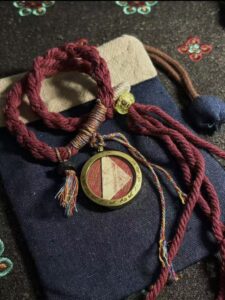
The object I presented was an amulet from Taiqing Palace in Qingdao. Taiqing Palace, located in Laoshan, Qingdao, is an important site in Chinese Daoist culture. For me, this amulet is not only a religious object. It is also connected to local culture, family memory and forms of spiritual reassurance in everyday life. Bringing it into the collective discussion made me think about how an object that originally belongs to a private and local context of belief changes meaning when it is placed within a curatorial discussion or exhibition setting.

In everyday life, the amulet functions as something associated with protection, blessing and safety. Within the space of collective discussion, however, it also becomes an object to be viewed, interpreted and contextualised. In this sense, it carries both a practical function and a symbolic meaning. It makes visible the idea of the object as a carrier of culture.

A close-up photograph of a red braided Daoist amulet from Taiqing Palace, Qingdao, placed on a dark blue fabric pouch, with multicoloured threads and a round pendant at the centre.

Daoist amulet from Taiqing Palace, Qingdao. Shared during Ji Ju Collective’s discussion at Summerhall as an object connecting hometown culture, everyday belief and curatorial thinking.

2. The Amulet Between Practical Meaning and Artistic Meaning

I chose this amulet partly because this year is my benmingnian, or zodiac birth year.

In Chinese culture, one’s birth year is often understood as a particularly sensitive or significant period, during which people may pay more attention to protection, safety and wellbeing. Because of this, red objects, amulets and other symbolic items are often used to express a wish for security and good fortune. Whether this protection is understood as religious, symbolic or emotional, it shows that objects are not only used, but also believed in.

On a practical level, the amulet relates to a sense of safety. It responds to uncertainty in everyday life and reflects how people turn to objects in order to create reassurance when facing pressure, change or the unknown.

From an artistic and curatorial perspective, however, the amulet is more than simply a piece of folk culture. It raises several important questions.

First, can a small, everyday object with a private or spiritual function be taken seriously within an exhibition space?

Second, how should curation provide access when viewers do not share the same cultural background?

Third, does the value of an object come only from its aesthetic form, or also from the cultural relations, lived use and emotional structures it carries?

What interests me most is that this object is not monumental, but specific. It turns culture from an abstract idea into something that can be touched, worn, trusted and narrated. It also reminds me that curatorial thinking does not always need to begin with large theoretical claims. Sometimes it can begin with a very small object and expand outward into broader cultural and social questions.


Week 6|From a Site Visit to Summer hall a Clearer Curatorial Plan: Awareness Through Materials

1) Summerhall group curating: learning from space, not just from ideas


This week, my Jiju group went to Summerhall for a collective curatorial exercise. Working as a group in a real exhibition context made my project feel less like an idea on paper and more like a set of decisions that must survive space, bodies, and time.


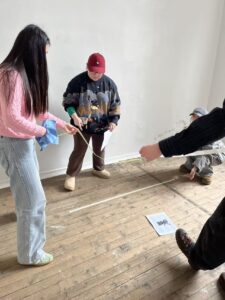
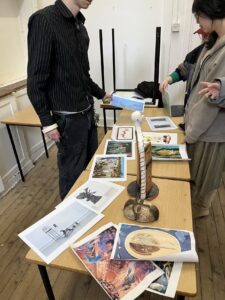
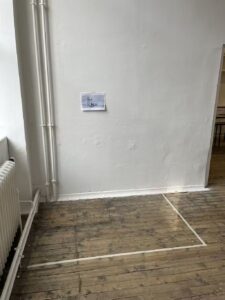
At Summer Hall, our discussion quickly moved from taste to structure: sightlines, pacing, and the practical question of how a viewer’s attention is guided. We tested the scale by laying out printed images on the table, then moved to the wall and the floor to simulate placement. The taped rectangle became a simple but powerful tool. It allowed us to translate an artwork from a photograph into an imagined physical footprint, and to notice how quickly an installation can dominate a room or disappear inside it. Measuring together also revealed something important about group work: curating is not only about authorship, but negotiation between people, and between artworks and architecture.

 Several students stand and crouch on a wooden floor, holding a tape measure across a taped outline while discussing the dimensions.

Measuring together: the group used a tape measure to check proportions and circulation, turning a floor plan idea into a physical, walkable scale test.

students stand around a table covered with printed artwork images and a small object, talking and pointing while planning a group curatorial layout.

Jiju group curatorial workshop: we laid out printed images and discussed scale, sequencing, and material relationships before moving into the gallery space.

A white wall with pipes on the left; a small printed image is taped to the wall, and a rectangular area is marked on the wooden floor with tape.

Testing placement in the room: a taped rectangle on the floor and a small image on the wall helped us visualise footprint, height, and viewing distance.


2) Tutor feedback and revision: narrowing the exhibition into a group show with material logic


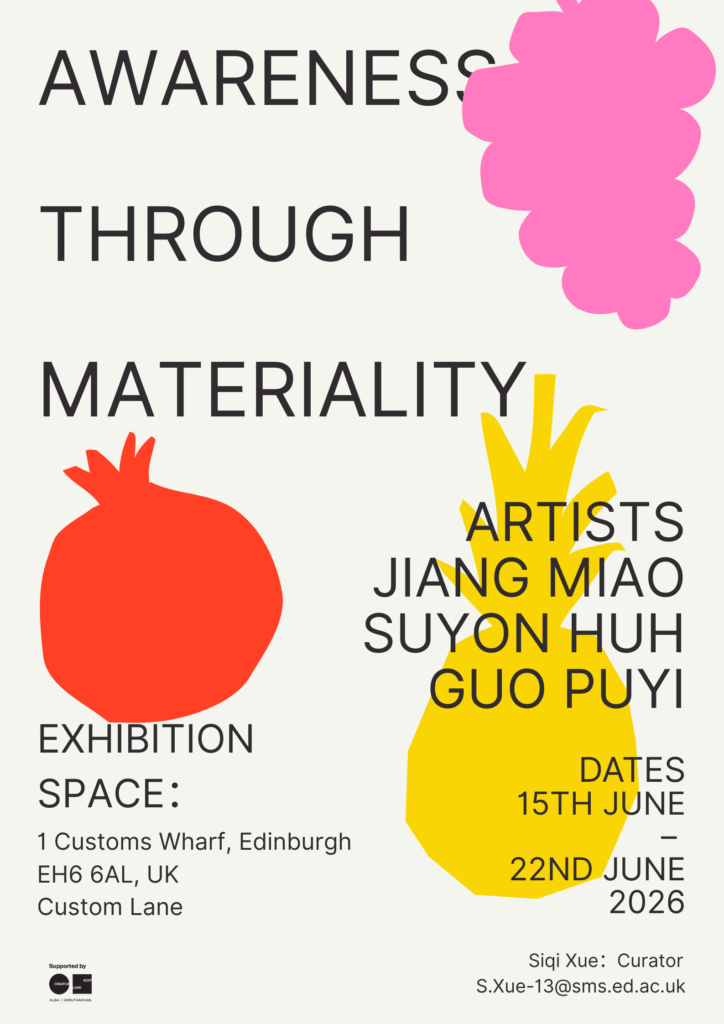
Based on feedback from class, I revised my blog and re-focused my proposal. Because we are not allowed to stage a solo exhibition, I rebuilt the project as a group show while keeping my theme of awareness (觉知). I also re-selected two artists whose practices are strongly material-led, and I confirmed a clearer venue choice. The revised exhibition brings together Suyon Huh (Korea), Jiang Miao (China), and Guo Puyi (China), and the site is Exhibition Space at Custom Lane.
What connects these artists for me is not a single style, but a shared commitment to material as a way of thinking. Suyon Huh’s works, using paper, rope, sand, and found communication objects, make “anxiety” and “absence” legible through fragile construction and tension. Jiang Miao’s carved surfaces (acrylic on aluminium or wood) turn the act of looking into a slow, tactile reading; the image is not simply presented, but repeatedly worked through. Guo Puyi’s modular and iterative pieces (including installation views and carving-based forms) emphasise how connection is built, tested, and sometimes fails, through repetition, assembly, and physical contact.


Curatorial Proposal

Title

Awareness: How Materials Accompany Us, and How They Push Back

Treat everyday materials as weighty presences, so viewers relearn attention through bodily pacing and looking. ___ Siqi Xue

Concept and curatorial questions

This group exhibition centres on “awareness”, but I want to pull it away from an abstract self-help term and return it to a concrete viewing practice: how we treat objects often mirrors how we treat ourselves and others. Under urban speed, efficiency logics, and social discipline, materials are frequently reduced to tools. Yet in many cultural contexts, objects can also be revered, carefully attended to, and allowed to hold space. The question is not whether an object is “just an object”, but whether we are willing to acknowledge that materials carry relationships, memory, labour, and power.

Here, awareness becomes a three-step practice:

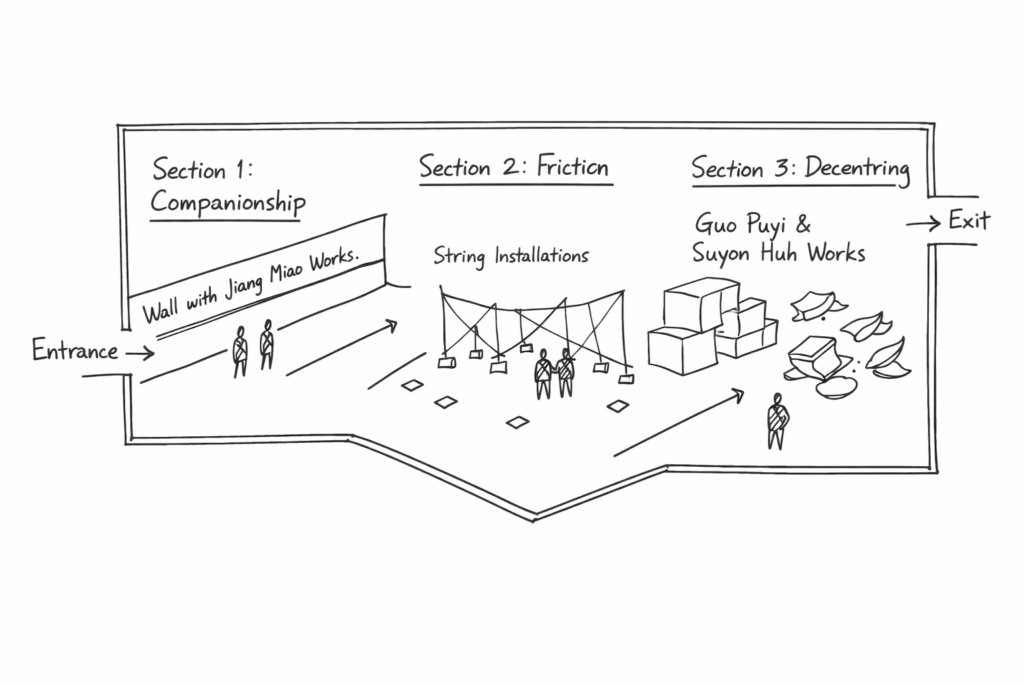
1.Companionship: materials as quiet companions that slow us down.
2.Friction: materials that make comfort fail and expose conflict.
3.Decentring: materials that pull the human subject off-centre and force reorientation.


Artists and selected works

A) Jiang Miao

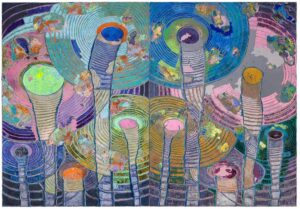
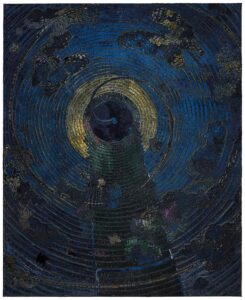
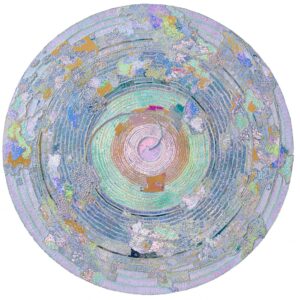
Jiang Miao’s three works all point to the first level of “awareness”: not a didactic spiritual therapy, but rather, through carving and the hardness of metal/wood, she brings attention back to the rhythm of touch and breath. Her paintings are like a state of repeated polishing, reminding the viewer that awareness is not a sudden flash of inspiration, but rather a long-term training.

A very large aluminium-panel painting with acrylic layers and carved marks; the surface shows cut lines and reflective shifts under light.

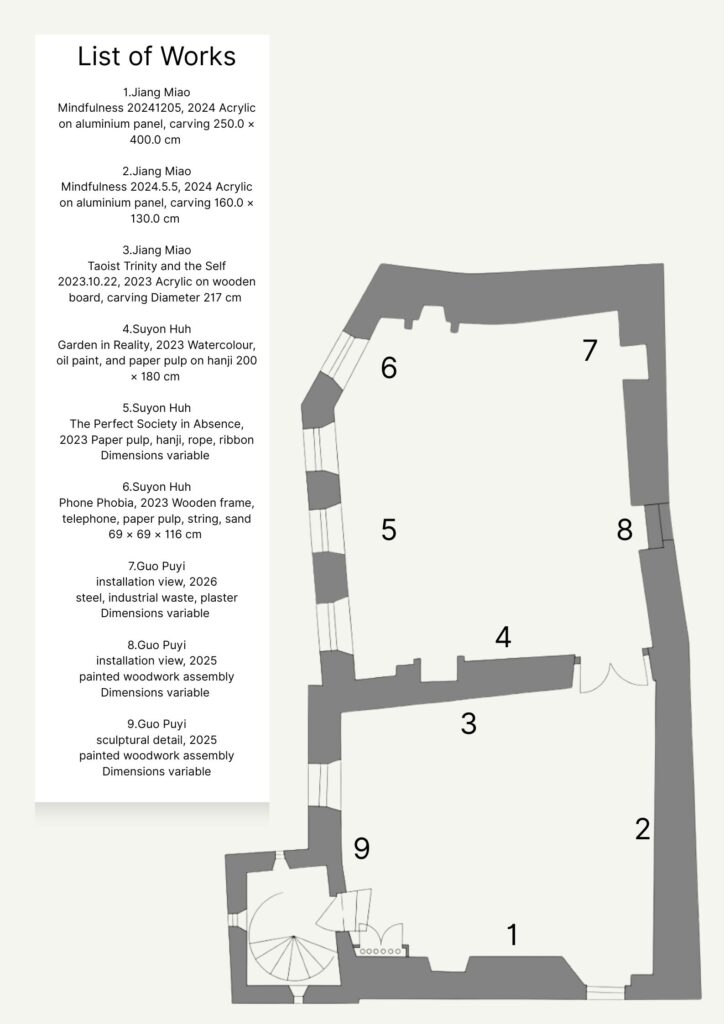
Mindfulness 20241205, JIANG MIAO, 2024. Acrylic on aluminium panel, carving. 250.0 × 400.0 cm.

A mid-sized aluminium-panel work with dense colour layers; carved and scraped lines create rhythmic grooves and edges across the surface.

Mindfulness 2024.5.5, JIANG MIAO, 2024. Acrylic on aluminium panel, carving. 160.0 × 130.0 cm.

A circular wooden-board work with acrylic layers carved into concentric or spiral structures, forming ring-like organisation similar to map or terrain textures.

Taoist Trinity and the Self 2023.10.22, JIANG MIAO, 2023. Acrylic on wooden board, carving. Diameter 217 cm.


B) Suyon Huh

Her works materialize everyday fears, absences, and fictitious orders into tangible material systems: papier-mâché, string, thread, Korean paper, watercolor, and oil painting overlays. They look light, but actually form a pulled structure in the space, causing the audience to experience physical tension and self-projection. She is responsible for the transition between the second and third sections of the exhibition: from being soothed to being pulled back to reality.

A large work on paper with layered, garden-like textures; watercolour and oil marks are visible, with raised paper-pulp areas creating uneven relief.

Garden in Reality, Suyon Huh, 2023. Watercolour, oil paint, and paper pulp on hanji. 200 × 180 cm.

Several paper-pulp and hanji structures are linked by ropes and ribbons that hang and pull across space, forming an expandable installation.

The Perfect Society in Absence, Suyon Huh, 2023. Paper pulp, hanji, rope, ribbon. Dimensions variable.

An installation on a wooden frame with a telephone at the centre, surrounded by string and paper-pulp forms with a gritty, sand-like surface, placed on the gallery floor.

Phone Phobia, Suyon Huh, 2023. Wooden frame, telephone, paper pulp, string, sand. 69 × 69 × 116 cm.


C) Guo Puyi

Guo Puyi is responsible for pushing the exhibition to the third level of “awareness”: the material not only accompanies it, but also organizes the space in turn, forcing us to adjust the way we see. In particular, he turned the text, structure and splicing system into a scalable installation logic, making the audience realize that the relationship between people and the real materials of the world is not a slogan, but a kind of repeated construction and maintenance.

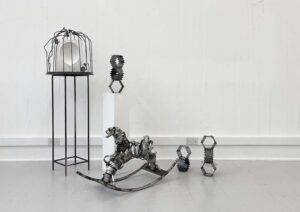
Installation view in a white studio: at left, a tall black metal stand supports a circular metal cage containing a white block with a balloon-shaped cavity. Centre foreground, a stainless-steel rocking-horse-like sculpture rests on curved runners. To the right, two small modular steel figures stand on the floor, and one similar figure sits on a white plinth.

A small “family” of objects shares the same room but holds different degrees of freedom. A balloon-like void is kept inside a metal cage, while a rocking-horse body lies on the floor like a toy that has grown heavier than play. Nearby, modular steel figures stand upright, as if play has been reorganised into structure. In this scene, comfort, control, and companionship are negotiated through material weight and spatial distance.

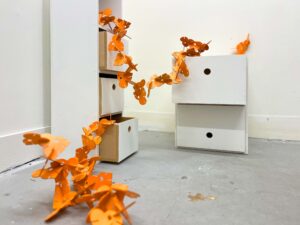
An installation view in a white room: orange modular forms snake from the floor up into open drawers and across to a small cabinet. The pieces appear to “crawl” through the furniture.

Placed among drawers and corners, the work behaves like something that escaped storage and began to travel. It turns the domestic into a site of agency, not just comfort.

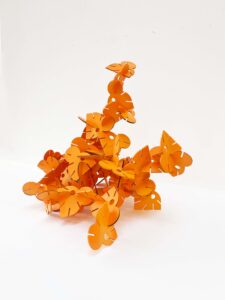
A cluster that looks like a soft plant but is built from rigid modules. It suggests how connection grows: not as one perfect form, but as many small contacts holding each other up.


Exhibition structure and visitor journey

Section 1 Entering and getting close (quiet companionship)

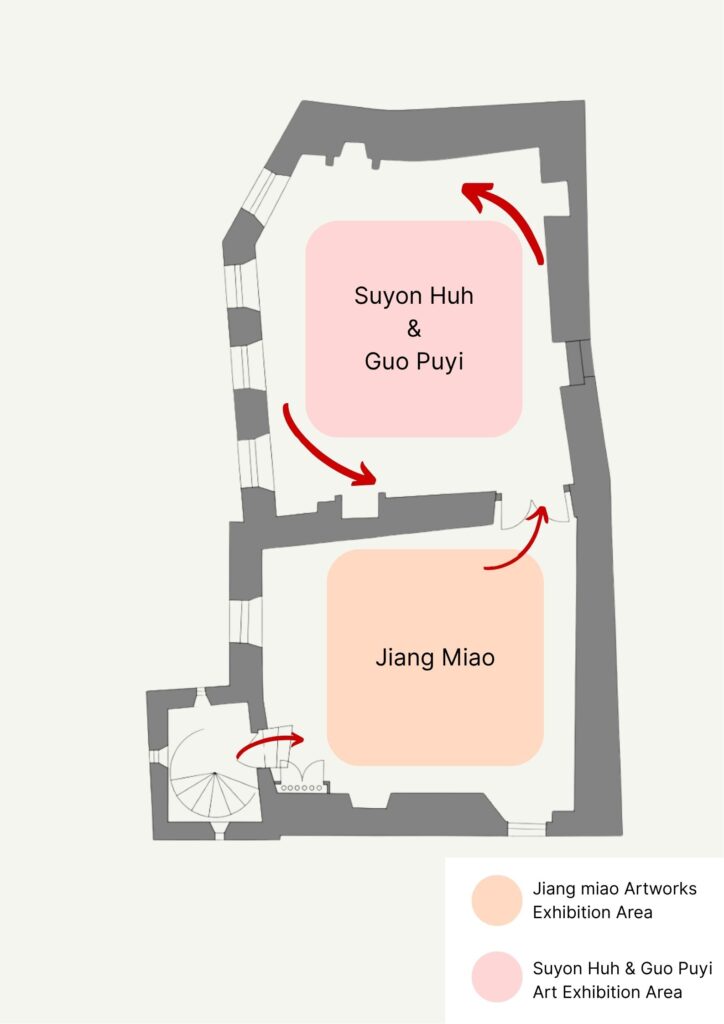
Featuring: Jiang Miao Fig.1–3

Mode: start with distance, then approach to read carving traces

Experience: attention returns from information-flow to surface, rhythm, breath

Section 2 Friction and rupture (comfort fails)

Featuring: Suyon Huh Fig.4–5

Mode: structure first, then strings and tension capture your gaze

Experience: material discomfort reveals how discipline enters everyday life

Section 3 Widening the gaze (decentring the human)

Featuring: Suyon Huh Fig.6 + Guo Puyi Fig.7–9

Mode: from being “caught” by structure to being “re-positioned” by it

Experience: you realise you are part of a relational network, not its centre

Display strategy (Custom Lane)

Lighting: Jiang’s works benefit from soft, even light to reveal carved shadows.

Heights: large panels read as a “breathing wall”; the circular work becomes a pause-point.

Installation safety: Huh’s string-based works require clear distances and subtle floor cues.

Guo Puyi: place modular works near the end as a “return point”, transforming earlier tension into a proposal for re-forming connection.


Audience and public programme

Audience: local Edinburgh publics, art students, visitors interested in material and installation, and those seeking slower forms of attention.
Low-cost programme:

  • 30-min guided walk-through: one work, one question.
  • Small workshop: build a “structure of attention” using paper and string.
  • Online layer: short texts plus alt text for every work to reduce barriers.

Ethics and collaboration

  • Clear permissions and crediting, with artist approval of all information.
  • Transparent fees, transport, and insurance to avoid hidden labour.
  • Avoid exoticising cultural background; centre material and embodied viewing.
  • Accessibility basics: clear labels, alt text, transcript for tour notes.


Budget (Total £10,000)

Item Estimate (GBP) Rationale
Venue hire (Custom Lane) 1,932 £276 × 7 days (kept under £500/day).
Venue tech / staffing contingency 600 basic ops, cleaning, equipment add-ons
Artist fees / loan fees (3 artists) 3,000 £1,000 each, labour and permissions respected
Transport & packing 1,600 local courier + lightweight international packing (paper/small works)
Insurance (artworks + public liability) 700 conservative placeholder pending quotes
Installation & materials 900 plinth tweaks, fixings, labels, minor lighting
Graphics & print 450 A2 poster set + in-space print
Documentation (photo/video) 550 one on-site documentation session
Accessibility & translation 300 bilingual text, alt text, text guide
Contingency 968 ~10% buffer
Total 10,000 balanced


Custom Lane link:exhibition-space

Timeline 

  • Weeks 1–2: confirm loans, artwork info, permissions


  • Week 3: transport and insurance locked; finalise texts and layout


  • Week 4: technical coordination; plinths and fixing plans


  • 2 install days, 7 public days, 1 deinstall day, 1 archive day


Curatorial Pitch

Title: Awareness

Artist: Guo Puyi


1) What I’m making

This is a solo show of Guo Puyi titled Awareness. It’s not trying to  teach people big theories. It’s about pulling our attention back to something basic: what we are actually seeing, touching, ignoring, and automatically accepting every day.

2) Why Guo

Guo’s work feels like “thunder in a quiet room.” It doesn’t rely on spectacle, but it hits hard. It makes me question how often I live in a practical, goal-driven mode.I grew up in Shandong, where social life often carries invisible rules about how to behave, how to fit in, how to be “proper.” Guo’s work opens a different possibility: objects don’t have to stay inside their assigned functions, and people don’t have to stay inside assigned roles. That sense of freedom is exactly why I chose him.

3) Three sections

A. Unnamed Companions (wood, small-scale constructions)
Some pieces carry a subtle Lovecraftian vibe: ordinary, “non-subject” things start to feel alive, spreading, almost breathing.
Many works are built from wooden components that resemble domestic building blocks. Even though this kind of object belongs to private spaces, Guo treats it as public-facing: a reminder to notice the small things we ignore in busy urban life.
For him, giving lifeless things a sense of “companionship” is a way to feel safely surrounded by life, like treating everyday objects as pets.

A cluster that looks like a soft plant but is built from rigid modules. It suggests how connection grows: not as one perfect form, but as many small contacts holding each other up.

A small orange modular sculpture on a white surface. Flat, slotted petal-like pieces form a curved line, arching upward at one end and bending down at the other.

A smaller body, but the same logic: connection as a chain of decisions. The work reads like a creature mid-move, showing how objects can carry emotion without becoming “cute.”

An installation view in a white room: orange modular forms snake from the floor up into open drawers and across to a small cabinet. The pieces appear to “crawl” through the furniture.

Placed among drawers and corners, the work behaves like something that escaped storage and began to travel. It turns the domestic into a site of agency, not just comfort.

B. Hard Comfort (iron works as protest against common sense)
Here, Guo uses imagery that usually signals softness and comfort, but he rebuilds it with iron, welding, sharp edges.
This isn’t just a material trick. It’s a refusal of social habit: we constantly project our assumptions onto objects (and people). By using “wrong” material, he forces a pause. The work becomes a practice of noticing what things really are, beyond their usual social function.

A round metal cage sits on a circular base atop a white plinth. Inside is a white block with a smooth, balloon-shaped cavity. Thin metal rods arch over the form.

A balloon-like void held behind a metal cage. The work flips softness into restraint, asking how comfort can become surveillance when it is “protected” too tightly.

A metal staircase structure in a workshop environment. The steps are silver sheet metal with welded seams; red machinery and industrial surfaces surround it.

Not a finished artwork, but a key part of the practice: fabrication as thinking. The studio image foregrounds labour, tools, and risk—what gets erased when we only see the final display.

A tall, vertical sculpture on a white plinth. Dark metal polygonal frames interlock like modular joints, forming a totem-like figure against a plain wall.

A stacked figure made of interlocking metal frames, like a toy turned stubborn. It keeps the language of play, but the material changes the mood: playful forms can carry pressure.

Installation view in a white studio: at left, a tall black metal stand supports a circular metal cage containing a white block with a balloon-shaped cavity. Centre foreground, a stainless-steel rocking-horse-like sculpture rests on curved runners. To the right, two small modular steel figures stand on the floor, and one similar figure sits on a white plinth.

A small “family” of objects shares the same room but holds different degrees of freedom. A balloon-like void is kept inside a metal cage, while a rocking-horse body lies on the floor like a toy that has grown heavier than play. Nearby, modular steel figures stand upright, as if play has been reorganised into structure. In this scene, comfort, control, and companionship are negotiated through material weight and spatial distance.

C. Moving the human gaze aside (photography, paper, leaves, text)
This section shifts attention away from human-centered meaning and toward nature, traces, time, and the possibility of something “beyond.” Guo references Borges’ The Circular Ruins and creates a loop-like text work, suggesting that reality, dreaming, objects, and self may generate each other.
The keyword for me is honesty: staying loyal to one’s own perception and touch, and facing the concrete world with an active attitude.

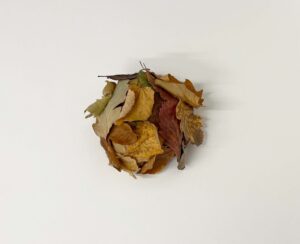
A ball-shaped cluster of dried leaves rests on a white surface. Leaves in yellow, brown, and reddish tones overlap tightly, with stems and curled edges visible.

A compact bundle of fallen leaves: not decoration, but a record of time. It treats the “discarded” as something worth holding, like a small ritual of attention.

A small sculptural book sits on a tall white plinth against a pale wall. The pages are fanned into a circular or cylindrical form, creating a dense, textured surface.

A book opened into a solid form: reading becomes architecture. It hints that knowledge is not only content, but also a physical habit we build around ourselves.

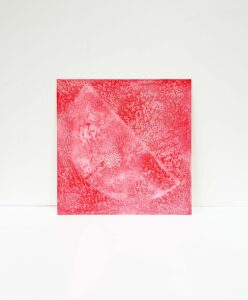
A red square artwork placed against a white background. The surface shows dense, branching textures and lighter areas, resembling liquid spread patterns or organic veins.

A surface that looks like a spill frozen in time. It plays with the border between accident and control: when does a stain become a decision.

A blue-toned square artwork on a light background. White drips and cloudy bursts spread across the surface, resembling ink wash, water stains, or fireworks captured as traces.

A quiet “firework”: the burst is slowed down into stains and drips. It holds a tension between celebration and residue—what remains after the moment ends.

A framed blue artwork on a white wall. The image shows pale, vertical forms with dripping marks, like ghostly figures emerging from washes of pigment.

A “portrait” without faces: figures appear as washes and drips. The work suggests family as atmosphere—presence, distance, and emotional weather rather than fixed identities.

A black-framed artwork on a white wall. Inside the frame is an image dominated by deep reds and pinks, showing an architectural interior with arched shapes and light reflections.

A view that feels like looking into a contained room. The frame acts like a boundary: protection and separation at the same time, asking what we keep “inside” when we say we are safe.

4) Link to Mono-ha

I see overlap with Mono-ha / object-centered thinking: objects are not props. They are active presences that shape how we feel and how we relate. This show is not “weird for the sake of weird.” It’s a way of training attention: materials, functions, and everyday objects have been shaping us all along.

5) Why a 3D online exhibition first

I’m proposing a 3D online gallery first, for practical reasons: it’s affordable, accessible, and easy to adjust. The 3D space will follow the same A/B/C structure, with short labels, material notes, and one-line “how to look” prompts to keep it welcoming.

6) Prompt: 3 questions for peer feedback

  1. Does “Awareness” feel clear, or still too abstract? If you had to make the title more everyday, what would you change?

  2. Which section feels strongest to you, and which one needs more explanation or different works?

  3. For a 3D online gallery, what feature would make you stay: audio guide, zoomable details, or shorter text?

7)If It Needs to Become Physical Later: A Realistic On-Site Version

If this exhibition needs to be realised physically later, I would translate the same three-part structure into a small-scale, low-risk show in a school or not-for-profit space. The key is to control cost, transport, and installation complexity.

  • Works selection: prioritise portable works, photography/paper first, limit heavy ironworks for safety

  • Pathway: keep the same three parts, using light changes and short prompts to create pauses

  • Display: extremely short labels, plus a small viewer response wall where people write what object reminded them to slow down

  • Ethics and transparency: a one-page collaboration and labour note at the entrance stating crediting, permissions, budget, and support clearly

8)Connection to the Jì Jū Collective

Our collective ethics around transparency and labour will shape how I work with Guo: clear permissions, clear crediting, and a clear explanation of fees or exchanges (even if the budget is low). I will also actively invite peer feedback, especially on representation and digital accessibility.


3D exhibition hall link:  https://metasteps.com/viewer/678486a4-78ff-4bdd-99fc-f2031e54f439?draft=true

Tip: Due to time constraints, we were unable to 3D scan the artists’ works. We will communicate with the artists later to select artworks for 3D scanning, build a more complete 3D exhibition hall, and enhance audience participation through VR technology.


Footnote

1.“Mono-ha,” Tate, accessed February 21, 2026, mono-ha .

Bibliography

Tate. “Mono-ha.” Accessed February 21, 2026, mono-ha .


Reading Week | Awareness, a one-person show proposal that turns everyday objects into companionship and resistance (Guo Puyi)

1) Why Awareness, and why I am working with Guo Puyi

This week I decided to ground my individual curatorial project in a theme that is easy to understand and also realistic to deliver: awareness. For me, awareness is not something abstract. It is the moment when you suddenly notice how you have been looking at things in the same habitual way, and maybe treating yourself in the same way too.


I want to curate a one-person show with Guo Puyi because his work does something very clear. He takes objects that seem lifeless and without agency, and gradually makes them feel alive, spreading, and present. His practice makes me question whether my own way of living has become too utilitarian, too shaped by rules and efficiency. That reflection also connects to my background. I grew up in Shandong, where social norms shaped by ritual and propriety can feel heavy. Guo’s work is not loud, but it has a quiet force that suggests there are other ways to exist.

2) Three groups of works: from companionship to rupture, then beyond a human-centred gaze

To keep the project readable, I am organising Guo’s works into three groups. This helps audiences follow the exhibition without needing theory first.


Group 1: wood and ceramic works, a sense of companionship

These works include wooden figure-like building blocks and ceramic or hand-made objects. Although these materials often belong to domestic settings, Guo sees them as public-facing. His intention is to bring attention to small, easily ignored things in a fast urban life.

In our conversation, he described how giving non-agentic objects a sense of life can create a feeling of safety, as if he is surrounded by living presences. He sometimes treats everyday objects almost like pets. That idea matters for my theme, because it makes awareness practical. The way you relate to objects can reflect the way you relate to yourself.


A cluster that looks like a soft plant but is built from rigid modules. It suggests how connection grows: not as one perfect form, but as many small contacts holding each other up.

A small orange modular sculpture on a white surface. Flat, slotted petal-like pieces form a curved line, arching upward at one end and bending down at the other.

A smaller body, but the same logic: connection as a chain of decisions. The work reads like a creature mid-move, showing how objects can carry emotion without becoming “cute.”

An installation view in a white room: orange modular forms snake from the floor up into open drawers and across to a small cabinet. The pieces appear to “crawl” through the furniture.

Placed among drawers and corners, the work behaves like something that escaped storage and began to travel. It turns the domestic into a site of agency, not just comfort.


Group 2: ironworks and hard materials, making softness sharp

Here, the key is the tension between familiar imagery and unexpected material. Guo often chooses forms that, in daily life, suggest softness and comfort. But he makes them in iron or sharp-edged materials. For him this is not an aesthetic trick. It is a refusal of social habits and fixed assumptions. We often project our expectations onto objects, and we do the same to people.

By using a material that resists comfort, he pushes viewers to notice the object’s actual properties, and to adopt a more critical gaze. It becomes a practice of awareness in itself: looking for possibilities beyond an object’s assigned function.


A round metal cage sits on a circular base atop a white plinth. Inside is a white block with a smooth, balloon-shaped cavity. Thin metal rods arch over the form.

A balloon-like void held behind a metal cage. The work flips softness into restraint, asking how comfort can become surveillance when it is “protected” too tightly.

A metal staircase structure in a workshop environment. The steps are silver sheet metal with welded seams; red machinery and industrial surfaces surround it.

Not a finished artwork, but a key part of the practice: fabrication as thinking. The studio image foregrounds labour, tools, and risk—what gets erased when we only see the final display.

A tall, vertical sculpture on a white plinth. Dark metal polygonal frames interlock like modular joints, forming a totem-like figure against a plain wall.

A stacked figure made of interlocking metal frames, like a toy turned stubborn. It keeps the language of play, but the material changes the mood: playful forms can carry pressure.

Installation view in a white studio: at left, a tall black metal stand supports a circular metal cage containing a white block with a balloon-shaped cavity. Centre foreground, a stainless-steel rocking-horse-like sculpture rests on curved runners. To the right, two small modular steel figures stand on the floor, and one similar figure sits on a white plinth.

A small “family” of objects shares the same room but holds different degrees of freedom. A balloon-like void is kept inside a metal cage, while a rocking-horse body lies on the floor like a toy that has grown heavier than play. Nearby, modular steel figures stand upright, as if play has been reorganised into structure. In this scene, comfort, control, and companionship are negotiated through material weight and spatial distance.


Group 3: photography, works on paper, and leaf-based pieces, shifting attention outward

This group feels like a movement away from human-centred urgency. Leaves, paper, and photography pull attention back to nature and to something slightly beyond the material everyday. Guo mentioned Borges’s The Circular Ruins, which I see as a useful hinge for the later part of the exhibition: once you become aware of the weight of everyday objects, you may also realise you are not the centre of everything.

In Guo’s practice, the idea is materially built into the work. His piece titled Book is made from the English edition of The Circular Ruins, physically constructed so that the text becomes a continuous loop, with the beginning and the end connected. This matters because the book is no longer only something we read for meaning. It becomes an object with weight, density, edges, shadows, and a circular structure that you encounter through the body. The paper carries time. The form carries repetition. Meaning is not only in language, but in what the material does to language.

This shift brings awareness into a third layer. In earlier sections, awareness is about how we attach feelings to objects and how material reality interrupts our habits. Here, awareness becomes a small step away from the self. Borges’s story is already built around a loop: the dreamer creates a human through dreaming, only to realise he might also be someone else’s dream. By turning the story into a ring-shaped Book, Guo translates that narrative logic into tactile experience. You do not need to “understand the plot” to enter the concept. You simply face a structure with no clear starting point and no final destination, and you begin to feel—almost automatically—that you are not always the centre of everything.

For me, this group frames awareness as honesty. It is about trusting one’s own perception and touch, and staying close to the concrete world rather than turning awareness into a slogan.


A note on Mono-ha

I do not want to force this exhibition into Mono-ha, but Mono-ha gives me a clear curatorial lesson: treat material, weight, scale, and placement as part of meaning, and let viewers understand through bodily experience rather than over-explanation. Mono-ha, emerging in postwar Japan, foregrounded direct encounters with materials and the relationships between things and site. That approach helps me keep awareness grounded in how people look and move, not only in what they read.


A ball-shaped cluster of dried leaves rests on a white surface. Leaves in yellow, brown, and reddish tones overlap tightly, with stems and curled edges visible.

A compact bundle of fallen leaves: not decoration, but a record of time. It treats the “discarded” as something worth holding, like a small ritual of attention.

A small sculptural book sits on a tall white plinth against a pale wall. The pages are fanned into a circular or cylindrical form, creating a dense, textured surface.

A book opened into a solid form: reading becomes architecture. It hints that knowledge is not only content, but also a physical habit we build around ourselves.

A red square artwork placed against a white background. The surface shows dense, branching textures and lighter areas, resembling liquid spread patterns or organic veins.

A surface that looks like a spill frozen in time. It plays with the border between accident and control: when does a stain become a decision.

A framed blue artwork on a white wall. The image shows pale, vertical forms with dripping marks, like ghostly figures emerging from washes of pigment.

A “portrait” without faces: figures appear as washes and drips. The work suggests family as atmosphere—presence, distance, and emotional weather rather than fixed identities.

A blue-toned square artwork on a light background. White drips and cloudy bursts spread across the surface, resembling ink wash, water stains, or fireworks captured as traces.

A quiet “firework”: the burst is slowed down into stains and drips. It holds a tension between celebration and residue—what remains after the moment ends.

A black-framed artwork on a white wall. Inside the frame is an image dominated by deep reds and pinks, showing an architectural interior with arched shapes and light reflections.

A view that feels like looking into a contained room. The frame acts like a boundary: protection and separation at the same time, asking what we keep “inside” when we say we are safe.


3) Curatorial plan: a workable online 3D solo show, with budget and ethics in view

To keep the project feasible and aligned with a not-for-profit curatorial context, I plan to build this as an online 3D exhibition. The reason is practical: it reduces venue costs, transport, and insurance risks, and it allows audiences to access the exhibition from home. At the same time, I want to take digital barriers seriously. Arts Council England highlights that digital delivery can also exclude people, so online does not automatically equal public.


Exhibition pathway

Part 1 entering and getting close: wood and ceramic works as quiet companions

Part 2 friction and rupture: ironworks that reframe familiar forms through material resistance

Part 3 widening the gaze: photography, paper, and leaf works that shift attention beyond the self

How the 3D space stays meaningful

short labels for each work: material, size, one key question

one small prompt per section: for example, choose one object that makes you feel safer

accessibility basics: alt text for images, clear text versions for any audio or video

transparency: a simple note listing any support, collaborations, and how labour is recognised

How this connects to the Jì Jū Collective

Our collective ethics around transparency and labour will shape how I work with Guo: clear permissions, clear fee structure where possible, respectful crediting, and a clear statement of my curatorial position. Our collective practice also reminds me to actively invite peer feedback, especially on representation and digital accessibility.


Week 5 |Where I’m From: Turning Lived Experience into Curatorial Material

1) My individual project: a simple, workable idea


This week I clarified a more grounded direction for my individual curatorial project. After seeing CAP classmates bring and present their works in class, I realised something very direct: most of the works were not built from “art jargon,” but from personal background, cultural memory, and lived experience. That made the project goal clearer for me. I want to curate an exhibition that helps audiences understand artworks through simple, human entry points: where the maker comes from, what they carry with them, and how that becomes form, material, and gesture.


Instead of assuming viewers will read long texts, the exhibition would be structured around three everyday prompts: Body(what is carried physically or emotionally), Home Objects (what comes from daily life), and Translation (how experiences change when moving across places and languages). The aim is not to “explain identity,” but to make the link between life and making visible in a way that is easy to access.


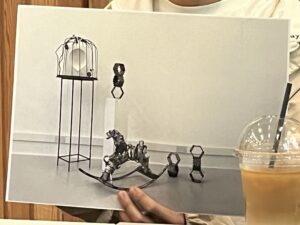
A person holds a printed photograph showing a metal sculpture installation in a studio space, with several small sculptural forms arranged on the floor and a tall stand at the left.

CAP classmate (name withheld), documentation image of a metal sculpture installation shared during an in-class session, ECA Main Building, Thursday, 12 February 2026. Photograph by the author.

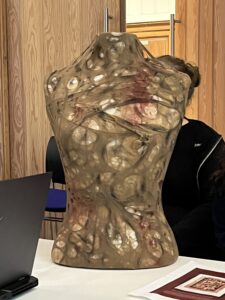
A torso-shaped sculpture sits on a table in a classroom setting, covered with layered textures and embedded circular forms, with wood-paneled doors and seated students in the background.

CAP classmate (name withheld), torso-shaped sculpture brought for an in-class sharing session, ECA Main Building, Thursday, 12 February 2026. Photograph by the author.

A printed presentation board on a desk displays multiple artwork images, sketches, and short texts arranged in a grid layout, photographed in a classroom environment.

CAP classmate (name withheld), printed presentation board combining artwork images, sketches, and short texts, shared during an in-class session, ECA Main Building, Thursday, 12 February 2026. Photograph by the author.

2) Collective and course learning: keeping it not-for-profit and realistic

Tutor guidance this week reinforced that our projects sit within not-for-profit curating and UK arts contexts, not commercial models. The Summerhall field trip and Sam Chapman’s talk also made the practical side feel real: production decisions, equipment, installation time, staffing, and audience movement shape what a project becomes. This encourages me to keep the project modest and achievable, and to consider 3D media as one realistic option (screening fees, lighter transport needs), while still staying conceptually focused. I will use Metasteps to create a virtual space to display the art works I want to display, I am still considering the selection of artists.

3) Developing the project within Jì Jū (寄居)

In our Jì Jū collective chats, I’ve started to be more careful with the idea of “cultural background.” It shouldn’t just be a label we stick on someone, and it also shouldn’t turn into something audiences “consume” because it feels exotic. Our manifesto keeps bringing me back to a few practical points: be aware of where we’re speaking from, try to represent people fairly, be clear about money and funding, and respect artists’ labour. So if I curate a project about personal experience and cultural background, I need to think more carefully about who gets to speak, who gets seen, who might be misunderstood, and how the work and effort behind each piece is properly acknowledged.


Notes:

All photographs were taken by the author. The artworks shown were brought and presented by MA Contemporary Art Practice (CAP) classmates during an in-class sharing session, and are used here as documentary material for curatorial reflection.


Week 4 |Seeing Art Outside the White Cube

1) My individual curatorial project

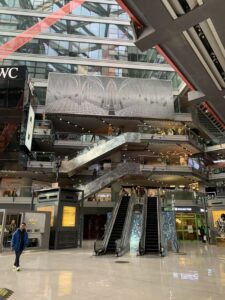
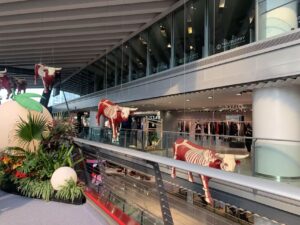
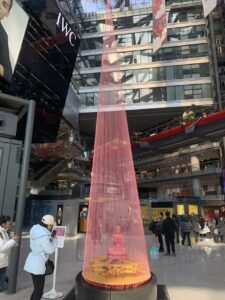
This week, I started to define my individual curatorial project in a more concrete way. Instead of thinking about exhibitions in an abstract sense, I am focusing on how curating can happen in everyday commercial spaces. In 2023 and 2024, I visited Parkview Green in Beijing several times. What stayed with me was how artworks were placed throughout the entire building, in corridors, atriums, and shared public areas, rather than inside a single gallery space. Walking through the building felt similar to walking through an exhibition, even though I was technically in a shopping mall.


Julia Halperin once mentioned in Food courts and pharmacies are Basel’s hottest new art spaces, Curator Stefanie Hessler once mentioned “By bringing art inside local businesses, “I hope it doesn’t feel like art tourism only,” she says. Perhaps a student will unexpectedly encounter Piotrowska’s photographs on a shopping trip and become inspired to pop inside the vacant pharmacy nearby to view works by the French artist Pol Taburet.”

This experience changed my understanding of what an exhibition can be. It made me realise that seeing art does not always need a formal setting or specialised knowledge. People encountered artworks naturally while shopping, meeting friends, or passing through the space. For me, this raised the question of how curating might work in places where people are not intentionally looking for art.

Artworks distributed across multiple levels of Parkview Green, creating a continuous exhibition-like experience within a commercial environment.

Artworks installed within the atrium of Parkview Green, integrated into the circulation space of a commercial complex.

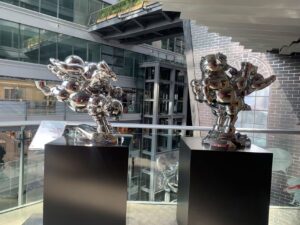
Contemporary artwork positioned within the open public space of Parkview Green, visible to visitors passing through the mall.

View of an installation placed in a shared seating area within Parkview Green, blending art with everyday activities.

2) Reflection through collective discussion

Talking about this experience within the Jì Jū (寄居) Collective helped me look at it more carefully. While Parkview Green feels open and welcoming, it is still a commercial space with its own rules and priorities. Our discussions about ethics and responsibility made me think about who really feels comfortable in these spaces, and who might still feel excluded, even if the art appears accessible.


The idea of “living away from home,” which shapes our collective identity, also connects to this context. As curators, we are not fully “at home” in commercial spaces, and neither are the artworks. They are placed there temporarily and have to adapt to existing conditions. This perspective encourages me to think about curating as something careful and responsive, rather than something that takes over a space.

3) How I Would Curate in a Commercial Space

If I were to curate a project in a commercial space, I would start small and work with what already exists. Instead of transforming the space, I would observe how people move through it, where they stop, and which areas feel more relaxed or more controlled. Based on this, I would introduce subtle interventions, such as short texts, small artworks, or sound elements that do not demand attention but invite curiosity.


I would avoid assuming that everyone wants to participate actively. The project would allow people to engage briefly, casually, or not at all. Practical considerations would be central to the project: permission from management, clarity around funding, respect for workers in the space, and transparency about who is organising the project. Rather than treating the space as a gallery, I would treat it as a shared environment where art exists alongside everyday activities.


Notes

1.All photographs reproduced here were taken by the author at Parkview Green (侨福芳草地), Beijing, during visits in 2023 and 2024, and are used as documentary material to support curatorial analysis.

2.”Food courts and pharmacies are Basel’s hottest new art spaces,” Julia Halperin, accessed February 08, 2025, dd37ae39-04b6-4719-9611-66b09c8614d0


Week 3|From Ideas to Decisions

1.A Shift from Conceptual Framing to Operational Thinking

This week marked a decisive shift in my curatorial approach, moving from conceptual framing towards operational thinking. While I did not conduct fieldwork, James Clegg’s workshop functioned as a form of situated knowledge production, grounding earlier theoretical discussions in the realities of curatorial practice. Rather than introducing entirely new ideas, the session reframed existing concerns, such as publicness, institutional context, and visibility, through the lens of decision-making.


.  


2.Curating as Negotiation Rather Than Pure Concept

What became evident is that curating does not operate as a linear translation of theory into form. Instead, it is a process of negotiation shaped by constraints. This perspective helps clarify that curatorial work is not about preserving conceptual purity, but about continuously recalibrating intentions in response to practical limitations.

In Clegg’s presentation, issues such as budget, collaboration, and institutional conditions were not secondary concerns, but central structuring forces. In this sense, curating becomes a process of managing tensions between idea and feasibility, authorship and collaboration, and intention and outcome.


3.From Idea to Process: Repositioning My Project

This has prompted me to rethink my own project development. Previously, I focused on defining conceptual questions around public and semi-public space. However, this approach now appears incomplete without considering the processes through which these ideas are enacted.

I have begun to shift towards a process-oriented framework: identifying potential formats, mapping stakeholders, and anticipating negotiations with institutions or site authorities. This aligns with the understanding that “publicness” is not a fixed condition, but something that is actively constructed through spatial, economic, and social constraints.

This shift also begins to inform my work within the collective, where curatorial decisions are inherently collaborative and contingent. Rather than approaching the project as an individual conceptual exercise, I now see it as a situated practice shaped through interaction and negotiation.

4.Towards a Situated Curatorial Method

Moving forward, my focus will be on translating these reflections into concrete steps. This includes identifying a feasible site and testing how curatorial ideas operate within real constraints. Rather than finalising a concept prematurely, I aim to allow practical conditions to shape the project actively.

In this sense, curating becomes not the execution of a fixed idea, but an iterative method, one that produces meaning through the dynamic interplay between concept and context.


Week 2 |Mapping Curatorial Infrastructures and Collective Agency

1.From Scale to Infrastructure

Building on Week 1’s attention to institutional scale, this week I reframed “scale” as an infrastructural condition rather than a purely spatial or visual attribute. Terry Smith’s account of the Visual Arts Exhibitionary Complex (VAEC) is helpful because it maps contemporary curating across interrelated contexts and platforms, where exhibitions circulate through institutions, networks, and publics rather than being contained within a single site.This led me to shift my question from “the difference in size” to: how curatorial authority and publicness are distributed and constructed at different nodes in the exhibition ecosystem.

2.Field Note: Visiting RSA200 at The Mound

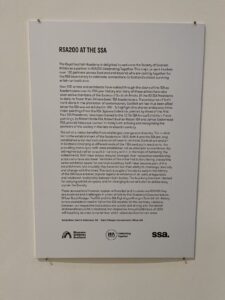
On Saturday, I visited the SSA 127th Annual Exhibition with my classmates at The Mound, within the National Galleries of Scotland and Royal Scottish Academy (RSA) complex. In the RSA Upper Galleries, the exhibition is explicitly positioned as part of RSA200: Celebrating Together and is framed as a “historic partnership.”A wall text titled “RSA200 at the SSA” foregrounds institutional longevity and collaboration, and the SSA webpage similarly emphasises shared history by referencing works from the RSA collection and an accompanying commissioned essay. Experiencing this framing on site made “publicness” feel less like a neutral attribute of a national cultural location and more like a curated claim produced through institutional partnership, heritage narratives, and the governance of shared space.


All photographs reproduced in this text are author’s photographs, taken during exhibition visits on January 24, 2026.


3. Collective Action as Method 

This visit connected directly to the week’s reading on collective action, which outlines how collective formations recur as operational responses to institutional norms of authorship and to political urgency. In this context, “artist-run” can be read not only as an identity descriptor but as a working method thlics are addressed, how resources circulate, and how agency is distributed across institutional frameworks.


Notes

1. “Mapping the Contexts of Contemporary Curating: The Visual Arts Exhibitionary Complex,” Terry Smith,accessed January 25, 2026,https://discovered.ed.ac.uk/permalink/44UOE_INST/1viuo5v/cdi_crossref_citationtrail_10_1386_jcs_6_2_170_1
2.https://elephant.art/brief-history-collective-action/ ,accessed January 25, 2026


Week 1|Curatorial Orientation: Scale, Publicness, and Philosophical Frameworks

1.Exhibition Scale as a Curatorial Condition


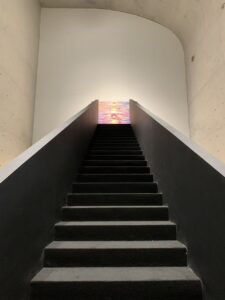
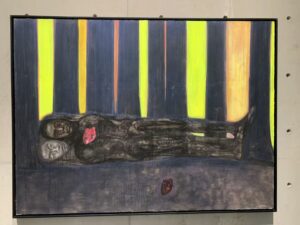
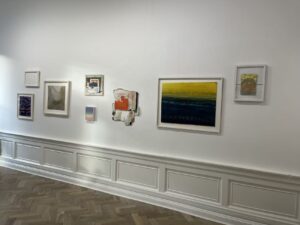
Over the past few years, I have encountered exhibitions operating at radically different institutional scales, ranging from Huang Yuxing’s solo exhibition Under the Vault of Heaven at Long Museum West Bund to the materially modest and process-oriented exhibition paper trails at & gallery. These encounters prompted me to reflect not on artistic style, but on how curatorial authority, meaning, and spectatorship are constructed through scale, space, and institutional context.


At the end of the long, black staircase stands a contemporary artwork by Huang Yuxing, its colors vibrant and varied. Huang Yuxing's contemporary artwork hangs on the hollow cement wall; the work depicts two black human figures lying sideways in an embrace.


Figure 1. Installation view of Huang Yuxing: Under the Vault of Heaven, Long Museum West Bund, Shanghai, 2023. Photograph by the author.
Figure 2. Installation view of Huang Yuxing: Under the Vault of Heaven, Long Museum West Bund, Shanghai, 2023. Photograph by the author.
Website: http://www.thelongmuseum.org/en/exhibition-369/detail-1847.html

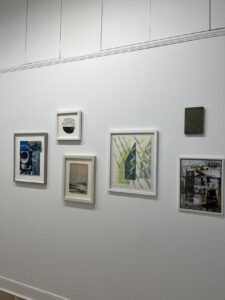
Several contemporary paper art pieces are hanging on a white wall.Several contemporary paper art pieces are hanging on a white wall.

Figure 3. Installation view of paper trails, &Gallery, Edinburgh, 2026. Photograph by the author.
Figure 4. Installation view of paper trails, &Gallery, Edinburgh, 2026. Photograph by the author.
Website: https://andgallery.co.uk/exhibitions/121-paper-trails/overview/


2.Micro-Curating and Centre–Periphery Relations


This awareness of scale is reinforced by the course readings. Micro-Curating: The Role of SVAOs (Small Visual Arts Organisations) highlights the historical importance of small organisations as sites of experimentation, flexibility, and local engagement within exhibition-making. These organisations complicate assumptions that innovation primarily emerges from large institutions.

Similarly, the editorial Centres / Peripheries – Complex Constellations challenges fixed hierarchies within curatorial discourse, proposing centre and periphery as relational and context-dependent positions rather than stable categories. In contrast, On Curating presents reflections by internationally established curators working within biennials and major institutions, revealing a pragmatic engagement with scale, visibility, and institutional constraints. Taken together, these texts suggest that curatorial practice is shaped less by scale itself than by the conditions under which exhibitions are produced.


3.Public Space, Curating, and Governance


My interest in curating in public and semi-public spaces is closely related to my personal experience. Because the family is engaged in real estate-related work, I observed how works of art are incorporated into architectural and urban development projects, playing a role between aesthetic presentation, public visibility and economic logic. This experience prompted me to rethink that public space does not exist naturally, but is continuously produced through curatorial, design and management.

This concern resonates with philosophical approaches to space and governance. Michel Foucault’s analysis of spatial organisation highlights how power operates through visibility and circulation rather than direct control. Giorgio Agamben’s writing on the state of exception further complicates this by examining how inclusion and exclusion are structured within public space.These ideas provide me with a perspective for understanding curatorial practice, allowing it to be viewed not only as a cultural intermediary but also as a practice of participating in spatial governance.


4. Personal Background and  Research Direction

I completed my undergraduate studies in Qufu, a place closely associated with Confucianism, which sparked my ongoing interest in how spatial order, ritual practices, and ethical structures shape collective experience. This has influenced my curatorial approach, which aims to juxtapose contemporary art with Chinese philosophical traditions and Western critical theory.

At this stage, I am not attempting to provide definitive conclusions, but rather viewing curating as an open research process. I am concerned with how curatorial practice can maintain its criticality across different institutional scales, and how publicness can be negotiated and reconstructed within economic and spatial constraints. These questions will continue to guide my research and practice in my coursework.

Notes

Huang Yuxing: Under the Vault of Heaven, curated by Lu Mingjun, exhibition held October 26, 2023–January 1, 2024, Long Museum West Bund, Shanghai.
paper trails, exhibition held January 10–31, 2026, &Gallery, Edinburgh.
Bilbao Yarto, Ana Edurne. Micro-Curating:The Role of SVAOs (Small Visual Arts Organisations) in the History of Exhibition-Making. 2018.
Thea, Carolee, and Thomas Micchelli. On Curating : Interviews with Ten International Curators. First edition. New York, N.Y: D.A.P./Distributed Art Publishers, 2009.
Ronald Kolb, Eva Krivanek, Camille Regli, and Dorothee Richter, “Centres ⁄ Peripheries – Complex Constellations,” Notes on Curating, no. 41 (June 2019): 3–11.
Foucault, Michel, and Jay Miskowiec. “Of Other Spaces.” Diacritics 16, no. 1 (1986): 22–27. https://doi.org/10.2307/464648.
Agamben, Giorgio, and Kevin Attell. State of Exception. 1st ed. Chicago: University of Chicago Press, 2005. https://doi.org/10.7208/9780226009261.