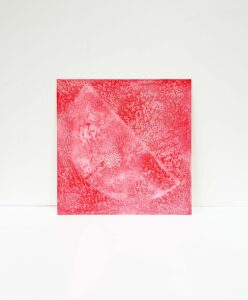
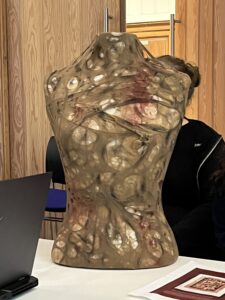
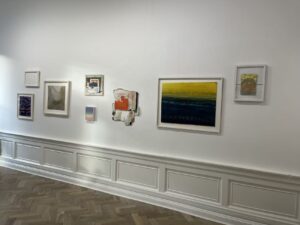
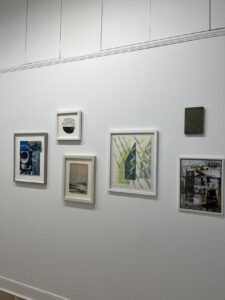
Critical reflection

1.Introduction: From Looking to Perceiving

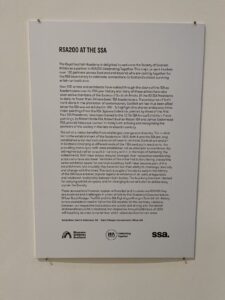
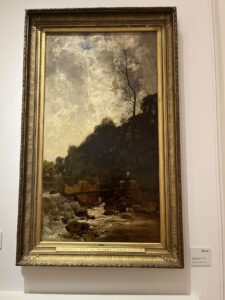
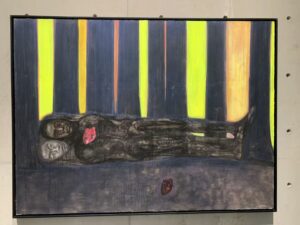
At the beginning of this semester, my understanding of the countermeasure exhibition is mainly at the level of visual arrangement: selecting works, placing them in space, and creating meaning through sorting. This assumption began to shift during a visit to the SSA 127th Annual Exhibition at the Royal Scottish Academy, where I noticed that the institutional scale of the space did not automatically produce a stronger experience for the viewer.

As Terry Smith argues, Contemporary curatorial practice is no longer limited to the institutional framework of museums, and no longer strictly distinguishes between curatorial work with collection and protection as the core and simple exhibition production. On the contrary, the connotation of curation has been extended to a variety of practical forms, including project planning in different alternative spaces and associated with experimental art space.1

This observation reminds me of a more fundamental question: what kind of experience can the exhibition bring to visitors?

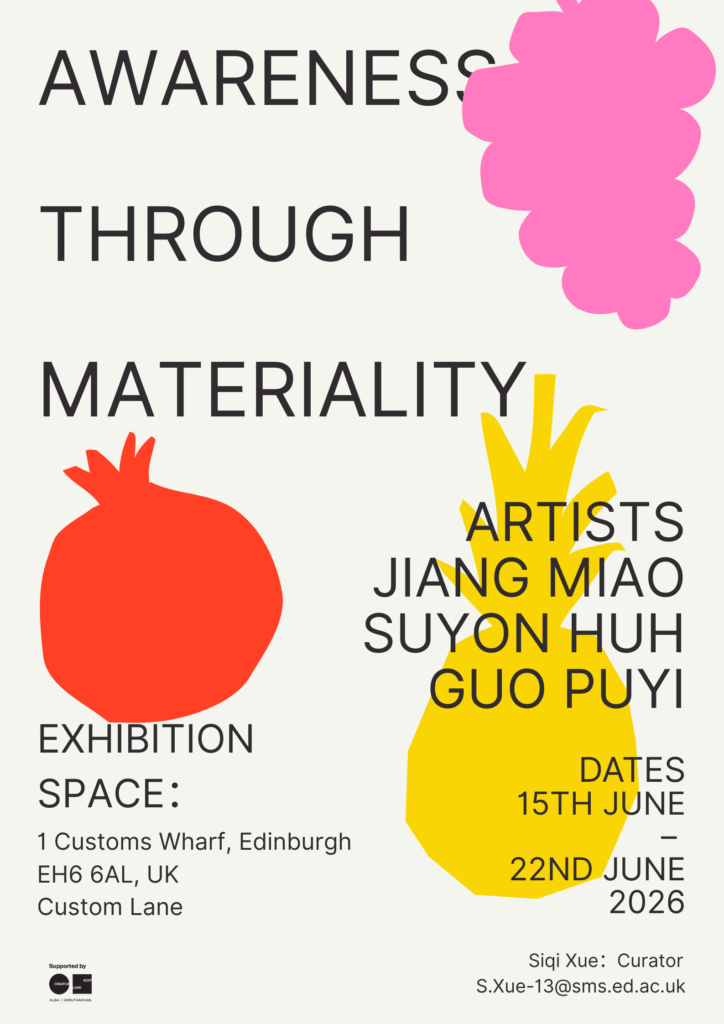
This reflective essay examines two curatorial projects developed this semester. The first is Our Shell, a group exhibition presented at Summerhall, Edinburgh, produced collaboratively by the Ji Ju Collective. The second is Awareness Through Materiality, an individual curatorial proposal for a group show at Custom Lane, Edinburgh, centring on works by Jiang Miao, Suyon Huh, and Guo Puyi.

These two projects together make me realize that curation is not a visual perception, but a physical practice: it focuses on how space, time and materials shape the attention and senses of visitors.


2.The Collective Shell: Curating as Spatial Habitation

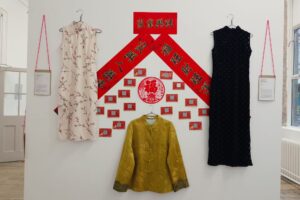
The Ji Ju Collective takes its name from the Chinese concept of Ji Ju (寄居), which describes the condition of living away from one’s original home, in a space that belongs to someone else. This condition shaped every decision in Our Shell, from the choice of title to the spatial arrangement of works inside the Summerhall gallery room.

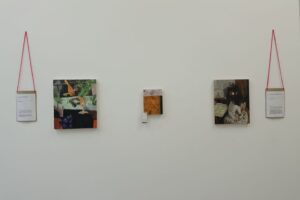
The exhibition brings together the paintings, textiles and mixed media works of the collective members, and physically connects them through the red line that runs through the entire exhibition hall. The red line is a low-cost material device, but its function is spatial and relational: it makes the distance between the works visible and crossable.

Gaston Bachelard’s writing on the poetics of intimate space offers a useful framework for reflecting on what the collective attempted.

Bachelard argues :“With nests and, above all, shells, we shall find a whole series of images that I am going to try to characterize as primal images; images that bring out the primitiveness in us. I shall then show that a human being likes to “withdraw into his corner,” and that it gives him physical pleasure to do so.” 2

The shell, for Bachelard,  is not a fixed residence, but movable. It moves with the creatures that carry it. Our Shell drew on this logic directly. Ji Ju Collective temporarily built a gallery to fill the space with items from the members’ respective cultural backgrounds, and connect these items through red lines to create a collective atmosphere. However, the curation process is not smooth sailing, and team members need to weigh between their personal artistic style and the coherence of the common theme to decide which works to be exhibited.

Jean-Paul Martinon describes this tension as intrinsic to all curatorial work: exhibitions always give the impression of cohesion when in fact what is displayed is the result of compromises, concessions, and trade-offs between contributing parties.3

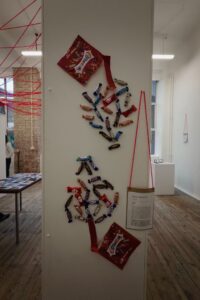
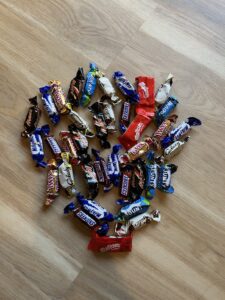
The candy installation Sweetness Within the Shell, which I contributed to the exhibition, added another layer of reflection. Visitors can use the shell-shaped candies on the wall at will. As they use candy, the shape of the shell will gradually change and eventually disappear.

Sandra Umathum notes:“Instead, these installations put into perspective the traditional subject-object relation. They divert attention away from themselves and share it with, or distribute it to, the inter-subjective encounters taking place at their edges.”4

This candy work fits this logic, but also complicates it. The access behavior introduces the concept of absence, and the slow disappearance of the placed object shows the time in a way that static objects cannot reach. This shows that the exhibition is not only a space to stay, but also a place that changes in the process of use.


3.Curating Attention: Material Friction and the Slowing of Time

The curatorial concept for Awareness Through Materiality grew from a concern with how attention operates under conditions of urban acceleration.

Hartmut Rosa points out that the widespread perception of time scarcity and the accelerated pace of social life in modern society cannot be fully explained by objective or quantifiable definitions alone, but should be understood as a complex socio-psychological phenomenon influenced by cultural factors. Against this background, the exhibition proposes a different model of perceptual art: in this mode, the material is slow and durable, and requires continuous viewing. The three artists selected for Awareness Through Materiality each work with materials that resist quick reading.

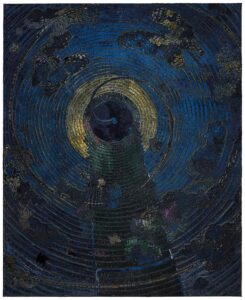
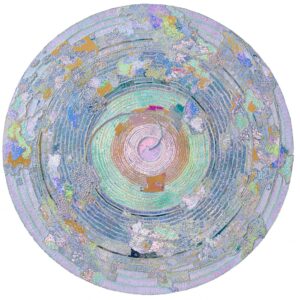
Jiang Miao repeatedly smeared acrylic paint on aluminum plates and wooden boards and painted them. In order to understand the content of the work, the viewer must approach the work, adjust the angle, and take time to observe it carefully. This does not invite the audience to view images in the traditional way, but requires the audience to pay attention to the physical surface of the object.

Tim Ingold describes:“Whenever we read that in the making of artefacts, practitioners impose forms internal to the mind upon a material world ‘out there’, hylomorphism is at work.”6 The surface of the artworks portrayed by Jiang Miao retains the evidence of this process, while the curation arranges the artworks in a way that allows the audience to enter the slow perception.

Suyon Huh works with paper pulp, hanji, rope, and string to build installations that are visually delicate but spatially tense. In Phone Phobia, the telephone is fixed by pulp and wire rope in a frame composed of wooden pillars, and its configuration makes the tension of the whole structure visible.

Jane Bennett suggests that materiality possesses its own vitality, not as something animated from outside, but as an active force that disrupts the idea of matter as inert and passive.7 In this work, the rope is tightened, the pulp is glued, and the wooden frame is fixed. This structure highlights the power rather than the form. The device does not express tension, but embodys the tension, which can make the viewer truly perceive how the matter itself exerts its power.

Juhani Pallasmaa argues :“However, the privileging of sight does not necessarily imply a rejection of the other senses, as the haptic sensibility, materiality and authoritative weight of Greek architecture prove; the eye invites and stimulates muscular and tactile sensations.”

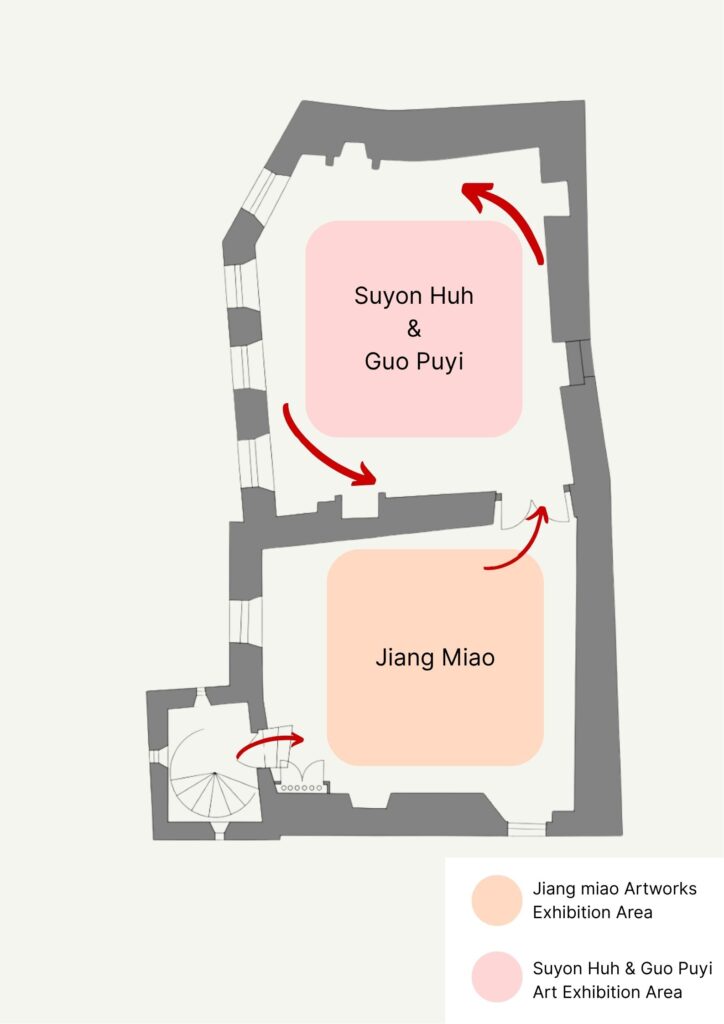
This argument shaped the sequencing decision in Awareness: Jiang’s surfaces come first, demanding closeness and time; Huh’s tension-based works follow; and Guo Puyi’s modular installations close the exhibition. Each part prepares for the next part by adjusting the rhythm of the audience’s movement in space.


4. Decentring the Viewer: Object Agency and Spatial Reorientation

The third section of Awareness was designed around the work of Guo Puyi, whose practice sits at the intersection of sculpture and what Lambros Malafouris describes as MET: an approach in which understanding emerges through direct interaction with materials rather than through detached analysis. 9

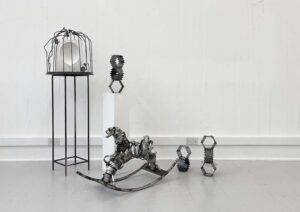
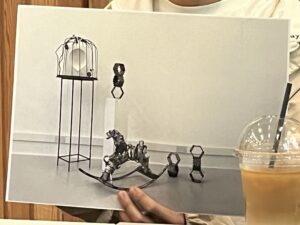
A cage that holds nothing, a rocking horse made from iron that cannot be ridden: these objects perform their expected forms while refusing their expected uses. At the same time, these elements evoke associations with family life, games and restraint, but they cannot be fixed by a single interpretation.

As Bill Brown suggests, things are not simply objects, but emerge through a shift in the relationship between subject and object.10

The meaning of the work comes from the movement of the viewer around the work. Through changes in scale, balance and distance, the work reveals the interdependence or confrontation between various components.

Alfred Gell argues that the agency attributed to artworks is inherently social and relational: art objects do not act as autonomous agents, but acquire a form of secondary agency through their entanglement with human actors and specific social contexts.11

Guo’s installations work in this way. The arrangement of cages, rocking horses and steel geometry creates a situation in which the viewer must explore the relationship between these objects by himself, rather than accepting the pre-set interpretation. This active identification process itself is a concern.

Miwon Kwon argues that modernist conceptions of neutral, idealised space were displaced by an understanding of art as situated within real, everyday environments, where works are experienced through the viewer’s embodied presence in space and time rather than through detached visual perception.12

In summary, this reflects the transformation of curatorial mode from watching to spatial participation. The audience is no longer a bystander who is out of the matter, but a participant who is constantly affected by material relationships through physical movement, perception and judgment. Therefore, the exhibition no longer provides the established meaning, but builds an interactive field in which things, space and the audience create experiences together.

5.Embodied Encounters: The Physicality of Curation

Changing from a passive observer to an active participant requires a deeper understanding of phenomenology in the context of the gallery.

Maurice Merleau-Ponty established that the body and the senses reveal a form of collective existence in which embodied subjectivity, while remaining singular and situated, extends beyond itself to generate meanings that structure perception, thought, and experience.13 In my project, this means not to regard the gallery as a container of images, but as a place where matter and consciousness meet.

In Our Shell, the red line acted as a haptic guide, forcing the body to navigate the space in relation to the distance between objects.

Claire Bishop argues that contemporary participatory art reconfigures artistic production: the artist is no longer understood as a sole maker of discrete objects but as a collaborator who produces situations, the artwork shifts from a bounded and commodifiable object to an open-ended process, and the audience is repositioned from passive viewer to active co-producer.14

Similarly, in Awareness Through Materiality, the sequencing of Jiang Miao’s works can be understood through David Freedberg and Vittorio Gallese’s theory of embodied simulation, the theory believes that aesthetic perception triggers the viewer’s automatic physical reaction, especially the perception of action, stress or potential movement in the work, thus producing simulated resonance at the physical level.15

6.Curatorial Sites as Social Assemblages

The experience of planning these two exhibitions made me realize that exhibitions are never neutral; they are a collection of human and non-human participants.

Bruno Latour argues that the social should not be understood as a fixed domain, but as a set of shifting associations, in which relations are continuously reconfigured through changing connections and arrangements.16

In this sense, curatorial practice can be understood as an assembly structure, in which space, materials, curatorial decision-making and the audience jointly produce meaning.

However, looking back at my two projects from this theory also reveals the problems in them.

Graham Harman argues that art does not simply strip away an object’s contingent qualities to reveal its essence; rather, it actively brings the viewer and the aesthetic object into relation, producing a new, composite entity.17

In Our Shell, the red thread was intended to connect works and symbolise collective inhabitation.However, by trying to plan a sense of intimacy, am I inadvertently ignoring the artist’s personal emotions just to pursue a unified narrative?

In addition, using familiar items to evoke a sense of common home may simplify the complex life experience.Sara Ahmed argues:“The work of inhabitance involves orientation devices; ways of extending bodies into spaces that create new folds, or new contours of what we could call livable or inhabitable space. ”18

In Awareness Through Materiality, the rhythm of viewing is slowed down through the slowness of materials, but this strategy also has limitations.

As Nicholas Mirzoeff argues:“The right to look claims autonomy from this authority, refuses to be segregated, and spontaneously invents new forms. ” 19 Therefore, the expectation of long-term viewing may exclude audiences who are not familiar with such perceptions.

At the same time, the emphasis on materiality may also weaken the diversity of interpretation.

Rancière cautions that the impulse to draw spectators out of passivity and into active participation can itself become a form of imposition: the assumption that viewers require a carefully constructed situation in order to know what to do, or how to feel, reproduces the very hierarchy it claims to dismantle.20

Reflecting on Awareness Through Materiality, this tension becomes difficult to ignore. By constructing deliberate material progression in space, I assume that a specific sequence is necessary, which can guide the audience to a slower and more focused perception.

7.Conclusion: The Exhibition as a Living Ecology

This semester has shifted my understanding of curating from the organisation of objects toward the orchestration of attention. The two projects discussed in this article discuss this topic from different perspectives.

Our Shell worked through collective inhabitation, using familiar objects, red thread, and shared process to transform an institutional gallery into a temporary home.

Awareness Through Materiality resistance and spatial sequencing, proposing an exhibition in which slowing down is not a request made of the visitor but a condition built into the encounter with the works themselves. The project arouses people’s consciousness through material resistance and spatial sequence, aiming to create an exhibition that allows visitors to slow down. This is not a requirement for visitors, but an inherent condition when encountering the work itself.

Brian O’Doherty’s analysis of the gallery space remains relevant here. O’Doherty argues:“The eye is abstracted from an anchored body and projected as a miniature proxy into the picture to inhabit and test the articulations of its space. ”21

Here, works of art are no longer passive objects waiting to be examined, space is no longer a silent background, and the audience is no longer a bystander who passes by in a hurry. Objects, space and people, through collision, friction and stay, weave a continuous flow and vibrant life experience.


Notes:


1. Terry Smith, Thinking Contemporary Curating (La Vergne: Independent Curators International, 2012), 2.

2. Gaston Bachelard, The Poetics of Space, trans. M. Jolas, foreword by Mark Z. Danielewski, introduction by Richard Kearney (New York: Penguin Books, 2015), 118–119.

3. Jean-Paul Martinon, Curating as Ethics (Minneapolis: University of Minnesota Press, 2020), xxii.

4. Sandra Umathum, “Given the Felix Gonzalez-Torres’s Case: The Art of Placing a Different Idea of Participation at Our Disposal,” Performance Research 16, no. 3 (2011): 97.

5. Hartmut Rosa, “What Is Social Acceleration?” in Social Acceleration: A New Theory of Modernity (New York: Columbia University Press, 2013), 80.

6. Tim Ingold, Making: Anthropology, Archaeology, Art and Architecture (London: Routledge, 2013), 4.

7. Jane Bennett, “Preface,” in Vibrant Matter: A Political Ecology of Things (Durham: Duke University Press, 2010), xiii.

8. Juhani Pallasmaa, The Eyes of the Skin: Architecture and the Senses, 4th ed. (Hoboken, NJ: Wiley, 2025), 20.

9. Lambros Malafouris, How Things Shape the Mind: A Theory of Material Engagement (Cambridge, MA: MIT Press, 2013), 43–44.

10. Bill Brown, “Thing Theory,” Critical Inquiry 28, no. 1 (2001): 4.

11. Alfred Gell, Art and Agency: An Anthropological Theory (Oxford: Clarendon Press, 2023), 17.

12. Miwon Kwon, One Place after Another: Site-Specific Art and Locational Identity (Cambridge, MA: MIT Press, 2002), 11.

13. Maurice Merleau-Ponty, Phenomenology of Perception (London: Routledge, 2002), 146.

14. Claire Bishop, Artificial Hells: Participatory Art and the Politics of Spectatorship (London: Verso, 2012), 21–22.

15. David Freedberg and Vittorio Gallese, “Motion, Emotion and Empathy in Esthetic Experience,” Trends in Cognitive Sciences 11, no. 5 (2007): 201.

16. Bruno Latour, Reassembling the Social: An Introduction to Actor-Network-Theory (Oxford: Oxford University Press, 2005), 73–74.

17. Graham Harman, Object-Oriented Ontology: A New Theory of Everything (London: Pelican Books, 2019), 33–34.

18. Sara Ahmed, Queer Phenomenology: Orientations, Objects, Others (Durham: Duke University Press, 2008), 11.

19. Nicholas Mirzoeff, The Right to Look: A Counterhistory of Visuality (Durham, NC: Duke University Press, 2011), 4.

20. Jacques Rancière, The Emancipated Spectator, trans. Gregory Elliott (London: Verso, 2012), 5.

21. Brian O’Doherty, “Notes on the Gallery Space,” in Inside the White Cube: The Ideology of the Gallery Space, expanded ed., ed. Brian O’Doherty and Thomas McEvilley (Berkeley: University of California Press, 2000), 18.


Bibliography

Ahmed, Sara. Queer Phenomenology : Orientations, Objects, Others. Durham: Duke University Press, 2006.

Bennett, Jane. Vibrant Matter : A Political Ecology of Things. Durham, [N.C: Duke University Press, 2010.

Bishop, Claire. Artificial Hells : Participatory Art and the Politics of Spectatorship. London: Verso, 2012.

Brown, Bill. “Thing Theory.” Critical Inquiry (CHICAGO) 28, no. 1 (October 2001): 1–22. https://doi.org/10.1086/449030.

Freedberg, David, and Vittorio Gallese. “Motion, Emotion and Empathy in Esthetic Experience.” Trends in Cognitive Sciences (LONDON) 11, no. 5 (May 2007): 197–203. https://doi.org/10.1016/j.tics.2007.02.003.

Gell, Alfred. Art and Agency : An Anthropological Theory. Oxford: Clarendon, 2023. https://doi.org/10.1093/oso/9780198280132.001.0001.

Harman, Graham. Object-Oriented Ontology : A New Theory of Everything. London: Pelican Books, 2019. https://www.vlebooks.com/product/openreader?id=Edinburgh&accId=9137656&isbn=9780241269176.

Ingold, Tim. Making : Anthropology, Archaeology, Art and Architecture. London ; Routledge, 2013.

Kwon, Miwon. One Place after Another : Site-Specific Art and Locational Identity. Cambridge, Mass. ; MIT Press, 2002.

Latour, Bruno. Reassembling the Social : An Introduction to Actor-Network-Theory. Oxford: Oxford University Press, 2005.

Malafouris, Lambros. How Things Shape the Mind : A Theory of Material Engagement. Cambridge, Massachusetts: The MIT Press, 2017.

Martinon, Jean-Paul. Curating as Ethics. Minneapolis, Minnesota ; University of Minnesota Press, 2020.

Merleau-Ponty, Maurice. Phenomenology of Perception. London: Routledge Classics, 2002. http://www.vlebooks.com/vleweb/product/openreader?id=Edinburgh&isbn=9780203994610.

Mirzoeff, Nicholas. The Right to Look : A Counterhistory of Visuality. Durham, N.C: Duke University Press, 2011.

O’Doherty, Brian. Inside the White Cube : The Ideology of the Gallery Space. Expanded edition. Berkeley ; University of California Press, 2000.

Pallasmaa, Juhani. The Eyes of the Skin : Architecture and the Senses. Fourth edition. Hoboken, NJ: Wiley, 2025. https://doi.org/10.1002/9781394200702.

Rancière, Jacques, and Gregory Elliott. The Emancipated Spectator. London: Verso, 2012.

Rosa, Hartmut, and Jonathan Trejo-Mathys. Social Acceleration : A New Theory of Modernity. New York, NY: Columbia University Press, 2013. https://doi.org/10.7312/rosa14834.

Smith, Terry, and Independent Curators International. Thinking Contemporary Curating. New York: Independent Curators International, 2013.

Umathum, Sandra. “Given the Felix Gonzalez-Torres’s Case: The Art of Placing a Different Idea of Participation at Our Disposal.” Performance Research (ABINGDON) 16, no. 3 (September 2011): 94–98. https://doi.org/10.1080/13528165.2011.606032.
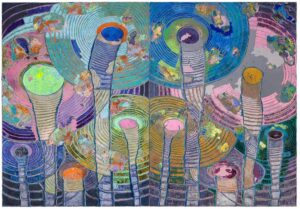


Curatorial Project Summary


AWARENESS THROUGH MATERIALITY

Custom Lane, Edinburgh, UK

June 15-22, 2026


1. Curatorial Narrative:

In contemporary urban life in pursuit of efficiency, matter is often simplified into functional tools. The materiality of perception in this exhibition refuses to regard perception as abstract psychological comfort, and reshapes it into a concrete viewing practice. By considering everyday materials as weighted existences, we explore how the way we treat material things projects our attitude towards ourselves and others.

The exhibition guides bodily pacing through three stages: companionship, friction, and decentring.The exhibition guides bodily pacing through three stages: companionship, friction, and decentring. Jiang Miao carves acrylic layers on aluminum panels; these traces act as quiet companions, prompting viewers to slow down through touch and breath. Following this, Suyon Huh constructs a physical field using pulp and ropes, materializing invisible anxiety into visible spatial pulling forces that break daily comfort through resistance. Finally, Guo Puyi utilizes fallen leaves and steel modules to reorganize visual logic, diverting attention from human-centered urgency and prompting us to reposition ourselves within a broader material network.

Materials should not be isolated from the institutional distance, but should accompany the audience in daily life. The exhibition was chosen to be held in Custom Lane, a community creative space, aiming to make natural encounters the beginning of perception.


2. Artists and selected works
A) Jiang Miao

Born in Jilin in 1981, China, Jiang Miao specialises in contemporary Woodblock Printmaking. She graduated from the Central Academy of Fine Arts in Beijing with a bachelor’s and master’s degree in Printmaking. Now she is Teaching at Central Academy of Fine Arts. Drawing from her background in fine arts painting and academic exploration of various genres, such as realism and woodprint, Jiang Miao has developed her distinct artistic style through years of experimenting with different creative techniques.
 

A very large aluminium-panel painting with acrylic layers and carved marks; the surface shows cut lines and reflective shifts under light.

Figure 1. Mindfulness 20241205, Jiang Miao, 2024. Acrylic on aluminium panel, carving. 250.0 × 400.0 cm.

A mid-sized aluminium-panel work with dense colour layers; carved and scraped lines create rhythmic grooves and edges across the surface.

Figure 2. Mindfulness 2024.5.5, Jiang Miao, 2024. Acrylic on aluminium panel, carving. 160.0 × 130.0 cm.

A circular wooden-board work with acrylic layers carved into concentric or spiral structures, forming ring-like organisation similar to map or terrain textures.

Figure 3.Taoist Trinity and the Self 2023.10.22, Jiang Miao, 2023. Acrylic on wooden board, carving. Diameter 217 cm.


B) Suyon Huh

Born in 1993 in Seoul, South Korea. She is an artist currently living and working in Seoul. Her works materialize everyday fears, absences, and fictitious orders into tangible material systems: papier-mâché, string, thread, Korean paper, watercolor, and oil painting overlays. They look light, but actually form a pulled structure in the space, causing the audience to experience physical tension and self-projection. She is responsible for the transition between the second and third sections of the exhibition: from being soothed to being pulled back to reality.


A large work on paper with layered, garden-like textures; watercolour and oil marks are visible, with raised paper-pulp areas creating uneven relief.

Figure 4. Garden in Reality, Suyon Huh, 2023. Watercolour, oil paint, and paper pulp on hanji. 200 × 180 cm.

Several paper-pulp and hanji structures are linked by ropes and ribbons that hang and pull across space, forming an expandable installation.

Figure 5. The Perfect Society in Absence, Suyon Huh, 2023. Paper pulp, hanji, rope, ribbon. Dimensions variable.

An installation on a wooden frame with a telephone at the centre, surrounded by string and paper-pulp forms with a gritty, sand-like surface, placed on the gallery floor.

Figure 6. Phone Phobia, Suyon Huh, 2023. Wooden frame, telephone, paper pulp, string, sand. 69 × 69 × 116 cm.


C) Guo Puyi

Born in 2002, from Fujian, China. He is currently pursuing a master’s degree in Contemporary Art Practice at the University of Edinburgh and lives and works in Edinburgh. Guo Puyi is responsible for pushing the exhibition to the third level of awareness: the material not only accompanies it, but also organizes the space in turn, forcing us to adjust the way we see. In particular, he turned the text, structure and splicing system into a scalable installation logic, making the audience realize that the relationship between people and the real materials of the world is not a slogan, but a kind of repeated construction and maintenance.


Installation view in a white studio: at left, a tall black metal stand supports a circular metal cage containing a white block with a balloon-shaped cavity. Centre foreground, a stainless-steel rocking-horse-like sculpture rests on curved runners. To the right, two small modular steel figures stand on the floor, and one similar figure sits on a white plinth.

Figure 7. Guo Puyi, installation view. 2026, steel, industrial waste, plaster. Dimensions variable.

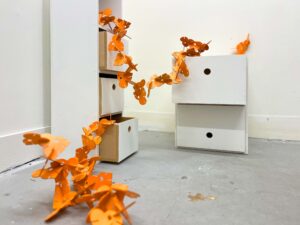
An installation view in a white room: orange modular forms snake from the floor up into open drawers and across to a small cabinet. The pieces appear to “crawl” through the furniture.

Figure 8. Guo Puyi, installation view. 2025, painted woodwork assembly. Dimensions variable.

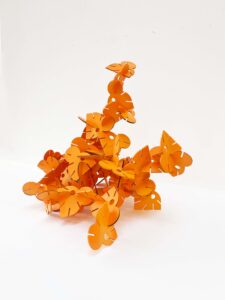
A close-up photograph of a sculptural object against a plain white background. The piece is constructed entirely from bright orange, flat, rigid modules shaped like stylized leaves with small circular holes in them. The interlocking pieces build upon one another in multiple directions to form a complex, abstract cluster that mimics the organic, irregular growth of a plant or crystal.

Figure 9. Guo Puyi, sculptural detail. 2025, painted woodwork assembly. Dimensions variable.


3. Location and Layout Design

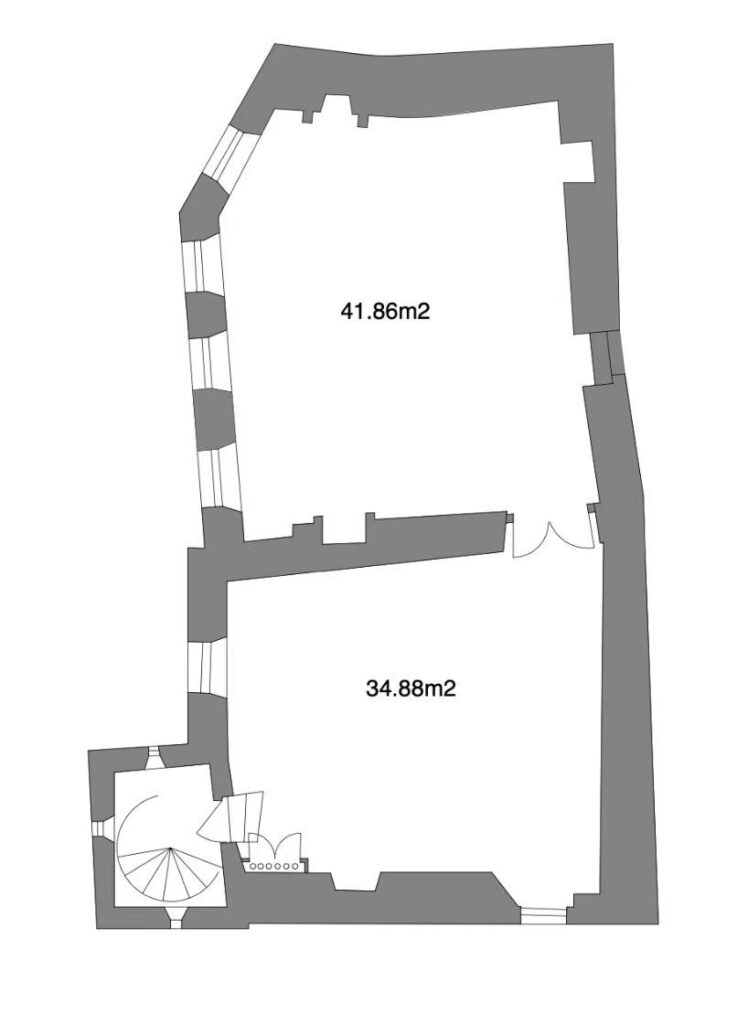
The exhibition will take place on the space of Custom Lane, Edinburgh. According to the floor plan provided, the site consists of two main galleries and an entrance area with spiral staircases. This non-traditional gallery layout aims to eliminate institutional distance and emphasize the natural encounter between material and daily community life.

  • Entrance area (at the spiral staircase): The audience enters from here, and this area serves as a psychological buffer space for the transition from the busy environment to the perceived state.

  • First Gallery (34.88m2) – Stage 1: Companionship (Jiang Miao):This exhibition hall focuses on displaying Jiang Miao’s works. Acrylic carving board is installed on the long wall of the exhibition hall. The relatively closed space structure helps to create a quiet atmosphere and guide the audience to observe the details and breathing rhythm in the engraving at close range.

  • Second Gallery (41.86m2) – Stage 2 & 3: Friction and Decentring (Suyon Huh & Guo Puyi):This is the largest area in the space, and the rows of windows on the left bring in natural light.

  • Central Space – Friction (Suyon Huh): Taking advantage of the openness of the exhibition hall, Suyon Huh’s rope installations and paintings stretch between the ground and the wall to form a physical barrier with tension. The audience walked through it and intuitively experienced the materialized presentation of anxiety. 

  • Window-side and Exit Zone – Decentring (Guo Puyi): Guo Puyi’s modular installation is arranged in the corner of the exhibition hall and near the final exit. These works use natural light and modular structural logic as the return point of the exhibition, guiding the audience to re-examine their position in the material network before leaving.


Figure 10. Floorplan of Custom Lane Studio Space. The layout supports a immersive curatorial structure. Image courtesy of Custom Lane. Accessed April 19, 2026. https://customlane.co/news/studio-space-available/

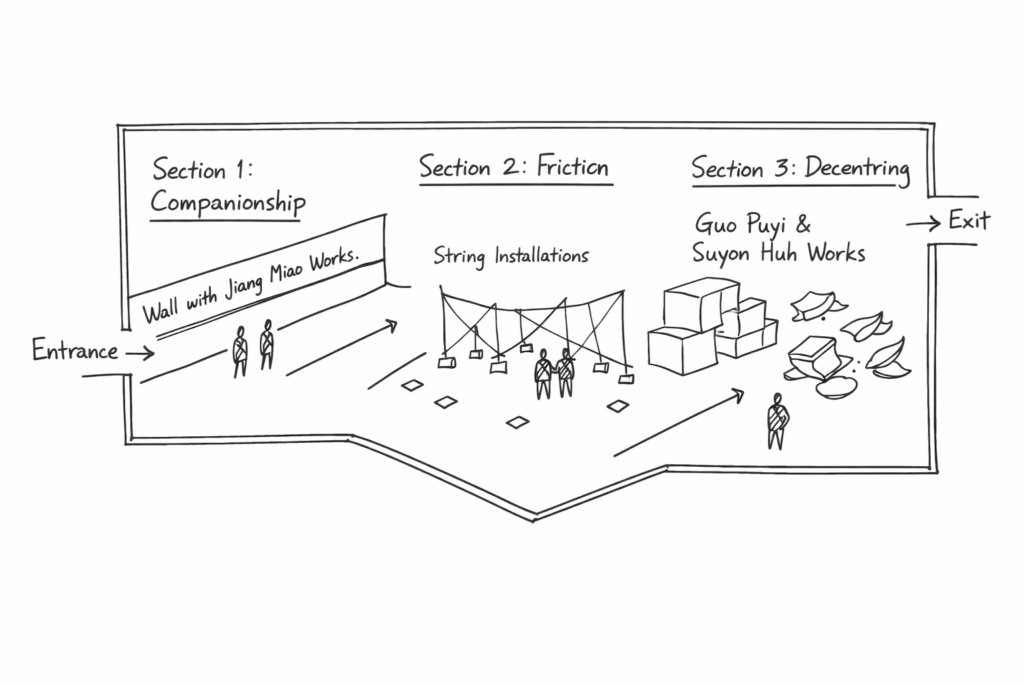
Figure 11. Spatial plan of the exhibition layout within Custom Lane designed by the curator. This is a diagram of the exhibition space's circulation.

Figure 11. Spatial plan of the exhibition layout within Custom Lane designed by the curator. This is a diagram of the exhibition space’s circulation.

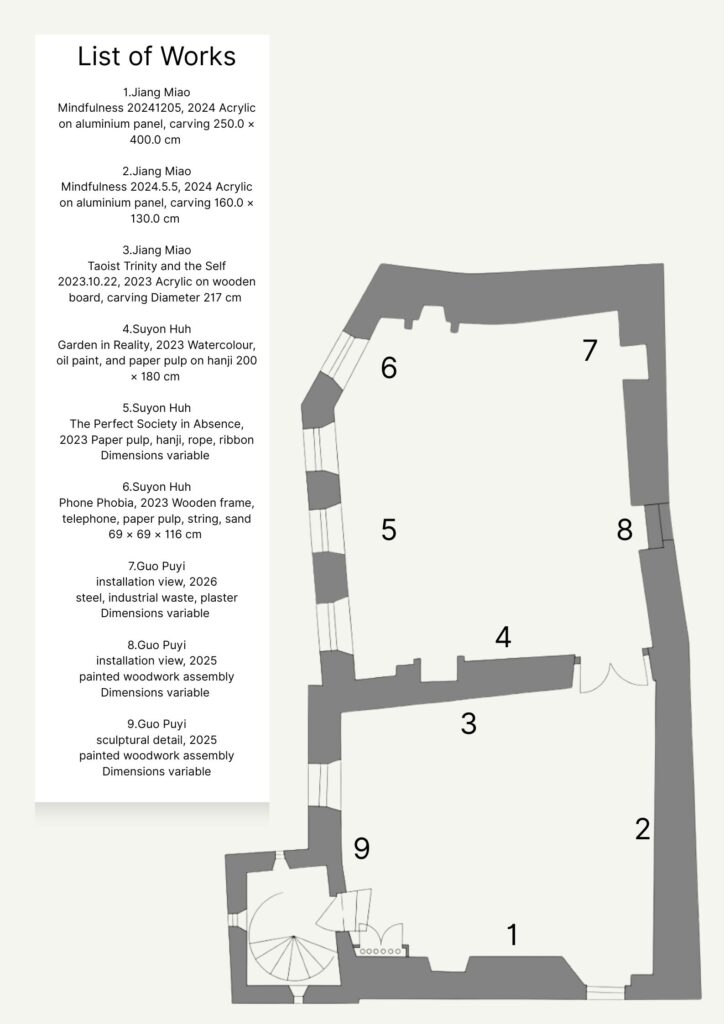
Figure 12. Spatial plan of the exhibition layout within Custom Lane designed by the curator. This is a map showing the distribution of artworks within the exhibition space.

Figure 12. Spatial plan of the exhibition layout within Custom Lane designed by the curator. This is a map showing the distribution of artworks within the exhibition space.


4. Public Programme


The programme is low-cost and designed to reduce barriers without over-explaining the works.

  • Sensory Walk-through

  • Lead: Led by a trained curator.

  • Timing: 30-minute sessions held twice per week on Day 2 and Day 5

  • Target Audience: Local community members and general visitors seeking low-barrier engagement.

  • Summary:The guide avoids the academic background of art history and guides the audience to observe the weight, texture and physical presence of the material through questions. This way encourages the audience to establish intuitive perception instead of relying on interpretation.

  • Fees: Facilitators receive professional fees from the £600 operational budget, reflecting the project’s ethical commitment to labor.

  • Material Workshop 

  • Lead: hosted by professional workshop tutors or part-time educators.

  • Timing: 45-minute practical course arranged on the fourth day of the exhibition week. 

  • Target Audience: Leith residents, students, and creative practitioners interested in tactile, hands-on activities.

  • Summary: Participants only use paper and ropes to build temporary structures to test physical tension and spatial resistance. This activity transforms the logic of Suyon Huh’s installation works into practical creative practices.

  • Fees: Facilitators receive professional fees from the £600 operational budget, reflecting the project’s ethical commitment to labor.


5. Curatorial Rationale

This project is based on the criticism of the tendency of material functionalization in contemporary urban life. The curatorial logic is deeply inspired by the Mono-ha concept, emphasizing that the weight, scale and spatial relationship of matter itself is the carrier of meaning, not just as an illustration of external language. By setting the exhibition dynamic line to a perceptual sequence from companionship to friction to decentralized, this plan aims to transform perception from abstract psychological healing into a concrete physical practice.

The choice of Custom Lane as the venue, rather than a traditional white-cube gallery, forms the critical core of this project. While the white cube often signifies institutional distance and authoritative models, and the community attributes and life atmosphere of Custom Lane create the necessary conditions for the natural encounter of material things. If the essence of perception lies in the reconstruction of attention in daily situations, then the exhibition space must resist the closed model and embrace the symbiosis with daily life.

At the ethical level, this project adheres to the budget management of seeking truth from facts, and regards artist expenses, transportation and insurance as insurmountable budget red lines to reflect respect for artistic labor. Artists choose those who do not explain a specific theme, but use the material as the practitioner of the way of thinking itself. In addition, the exhibition is committed to eliminating elite art barriers and ensuring that auxiliary facilities can provide access paths for a wider range of groups by setting up low-threshold sensory tours and material workshops.


6. Budget 


Item

Estimate (GBP)

Rationale

Venue hire — Custom Lane

£1,932

£276 × 7 days

Venue tech / staffing contingency

£600

Basic ops, cleaning, equipment add-ons

Artist fees / loan fees (3 artists)

£3,000

£1,000 each, respecting labour and permissions

Transport and packing

£1,600

Local courier + lightweight international packing

Insurance (artworks + public liability)

£700

Conservative placeholder pending quotes

Installation and materials

£900

Plinth tweaks, fixings, labels, minor lighting

Graphics and print

£450

A2 poster set + in-space print

Documentation (photo/video)

£550

One on-site documentation session

Accessibility and translation

£300

Bilingual text, alt text, text guide

Contingency (~10%)

£968

Buffer

TOTAL

£10,000

Balanced


7. Funding Sources

The following foundations have been identified as realistic candidates based on their eligibility criteria, funding ranges, and the nature of this project.

Amount available: £500–£50,000 (rolling deadline, no fixed closing date). This project would apply for approximately £10,000.

website:https://www.creativescotland.com/funding/funding-programmes/open-funding/open-fund-for-individuals


Peer Review for Han Qiu

Han Qiu’s blog represents a sophisticated evolution from an art history student to a critical curator. Her work is characterized by a rigorous synthesis of sociopolitical theory and digital ethics,  treats the exhibition space as a site for urgent socio-political inquiry.


1.Strengths: 

Professional Operationality : The Week 6 Pitch is a standout. Including a detailed budgetand a multi-layered public program (AI Identity workshop, Data Ethics Lab) is a masterstroke. It demonstrates that curating is a production of social relations and financial logistics, not just selecting pretty things.

Narrative Cohesion: The blog transitions naturally from institutional critique to technological critique and finally to accessibility, forming a logically self-consistent research loop.


2.Areas for Further Strengthening

Visual Annotation :While the blog images are evocative, they lack visual critical annotations. As a curator, Qiu should mark up these images to show the reader exactly what her curatorial gaze is identifying.

The Sensory Gap: The blog is intellectually dense but could be more grounded in sensory experience. For a physical exhibition at Summer hall, how do we make the Algorithmic Gaze feel visceral? More diagrams on lighting, sound, and audience flow would bridge this gap.

Deeper Cross-disciplinary Dialogue: In the Week 5 dialogue with CAP students, the author could further analyze how artists reciprocally shape the curatorial logic, rather than  recording the conversation process.

Metaphorical Connection: The link between AI surveillance and the Ji Ju collective theme could be tightened. How does an algorithm inhabit or displace a migrant body?


Digital vs. Material: Qiu’s digital shell (the algorithm) perfectly complements my focus on physical shell (materiality). It’s a reminder that as sojourners, we inhabit both physical and data-driven structures.

Archive as Care:  Her concept of writing in the margins in week 8  encourages me to embrace fragmentation. Instead of forcing a perfect linear logic, I can allow my blog to be a research site that evolves, much like the Ji ju spirit of movement.


4.Academic Recommendations for Han Qiu’s Curatorial Direction

1.Noble, Safiya Umoja. Algorithms of Oppression How Search Engines Reinforce Racism. New York: New York University Press, 2018. https://ebookcentral.proquest.com/lib/ed/detail.action?docID=4834260.

2.Hui, Yuk. “On the Existence of Digital Objects.” ProQuest Dissertations & Theses, 2012.

3.Classen, Constance. The Museum of the Senses : Experiencing Art and Collections. New York: Bloomsbury Academic, 2017. https://doi.org/10.5040/9781474252454.  


Peer Review completed: Saturday, 4th April


Week 13 | Final Synthesis: The Curatorial Gaze as Care

1.SICP Synthesis: Awareness and Material Agency

This thirteen-week journey has transformed my curatorial focus from the authority of grand institutions to the care for microscopic material tensions. My individual project, Awareness Through Materiality, successfully weaves together the works of Jiang Miao, Suyon Huh, and Guo Puyi. I have realized that a curator is not merely a spatial manager but a facilitator of material agency. Objects are not passive tools of human intentions. They have the potential to change social relations. In the planning of Custom Lane, I guided the audience to break free from the habitual logic of efficiency by showcasing the friction and companionship between these artworks.

2.Ji Ju Reflection: Care as Social Practice

The Ji Ju collective’s exhibition, Our Shell, served as a testing ground for my curatorial ethics. At Summerhall, we proved that curating is an art of flaw and negotiation. Instead of pursuing perfect unity, we use the metaphorical tool of the red line to weave the fragmented migration experience into a temporary archive. As Je Yun Moon notes:

What has to be emphasized here is the fact that the word ‘curatorial’ is not an adjective that describes the mode of operation of professional curators. In other words, the curator is not the first to exist and then the curatorial happens to be its mode of operation. The term ‘curatorial’ no longer dictates a specific role or position. It is a driving word through which we can begin to negotiate with the imperatives of the modern subject machine.

Our collective practice proves that the work of curators is to establish connections for plural voices, even if this connection has friction.


3.Curating as Continuous Research

This 13-week blog record itself is my curatorial research laboratory. It records every friction from the germination of the concept to the practical operation. The curator is not only a display of known knowledge, but also a process of producing new knowledge. This idea will serve as the cornerstone of my future career, guiding me to continue to explore how to connect alienated individuals into a caring community through art.


Notes:

1.Martinon, Jean-Paul, ed. The Curatorial : A Philosophy of Curating. London: Bloomsbury Publishing Plc, 2015, 27, Accessed April 21, 2026. ProQuest Ebook Central.


Week 12 | Planning the Curatorial Project: From Insights to Structural Enactment

1.Material Agency and the Logic of Awareness

In Week 12, my work transitions from gathering observations toward the deliberate planning of my final Curatorial Project report. This stage is not to draw conclusions, but to plan how to implement the research within a professional framework. By finalizing the selection of Jiang Miao, Suyon Huh, and Guo Puyi, I am grounding my curatorial gaze in a concrete study of material . Refining this project requires acknowledging that objects are not passive tools of human intent. 

As Jane Bennett argues:

Not Flower Power, or Black Power, or Girl Power, but Thing-Power: the curious ability of inanimate things toanimate, to act, to produce effects dramatic and subtle.

2. Material Agency and Site Negotiation

In planning the spatial layout for Custom Lane, I have begun to treat matter as an active participant. Jiang Miao’s carvings and Guo Puyi’s modules should not be decorative; they must function as vibrant matter in dialogue with the site’s industrial history. I plan to elaborate in the proposal on how this materiality interferes with the physical rhythm of the audience. Boris Groĭs argues: 

Meanwhile the installation itself has been blessed with art status: installation has become accepted as an art form and increasingly assumes a leading role in contemporary art. So even though the individual images and objects lose their autonomous status, the entire installation gains it back.

This means that my curatoral plan must respect the physical resistance of the material and transform it into a kind of perceptual care.

3.Ethical Integration of Curatorial Components

Finally, I am planning how to integrate the ethical reflections from the Ji Ju collective into my SICP. The curatorial proposal is not only about vision, but also about the management of relationships. I will establish a transparent operation framework, covering artist labor fees, barrier-free design, and collaboration with venue supervisors. I realized that curation is a complex configuration composed of multiple components. This instructs me to ensure that every administrative and technical detail serves the overall ethical commitment of the exhibition before the last week’s summary.

Notes:

1.Bennett, Jane. Vibrant Matter : A Political Ecology of Things. Durham, [N.C: Duke University Press, 2010, 6.

2.Groĭs, Boris. Art Power. Cambridge, Mass. ; MIT Press, 2008,  53-54.


Week 11 | Post-Exhibition: From Collective Belonging to Spatial Relations

1.Reflecting on Ji Ju: Flawed Cohesion

After the exhibition at Summerhall, my understanding of the curator’s role shifted from a controller to a mediator. Our Shell is not a perfect white box exhibition. It is full of friction and understanding between different sounds. However, this flawed cohesion gave the exhibition its vitality. I realized that curating is not about erasing differences but about building a temporary community through dialogue. This experience convinced me that the value of curation lies in the process of maintaining these interactions, not just showing the final result.

As scholar Boris Groys argues:

” The artworks presented in these exhibitions/ installations take on the role of documentation of a curatorial project. Yet such curatorial projects are in no way iconophilic; they do not aim to glorify the image’s autonomous value. “

2.Fieldwork at ECA: The Active Spectator

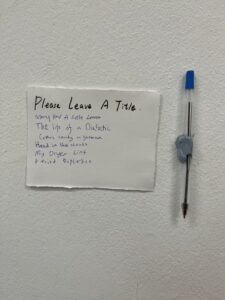
During my visit to the ECA Sculpture Court, the work “Please Leave a Title” caught my attention. The audience was invited to participate in the naming of the work, and this transfer of interactive power changed the nature of the field. It shows me that the field of contemporary exhibition is not a fixed container, but an open system completed by the participation of the audience.  Scott R. argues:

Thus, the properties of a painting are open to many interpretations, but it is hard to see how one interpretation is conclusively true. One must provide a standard with which to adjudicate such interpretations, and I would argue that such standards are themselves open to reevaluation. The basic fact of determinable properties still remains-art always allows for levels of interpretation.

3.Refining Awareness: Towards a Relational Logic

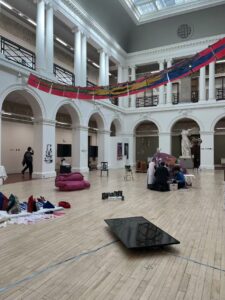
The ECA experience provided fresh perspectives for my project. The sculpture courtyard itself is a heavy space full of historical authority, but the contemporary art intervention breaks this stillness. I realized that to make audiences perceive material resistance, I must introduce a tensional participation rather than relying on static display. This led me to consider how I might use similar non-linear narratives at Custom Lane to pull viewers away from habitual gazing.

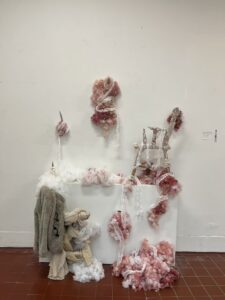
A messy textile installation with pink and white materials on a white wall.

Figure 1. Installation view exploring the raw materiality and tactile friction of everyday fibers, ECA Sculpture Court, Edinburgh, 2026. Photograph by the author.

A handwritten note "Please Leave A Title" with a blue pen taped to the wall.

Figure 2. Detail of the interactive installation Please Leave A Title, demonstrating direct audience agency and curatorial participation, ECA Sculpture Court, Edinburgh, 2026. Photograph by the author.

Wide view of ECA Sculpture Court with contemporary art in a classical space.

Figure 3. Installation view showing the contrast between contemporary exhibition and classical institutional structure, ECA Sculpture Court, Edinburgh, 2026. Photograph by the author.


Note:

1. Groĭs, Boris. Art Power. Cambridge, Mass. ; MIT Press, 2008, 53-54.

2.Stroud, Scott R. “How To Do Things with Art.” The Southern Journal of Philosophy (Oxford, UK) 44, no. 2 (June 2006): 341–64. https://doi.org/10.1111/j.2041-6962.2006.tb00105.x.


Week 10 | Ji Ju Collective : Weaving “Our Shell” at Summerhall

The culmination of Week 10 saw the opening of Our Shell at Summerhall, Edinburgh, a group exhibition curated by and featuring the Ji Ju Collective. Moving beyond a mere display of objects, the project functioned as a critical inquiry into the hermit crab condition: the constant negotiation of identity, memory, and domesticity within the precarious shells of a migratory life.

1.Collective Action as Method: From Theory to Site

Our exhibition navigated the tension between cultural roots and the temporary shells we inhabit while living abroad. By using red threads to physically connect disparate works, from traditional Qipao to contemporary paintings, we transformed a static gallery room into a living, interconnected organism.

This approach resonates with Miwon Kwon’s discourse on the evolution of site-specificity. She argues that the site has shifted from a fixed physical location to a discursive, mobile network:

The final ‘site’ or frame for art reception and dissemination in this appraisal is no less than the artist–producer and the sometimes transitive and site-less communities of the early 21st century. 

By framing our collective as a site-less community, we demonstrated that curatorial practice can create a sense of belonging that is not tied to a specific geography, but to shared experience and material as a way of thinking.

Curating is famous for an ordered appearance that on quick inspection is always flawed. Exhibitions always give the impression of cohesion when in fact what is exhibited is often the result of many compromises, concessions, and trade- offs between institutions,funders, lenders, contexts, and/or artists.

This flawed cohesion was evident in how we balanced individual artistic voices within the Ji Ju Collective. For my final project, I will embrace these compromises not as failures, but as an ethical method of sourcing and displaying artists, ensuring that the tension between different materialities remains visible rather than smoothed over.

3.Inspiration for My Personal Project

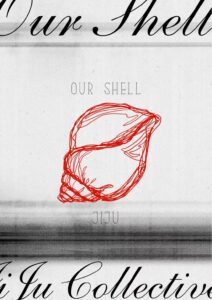
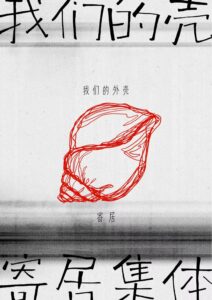
Bilingual poster for "Our Shell" exhibition with a red shell sketch.

Figure 1. English visual identity and exhibition poster for Our Shell, designed by the Ji Ju Collective, 2026.

Bilingual poster for "Our Shell" exhibition with a red shell sketch.

Figure 2. Chinese visual identity and exhibition poster for Our Shell, designed by the Ji Ju Collective, 2026.

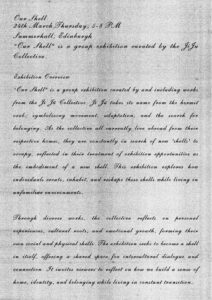
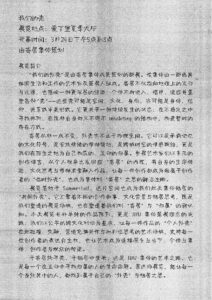
Bilingual poster for "Our Shell" exhibition with a red shell sketch.

Figure 3. English exhibition statement outlining the curatorial narrative of Our Shell, Summerhall, Edinburgh, 2026. Photograph by the author.

Bilingual poster for "Our Shell" exhibition with a red shell sketch.

Figure 4. Chinese exhibition statement for Our Shell, Summerhall, Edinburgh, 2026. Photograph by the author.

Celebrations chocolates arranged in tree-like forms on a pillar.

Figure 5. Siqi Xue. Candy Art Installation. Installation view demonstrating the use of red thread as a spatial connecting device to link fragmented narratives, Our Shell, Summerhall, Edinburgh, 2026. Photograph by the author.

Traditional Chinese garments (Qipao/Tangzhuang) displayed on a white wall.

Small paintings with labels hung by red strings.

Notes:

1.Kwon, Miwon, and Scott Townsend. Review of One Place after Another: Site-Specific Art and Locational Identity. Visual Communication (London, England) 4, no. 3 (October 2005): 372.

2.Martinon, Jean-Paul. 2020. Curating As Ethics. Minneapolis: University of Minnesota Press. Accessed March 30, 2026. ProQuest Ebook Central,xxii.


Week 9 |Curating as Redistribution: Participation, Materiality, and Change

1.From Concept to Situated Practice

Week 9 marks a critical moment where my curatorial thinking is realised through the exhibition Our Shell at Summerhall. The project shifts from a conceptual exploration of  home  towards a situated practice shaped by material, audience interaction, and spatial conditions. Rather than presenting a fixed narrative, the exhibition operates as an open system in which meaning is continuously produced through participation.


2. Participation and the Ethics of Taking

A key curatorial decision in Our Shell is to invite audience interaction, particularly through works that can be altered over time. However, rather than celebrating participation uncritically, the exhibition considers its ethical dimension: what does it mean to take from an artwork?

As Nicolas Bourriaud argues:

in relational art, the audience is envisaged as a community. Rather than the artwork being an encounter between a viewer and an object, relational art produces encounters between people. Through these encounters, meaning is elaborated collectively, rather than in the space of individual consumption. “


A floor-based installation composed of multiple small, individually wrapped chocolates arranged into a shell-like shape. The candies form an organic, clustered structure on a wooden floor, with different coloured wrappers (red, blue, gold, black, and white) creating visual variation. The arrangement resembles a fragmented shell or organic form, suggesting both accumulation and dispersal.

Figure 1. Sweetness Within the Shell, 2026
Mixed-media installation: wrapped candies, candy wrappers, floor arrangement
Variable dimensions (four shell-shaped units)
Artist: siqixue
Installation view, Our Shell, Summerhall, Edinburgh, 2026

3.Material as a Way of Thinking

The exhibition also reflects a shared curatorial approach among participating artists: a commitment to material as a mode of thinking. This aligns with practices such as Mono-ha.

“Founding member Lee observed that an artist’s ability to make things had been nullified by technology. As a result, he rejected traditional ideas of representation in favour of revealing the world as it is by engaging with materials and exploring their properties.”

In Sweetness Within the Shell, candy functions not only as a symbolic object but as an active material. Its consumable nature introduces temporality and instability into the work. As the candies are removed, the installation becomes a site of ongoing transformation, challenging the idea of the artwork as a stable entity.

4.Collective Practice and Curatorial Method

Working within the collective has been central to the development of Our Shell. Curatorial decisions, ranging from spatial arrangement to thematic framing, were shaped through negotiation and dialogue. This reflects a broader understanding of curating as a collaborative and process-based practice rather than an individual authorship.

Importantly, the exhibition format moves beyond a single-artist focus, instead creating a multi-voiced environment that better aligns with contemporary curatorial discourse.


Notes

The Board of Trustees of the Tate Gallery, accessed March22, 2026, https://www.tate.org.uk/art/art-terms/m/mono-ha.


Week 8 | Structure and Negotiation: Defining Our Shell

1. Negotiation in Collective Collaboration

our discussion at Summerhall helped us confirm the direction of our exhibition more clearly. We finalised the exhibition date, selected the works we want to include, and agreed on the title: Our Shell. This title feels closely connected to Ji Ju Collective itself. For us, Ji Ju is not just a group name, but a way of thinking about being together through difference. 

In Summerhall’s site research, we realized that curation is not only the stacking of works of art, but also the power negotiation between different voices. The artist’s works brought by each member need to find their own place in the limited physical space. We must strike a balance between protecting the uniqueness of personal narratives and maintaining the overall sense of the exhibition. This process made me understand that the curator is more like a coordinator, looking for the possibility of coexistence between multiple intentions.

With the determination of the name of the exhibition, the focus of our work shifted to how to show the profound artistic significance through limited materials. Although we need to deal with trivial matters such as budget, venue contracts and logistics, I always remind myself that the essence of curation lies in the reproduction of meaning. As curatorial theorist Terry Smith emphasizes:

I am assuming that exhibiting artistic meaning is the main task of the contemporary curator, to which all other roles are subservient.

This means that all our administrative negotiations and spatial planning must ultimately serve the core purpose of presenting the complex inner worlds of sojourners.

3.Spatial Layout and Logistics Negotiation

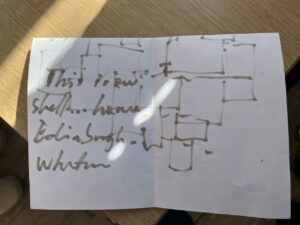
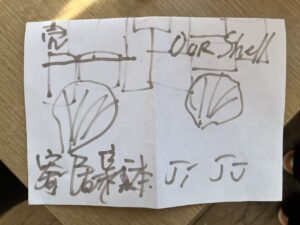
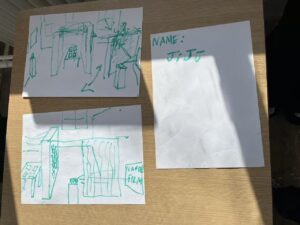
At the operational level, we have begun drafting detailed floor plans for the Summerhall gallery. This is a process of continuous compromise. We need to consider how to arrange works in different media, from installation to flat painting, to ensure that the audience’s movement is natural and rhythmic. The curation is not only to put things together, but also to imply the narrative relationship through the arrangement of physical distance. We are learning how to make these fragmented shells form a complete collective landscape through spatial intertextuality while respecting the creative independence of each member.

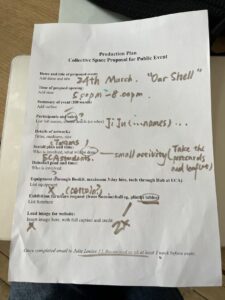
Hand-drawn exhibition plans, layout sketches, and planning notes made by Ji Ju Collective during a group discussion at Summerhall.

Figure 1. Ji Ju Collective discussion materials and planning notes developed during Week 8 at Summerhall, focusing on exhibition selection, event timing, and printed materials for public engagement.

Hand-drawn exhibition plans, layout sketches, and planning notes made by Ji Ju Collective during a group discussion at Summerhall.

Figure 2. Ji Ju Collective discussion materials and planning notes developed during Week 8 at Summerhall, focusing on exhibition selection, event timing, and printed materials for public engagement.

Hand-drawn exhibition plans, layout sketches, and planning notes made by Ji Ju Collective during a group discussion at Summerhall.

Figure 3.Ji Ju Collective discussion materials and planning notes developed during Week 8 at Summerhall, focusing on exhibition selection, event timing, and printed materials for public engagement.

Hand-drawn exhibition plans, layout sketches, and planning notes made by Ji Ju Collective during a group discussion at Summerhall.

Figure 4.Ji Ju Collective discussion materials and planning notes developed during Week 8 at Summerhall, focusing on exhibition selection, event timing, and printed materials for public engagement.

Notes:

1.Smith, Terry, and Independent Curators International. Thinking Contemporary Curating. New York: Independent Curators International, 2013, 23-24.


Week 7 | Site Survey and Initial Collective Negotiation

Category: Uncategorised
|

1. Objects as Narrators

This week, the Ji Ju collective transitioned into a substantive material phase. We are not in a hurry to determine a grand curatoral theme, but choose to start with the objects brought by individuals. Some people brought amulets, and some people shared old photos. These objects are not just souvenirs, they are shells that carry the memory of migration. At this stage, we do not pursue consensus, but allow each voice to maintain its uniqueness in the collective space. This approach makes us realize that the first task of the curatorial exhibition is not to force a title, but to provide a field for these fragmented narratives to collide with each other.

A close-up photograph of a red braided Daoist amulet from Taiqing Palace, Qingdao, placed on a dark blue fabric pouch, with multicoloured threads and a round pendant at the centre.

Figure 1. Daoist amulet from Taiqing Palace, Qingdao. Shared during Ji Ju Collective’s discussion at Summerhall as an object connecting hometown culture, everyday belief and curatorial thinking.

2.Curating as Connection

Although we have not yet identified the final name of the exhibition, our activity itself is a kind of curatorial practice. We are establishing some kind of nonlinear connection between the backgrounds of different members. This gathering process responds to Hans Ulrich Obrist’s discourse on the function of curating.In his work, he suggests that curating is about building bridges rather than mere preservation. He writes:

Ever since, this has been a central theme of all my exhibitions. I don’t believe in the creativity of the curator. I don’t think that the exhibition-maker has brilliant ideas around which the works of artists must fit. Instead, the process always starts with a conversation, in which I ask the artists what their unrealized projects are, and then the task is to find the means to realize them. At our first meeting, Boetti said curating could be about making impossible things possible.

3.Negotiating the Unknown

The current stage of discussion is full of friction and fragmentation. We visited Summerhall multiple times to understand how the site could accommodate our unformed ideas. The lack of a preset theme brings us a kind of freedom, allowing us to adjust the curatorial strategy according to the physical restrictions of the venue and the improvised feedback of the members. This is a kind of pragmatic consultation: how to extract publicly significant curatorial logic from the private experience of a group of nomiders, driven by respecting the labor of each artist. We are learning to accept this uncertain state and regard it as a necessary tension in collective creation.


Notes:

1. Obrist, Hans Ulrich, and Asad Raza. Ways of Curating. UK: Penguin Books, 2016, 11.


Week 6|Site Testing: Site Visit as a Research Method

Category: Uncategorised
|

1.Ji Ju Collective: Physical Mapping at Summerhall

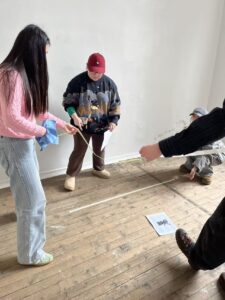
This week, the Ji Ju Collective conducted site testing at the Summerhall exhibition space. At this time, we have not yet determined the final curatorial theme, but focus on understanding the physical limitations of the venue. We used tape to mark the potential audience movement on the ground, and measured the height of the wall and the projection angle of natural light. This preliminary physical contact is essential because it forces us to think from an abstract perspective, but from the relationship between the body and the building. Measuring together also revealed something important about group work: curating is not only about authorship, but negotiation between people, and between artworks and architecture.

 Several students stand and crouch on a wooden floor, holding a tape measure across a taped outline while discussing the dimensions.

Figure 1. Measuring together: the group used a tape measure to check proportions and circulation, turning a floor plan idea into a physical, walkable scale test.

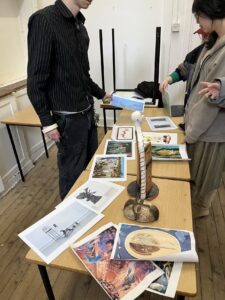
students stand around a table covered with printed artwork images and a small object, talking and pointing while planning a group curatorial layout.

Figure 2. Jiju group curatorial workshop: we laid out printed images and discussed scale, sequencing, and material relationships before moving into the gallery space.

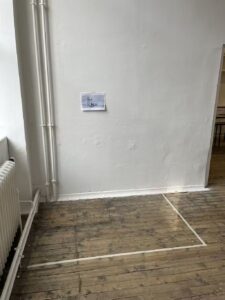
A white wall with pipes on the left; a small printed image is taped to the wall, and a rectangular area is marked on the wooden floor with tape.

Figure 3. Testing placement in the room: a taped rectangle on the floor and a small image on the wall helped us visualise footprint, height, and viewing distance.


2.Theoretical Framework: The Curatorial as Potentiality

This state of indecision aligns with contemporary curatorial theories regarding potentiality. Curating should not be viewed as a finished conclusion but as an event in a constant state of becoming.

As Irit Rogoff argues:

So here is the beginning of my argument: I am not interested in understanding the expanded field of art as a multiplicity, as a proliferation of coexistent practices, as a widening of what might have previously been seen as a somewhat narrow arena defined by fine art practice. In addition to art I would designate the terms: ‘practice’, ‘audience’, ‘curator’, ‘space’, ‘exhibition’, ‘performance’, ‘intervention’, ‘education’ and many other terms as subjected to this same disorientation – a historically determined meaning which has been pushed at the edges to expand and contain a greater variety of activity – but never actually allowed to back up on itself and flip over into something entirely different. The hallmarks of an epistemological crisis in the way in which it interests me here are not the trading of one knowledge or one definition for another more apt or relevant one, but rather the question of what happens when practices such as thought or production are pushed to their very limits.

This view supports our current open and even somewhat confused discussion. At present, this uncertainty is not missing, but a research field waiting to be activated.

3.Extensions for the Individual Project (SICP)

The spatial experiments at Summerhall directly informed my individual project (SICP) planning at Custom Lane. By observing the movement of the collective members in different corners, I learned how to control the rhythm of the audience through the spacing of the work. For my future SICP, I plan to use similar physical marking techniques to position Guo Puyi’s works within the non-traditional space of Custom Lane. This method ensures that curatorial decision-making is based on honest perception of the venue, rather than blind visual aesthetics.


Notes:

1.Martinon, Jean-Paul. The Curatorial : A Philosophy of Curating. London: Bloomsbury, 2013,43.


Curatorial Pitch

Category: Uncategorised
|

Title: Awareness Through Materiality

Venue: Custom Lane, Edinburgh

1. Curatorial Narrative

This group exhibition will take awareness as a specific viewing practice, not an abstract psychotherapy. In urban life that pursues speed and efficiency, materials are often simplified into tools. This exhibition regards daily materials as weighted existences, explores how we treat objects, and then reflects on how we treat ourselves and others.

Through the works of three artists, the exhibition guides the audience through three stages of bodily and visual pacing: companionship, friction, and decentring. Jiang Miao carved acrylic paint on the aluminum plate. These traces on the hard surface acted as a quiet companion, making the audience slow down. Suyon Huh uses pulp, Korean paper and ropes to transform invisible anxiety into visible spatial pulling force, and break the daily comfort through the resistance of the material. Guo Puyi, on the other hand, uses modular structures such as fallen leaves and steel to divert the audience’s attention from the human-centered sense of urgency, prompting us to reposition ourselves in a broader material network.


2. Space and Location

Custom Lane link:exhibition-space

The exhibition will be held in the Custom Lane exhibition space in Edinburgh. Custom Lane is an independent creative workspace in Leith, with a flexible ground-floor exhibition room suited to installation, wall-based, and floor-based works. Unlike the traditional White Cube gallery, Custom Lane has a strong atmosphere of life and community, which is very suitable for displaying works that explore everyday materials.

The move away from a white-cube gallery reflects the curatorial logic of the project: materials should accompany audiences in their daily lives, not be isolated behind institutional distance. Custom Lane’s existing circulation, the movement of workers, visitors, and the community, creates the conditions for natural encounter.


Layout overview:

• Section 1 (Jiang Miao): Works mounted on the main wall. Visitors begin at distance, then approach to read carved surfaces. Soft, even lighting to reveal shadow in the carving.

• Section 2 (Suyon Huh): String-based works require clear floor distance and subtle cue markers. Structure is visible first; tension draws the eye inward.

• Section 3 (Suyon Huh Fig.6 and Guo Puyi): Modular and leaf-based works near the exit, functioning as a return point, transforming earlier tension into a proposal for reformed connection.


3. Curatorial Rationale


The curatorial method of this exhibition is based on the theme, participation and venue. The three-part structure derives from the curatorial practice lesson I drew from Mono-ha: treat material, weight, scale, and placement as carriers of meaning, and let viewers understand through bodily experience rather than explanation.

Choosing Custom Lane instead of the traditional White Cube Gallery is carefully considered: it embodies this concept. If the awareness of consciousness lies in relearning attention in daily situations, then the exhibition itself must resist the closed and authoritative institutional exhibition model. Venue here means choosing a space where art can coexist with daily life.

The artist selection prioritises material as a way of thinking, not illustration. Jiang Miao’s carving practice is a form of long-term polishing. Suyon Huh’s tension-based works make anxiety and absence physical. Guo Puyi’s modular logic turns connection into a tactile argument. Together, these three practices build a sequence from quiet companionship through rupture to reorientation.

Accessibility and ethics are structural, not decorative. Clear labels avoid exoticising the cultural backgrounds of the artists. Artist fees, transport, and insurance are treated as non-negotiable. Audience participation in the walk-through is optional, and the online layer ensures that those who cannot visit in person can still access the work.


4. Artists and selected works

A) Jiang Miao

Jiang Miao’s three works all point to the first level of awareness: not a didactic spiritual therapy, but rather, through carving and the hardness of metal/wood, she brings attention back to the rhythm of touch and breath. Her paintings are like a state of repeated polishing, reminding the viewer that awareness is not a sudden flash of inspiration, but rather a long-term training.

A very large aluminium-panel painting with acrylic layers and carved marks; the surface shows cut lines and reflective shifts under light.

Figure 1. Mindfulness 20241205, JIANG MIAO, 2024. Acrylic on aluminium panel, carving. 250.0 × 400.0 cm.

A mid-sized aluminium-panel work with dense colour layers; carved and scraped lines create rhythmic grooves and edges across the surface.

Figure 2. Mindfulness 2024.5.5, JIANG MIAO, 2024. Acrylic on aluminium panel, carving. 160.0 × 130.0 cm.

A circular wooden-board work with acrylic layers carved into concentric or spiral structures, forming ring-like organisation similar to map or terrain textures.

Figure 3.Taoist Trinity and the Self 2023.10.22, JIANG MIAO, 2023. Acrylic on wooden board, carving. Diameter 217 cm.


B) Suyon Huh

Her works materialize everyday fears, absences, and fictitious orders into tangible material systems: papier-mâché, string, thread, Korean paper, watercolor, and oil painting overlays. They look light, but actually form a pulled structure in the space, causing the audience to experience physical tension and self-projection. She is responsible for the transition between the second and third sections of the exhibition: from being soothed to being pulled back to reality.

A large work on paper with layered, garden-like textures; watercolour and oil marks are visible, with raised paper-pulp areas creating uneven relief.

Figure 4. Garden in Reality, Suyon Huh, 2023. Watercolour, oil paint, and paper pulp on hanji. 200 × 180 cm.

Several paper-pulp and hanji structures are linked by ropes and ribbons that hang and pull across space, forming an expandable installation.

Figure 5. The Perfect Society in Absence, Suyon Huh, 2023. Paper pulp, hanji, rope, ribbon. Dimensions variable.

An installation on a wooden frame with a telephone at the centre, surrounded by string and paper-pulp forms with a gritty, sand-like surface, placed on the gallery floor.

Figure 6. Phone Phobia, Suyon Huh, 2023. Wooden frame, telephone, paper pulp, string, sand. 69 × 69 × 116 cm.


C) Guo Puyi

Guo Puyi is responsible for pushing the exhibition to the third level of awareness: the material not only accompanies it, but also organizes the space in turn, forcing us to adjust the way we see. In particular, he turned the text, structure and splicing system into a scalable installation logic, making the audience realize that the relationship between people and the real materials of the world is not a slogan, but a kind of repeated construction and maintenance.

Installation view in a white studio: at left, a tall black metal stand supports a circular metal cage containing a white block with a balloon-shaped cavity. Centre foreground, a stainless-steel rocking-horse-like sculpture rests on curved runners. To the right, two small modular steel figures stand on the floor, and one similar figure sits on a white plinth.

Figure 7. Guo Puyi, installation view. A small family of objects shares the same room but holds different degrees of freedom. A balloon-like void is kept inside a metal cage, while a rocking-horse body lies on the floor like a toy that has grown heavier than play. Nearby, modular steel figures stand upright, as if play has been reorganised into structure. In this scene, comfort, control, and companionship are negotiated through material weight and spatial distance.

An installation view in a white room: orange modular forms snake from the floor up into open drawers and across to a small cabinet. The pieces appear to “crawl” through the furniture.

Figure 8. Guo Puyi, installation view. Placed among drawers and corners, the work behaves like something that escaped storage and began to travel. It turns the domestic into a site of agency, not just comfort.

A close-up photograph of a sculptural object against a plain white background. The piece is constructed entirely from bright orange, flat, rigid modules shaped like stylized leaves with small circular holes in them. The interlocking pieces build upon one another in multiple directions to form a complex, abstract cluster that mimics the organic, irregular growth of a plant or crystal.

Figure 9. Guo Puyi, sculptural detail. A cluster that looks like a soft plant but is built from rigid modules. It suggests how connection grows: not as one perfect form, but as many small contacts holding each other up.


5.Public Programme

The programme is low-cost and designed to reduce barriers without over-explaining the works.


6. Budget (Total: £10,000)

Item

Estimate (GBP)

Rationale

Venue hire — Custom Lane

£1,932

£276 × 7 days

Venue tech / staffing contingency

£600

Basic ops, cleaning, equipment add-ons

Artist fees / loan fees (3 artists)

£3,000

£1,000 each, respecting labour and permissions

Transport and packing

£1,600

Local courier + lightweight international packing

Insurance (artworks + public liability)

£700

Conservative placeholder pending quotes

Installation and materials

£900

Plinth tweaks, fixings, labels, minor lighting

Graphics and print

£450

A2 poster set + in-space print

Documentation (photo/video)

£550

One on-site documentation session

Accessibility and translation

£300

Bilingual text, alt text, text guide

Contingency (~10%)

£968

Buffer

TOTAL

£10,000

Balanced


7. Funding Sources

The following foundations have been identified as realistic candidates based on their eligibility criteria, funding ranges, and the nature of this project.

Amount available: £500–£50,000 (rolling deadline, no fixed closing date). This project would apply for approximately £10,000.

website:https://www.creativescotland.com/funding/funding-programmes/open-funding/open-fund-for-individuals


8. Project Timeline

Phase

Tasks

Notes

Weeks 1–2

Confirm artist loans, artwork information, permissions, and crediting agreements. Draft contract and fee structure.

Apply to Creative Scotland (rolling). Confirm Custom Lane booking.

Week 3

Lock transport and insurance. Finalise bilingual wall texts and accessibility materials.

Commission documentation photographer. Finalise layout and floor plan.

Week 4

Technical coordination: plinths, fixings, lighting rig, floor cue markers for Huh’s string works.

Print graphics. Brief walk-through guide for workshop facilitators.

Install (2 days)

Install Jiang Miao panels first (heaviest and wall-fixed). Then Huh’s tension works. Guo Puyi last , modular works adjusted in situ.

Private view on final install evening (optional, low-cost).

Open (7 days)

Public opening. Two walk-throughs per week (Day 2 and Day 5). One workshop session (Day 4).

Online layer live from Day 1. Invigilator schedule confirmed with Custom Lane.

Deinstall (1 day)

Careful deinstall and packing. Artworks returned or held for collection.

Document condition of works on departure.

Archive (1 day)

Edit documentation. Compile report: visitor numbers, programme feedback, financial summary.

Share archive with artists and funders.


Reading Week | Awareness: Reshaping the Curatorial Gaze Through Materiality

Category: Uncategorised
|

1.The Evolution of a Curatorial Pitch

During Reading Week, I grounded my individual curatorial project in the theme of Awareness. This is not an abstract spiritual slogan, but a concrete effort to detect how inertial gaze shapes our relationship with objects and ourselves. I chose to cooperate with the artist Guo Puyi and had an in-depth discussion with him. Because his works give life and dynamism to seemingly inanimate materials, challenging the utilitarian efficiency logic that dominates modern life. This reflection stems from the background of my growing up in Shandong, where social norms composed of etiquette and rules sometimes make people feel heavy, which prompts me to find another way of existence through art.


2.Material Strategy: Companionship and Resistance

I divided Guo’s works into three groups: the first is wooden and ceramic works, showing the warmth of matter as a daily partner; the second is iron and hard materials, which challenge the audience’s comfort and stimulate critical thinking by transforming familiar soft forms (such as balloons or rocking horses) into cold and hard metal; finally, based on leaf The works of children and paper lead attention to the vast world outside nature and self. This curatorial logic aims to let the audience understand the work through physical experience rather than complex terms. 

I do not want to force this exhibition into Mono-ha, but Mono-ha gives me a clear curatorial lesson: treat material, weight, scale, and placement as part of meaning, and let viewers understand through bodily experience rather than over-explanation. Mono-ha, emerging in postwar Japan, foregrounded direct encounters with materials and the relationships between things and site. That approach helps me keep awareness grounded in how people look and move, not only in what they read.


An installation view in a white room: orange modular forms snake from the floor up into open drawers and across to a small cabinet. The pieces appear to “crawl” through the furniture.

Figure 1. Guo Puyi, installation view featuring modular leaf-like structures interacting with a domestic drawer unit.


Installation view in a white studio: at left, a tall black metal stand supports a circular metal cage containing a white block with a balloon-shaped cavity. Centre foreground, a stainless-steel rocking-horse-like sculpture rests on curved runners. To the right, two small modular steel figures stand on the floor, and one similar figure sits on a white plinth.

Figure 2. Guo Puyi, installation view of the metal sculpture series, featuring forms of a cage, a rocking horse, and modular figures.


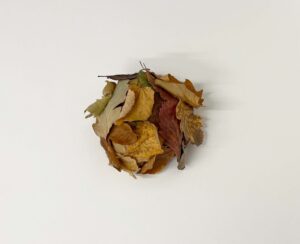
A ball-shaped cluster of dried leaves rests on a white surface. Leaves in yellow, brown, and reddish tones overlap tightly, with stems and curled edges visible.

Figure 3. Guo Puyi, sculptural object constructed from compacted fallen leaves.


A red square artwork placed against a white background. The surface shows dense, branching textures and lighter areas, resembling liquid spread patterns or organic veins.

Figure 4. Guo Puyi, surface-based artwork exploring the visual tension of a frozen spill or stain.


3. Ji Ju Collective: Ethics of the Transitive Site

This week, the Ji Ju Collective discussions focused on the ethics of nomadic identity and curatorial labor. As a mobile network composed of foreigners, we lack a fixed physical structure, and our exhibition space is essentially instantaneous. However, this requires us to have a deeper curatory responsibility. As Miwon Kwon warns in her examination of site-specificity, without a relational sensibility, our migratory trajectories might become genericized sequences. Instead, she argues:

Thus, it is not a matter of choosing sides—between models of nomadism and sedentariness, between space and place, between digital interfaces and the handshake. Rather, we need to be able to think the range of the seeming contradic-tions and our contradictory desires for them together; to understand, in other words, seeming oppositions as sustaining relations.

Notes:

1.All photographs of the artworks featured in this post are provided courtesy of the artist, Guo Puyi.

2.Kwon, Miwon. One Place after Another : Site-Specific Art and Locational Identity. Cambridge, Mass. ; MIT Press, 2002, 166.

3.”Mono-ha,” Art Terms, Tate, accessed April 19, 2026, https://www.tate.org.uk/art/art-terms/m/mono-ha


Week 5 |Turning Lived Experience into Curatorial Material

Category: Uncategorised
|

1.CAP Workshop: From Jargon to Memory

After observing Contemporary Art Practice (CAP) classmates present their work, I recognized that artistic vitality stems from personal background, cultural memory, and lived experience rather than abstract jargon. This discovery makes my project goal clearer: I hope to plan an exhibition to help the audience understand the work through a simple entry point, explore the source of the creator and how these experiences can be transformed into forms, materials and postures. This narrative style makes the curation no longer just a display of works, but makes the relationship between life and creation clearly visible.


A person holds a printed photograph showing a metal sculpture installation in a studio space, with several small sculptural forms arranged on the floor and a tall stand at the left.

Figure 1. CAP classmate (name withheld), documentation image of a metal sculpture installation shared during an in-class session, ECA Main Building, Thursday, 12 February 2026. Photograph by the author.

A torso-shaped sculpture sits on a table in a classroom setting, covered with layered textures and embedded circular forms, with wood-paneled doors and seated students in the background.

Figure 2. CAP classmate (name withheld), torso-shaped sculpture brought for an in-class sharing session, ECA Main Building, Thursday, 12 February 2026. Photograph by the author.

A printed presentation board on a desk displays multiple artwork images, sketches, and short texts arranged in a grid layout, photographed in a classroom environment.

Figure 3. CAP classmate (name withheld), printed presentation board combining artwork images, sketches, and short texts, shared during an in-class session, ECA Main Building, Thursday, 12 February 2026. Photograph by the author.


2. SICP: Material, Home, and Translation

My personal project (SICP) will revolve around three daily clues: material (emotional carrier in reality), household goods (from daily life) and translation (changes in experience in cross-regional and language migration). The purpose is not to explain identity, but to make the connection between life and creation visible. In her work, she explores how backgrounds shape how we inhabit space:

Familiarity is what is, as it were, given, and which in being given “gives” the body the capacity to be orientated in this way or in that. The question of orientation becomes, then, a question not only about how we “find our way ”but how we come to “feel at home.”

3. Ji Ju Collective: The Ethics of Representation

Within the Ji Ju collective, our discussions focused on a cautious approach to the concept of cultural background. We agreed that artistic backgrounds should not be treated as fixed labels or transformed into exotic commodities for audience consumption. Our collective manifesto emphasizes that curators must be aware of their speaking position, ensure financial transparency, and maintain profound respect for artist labor.This requires me to think carefully about who gets to speak and how the effort behind each piece is properly acknowledged through transparent processes.


Notes:

1. All photographs were taken by the author. The artworks shown were brought and presented by MA Contemporary Art Practice (CAP) classmates during an in-class sharing session, and are used here as documentary material for curatorial reflection.

2. Ahmed, Sara. Queer Phenomenology Orientations, Objects, Others. Durham: Duke University Press, 2008,7, https://login.eux.idm.oclc.org/login?url=http://dx.doi.org/10.1215/9780822388074.


Week 4 |Seeing Art Outside the White Cube

Category: Uncategorised
|

1. Parkview Green Beijing

During my visits to Parkview Green Beijing in 2023 and 2024, I observed art integrated into corridors and atriums. I was impressed by the curation here: works of art are scattered in corridors, atriums and public areas, not confined to closed galleries. This layout allows the audience to meet art naturally when shopping or socializing. This informal setting challenges the traditional idea that art must be watched in a specific institution and provides an important reference for my personal project.


A tall, glowing pink conical light installation placed in the center of a modern, multi-level shopping mall atrium. A visitor is standing near the base observing it.

Figure 1. Art installation situated within the central circulation area of Parkview Green, Beijing, ca. 2023–2024. Photograph by the author.

A wide interior view of a multi-story commercial atrium featuring crisscrossing escalators, glass-lined balconies, and retail storefronts.

Figure 2. View of the multi-level commercial infrastructure and spatial layout at Parkview Green, Beijing, ca. 2023–2024. Photograph by the author.

Two highly reflective, abstract metallic sculptures displayed on black rectangular pedestals. They are positioned alongside a glass railing overlooking the interior of a shopping center.

Figure 3. Abstract metallic sculptures displayed along a public walkway overlooking the atrium in Parkview Green, Beijing, ca. 2023–2024. Photograph by the author.

Several red sculptures shaped like cattle are positioned along the edge of a glass balcony in a commercial building. Below the balcony, there is a landscaped area with green plants and large decorative spheres.

Figure 4. Animal-shaped sculptures integrated into the pedestrian pathways and landscaping of Parkview Green, Beijing, ca. 2023–2024. Photograph by the author.

Website: https://www.parkview.world/#/en/parkview-green-beijing/ 


2. Potential of Everyday Infrastructures

Bringing art into commercial space can break the barriers between institutions. As curator Stefanie Hessler stated in Julia Halperin’s article:

By bringing art inside local businesses, “I hope it doesn’t feel like art tourism only,” she says. Perhaps a student will unexpectedly encounter Piotrowska’s photographs on a shopping trip and become inspired to pop inside the vacant pharmacy nearby to view works by the French artist Pol Taburet.

This aligns with Miwon Kwon’s critique of the White Cube. Kwon explores how site-specific art redefines relations with the public by entering non-art sites, challenging detached exhibition spaces.

3. Ji Ju Collective

The Ji Ju collective began formal discussions this week. We first confirmed the name of our group this week.Given our collective identity centers on living away from home, we realized that artworks also function as sojourners in these environments. We discussed ethical issues in commercial spaces, especially exclusivity and who feels comfortable in these spaces.Therefore, the curation must be meticulous and flexible, rather than forcibly occupying space.

Notes

1.All photographs reproduced here were taken by the author at Parkview Green (侨福芳草地), Beijing, during visits in 2023 and 2024, and are used as documentary material to support curatorial analysis.

2.”Food courts and pharmacies are Basel’s hottest new art spaces,” Julia Halperin, accessed February 08, 2025, 1, dd37ae39-04b6-4719-9611-66b09c8614d0

3. Kwon, Miwon. One Place after Another : Site-Specific Art and Locational Identity. Cambridge, Mass. ; MIT Press, 2002, 3.


Week 3|From Ideas to Decisions

Category: Uncategorised
|

1.From Conceptual Framing to Operational Reality

Clegg’s presentation highlighted the central role of decision-making: a curator must balance conceptual purity with practical feasibility. This made me realize that public nature, institutional context and visibility are not abstract academic words, but are jointly shaped by specific spatial and economic constraints.


A photograph of a projector screen displaying a detailed spreadsheet, likely a curatorial budget or project plan. A speaker stands in silhouette in the lower-left corner, presenting to an audience.

A photograph of a projector screen showing a digital whiteboard tool filled with green and red sticky notes. The notes contain operational planning terms such as "Money," "Artists," "Time frame," "Policy," and "Physical space." Silhouettes of audience members are visible at the bottom.


2.Curating as a Methodology of Negotiation

From this perspective, curation is essentially a consultative process for multiple stakeholders and on-site conditions. This kind of negotiation is not a simple compromise on the concept, but a necessary means to make the project effective in a specific field.

As Jean-Paul Martinon describes in his writing on curatorial ethics:

This flawed cohesion accurately defines the complexity of curatorial practice, where temporary visual order is established by navigating contradictions.

3.Positioning Future Practice

The next work will focus on transforming these operational logics into specific steps, including identifying feasible sites and testing how the planning concept can operate under real constraints. I no longer pursue to finalize a perfect plan at the beginning of the project, but allow practical conditions to actively shape the form of curation.

Now, I am repositioning the project by identifying potential forms, describing stakeholders, and foreseeing consultation with the venue supervisor. I realize that public nature is not a fixed state, but actively constructed through spatial, economic and social restrictions. The adjustment of this method has shifted my project from theoretical conception to practical implementation.


Notes:

1.Martinon, Jean-Paul. Curating as Ethics. Minneapolis, Minnesota ; University of Minnesota Press, 2020, xxii-xxiii.


Week 2 |Mapping Curatorial Infrastructures and Collective Agency

1.From Scale to Infrastructure

2.Field Note: Visiting RSA200 at The Mound

Visiting the Royal Scottish Academy (RSA) and National Galleries of Scotland at The Mound provided a concrete example of a different institutional model. Unlike the contemporary or micro-spaces discussed in Week 1, The Mound represents a site of deep establishment history. The RSA200 celebration demonstrates how publicness functions as a curated claim. It is not a neutral cultural place, but is jointly generated through institutional partnerships, heritage narratives and the governance of shared spaces. In Smith’s VAEC model, this field represents the traditional and core institutional node, and its curatorial proposition is often closely related to the cultural identity and historical legitimacy of the country.


A printed wall text panel titled "RSA200 AT THE SSA" hanging on a white gallery wall, featuring logos for the Royal Scottish Academy and the Society of Scottish Artists at the bottom.

A traditional landscape oil painting displayed in a heavy, ornate gold frame against a white wall. The painting depicts a wooded, hilly landscape with a stream flowing through it under a cloudy sky.

Figure 2. Robert Noble, Summer-time, ca. 1895. Oil on canvas, 167.7 x 91.4 cm. Royal Scottish Academy Diploma Collection. Displayed at the SSA 127th Annual Exhibition, Edinburgh, January 24, 2026. Photograph by the author.


3. Collective Action within Frameworks

Notes

1. Smith, Terry. “Mapping the Contexts of Contemporary Curating: The Visual Arts Exhibitionary Complex.” Journal of Curatorial Studies (BRISTOL) 6, no. 2 (October 2017): 11. https://doi.org/10.1386/jcs.6.2.170_1.
2.https://elephant.art/brief-history-collective-action/ ,accessed January 25, 2026


Week 1|Curatorial Orientation: Scale, Publicness, and Philosophical Frameworks

1.Exhibition Scale as a Curatorial Condition

At the end of the long, black staircase stands a contemporary artwork by Huang Yuxing, its colors vibrant and varied.

Figure 1. Installation view of Huang Yuxing: Under the Vault of Heaven, Long Museum West Bund, Shanghai, 2023. Photograph by the author.

Huang Yuxing's contemporary artwork hangs on the hollow cement wall; the work depicts two black human figures lying sideways in an embrace.

Figure 2. Installation view of Huang Yuxing: Under the Vault of Heaven, Long Museum West Bund, Shanghai, 2023. Photograph by the author.

Website: http://www.thelongmuseum.org/en/exhibition-369/detail-1847.html


Several contemporary paper art pieces are hanging on a white wall.

Several contemporary paper art pieces are hanging on a white wall.

Website: https://andgallery.co.uk/exhibitions/121-paper-trails/overview/


2.Micro-Curating and Centre–Periphery Relations

This awareness of scale is reinforced by the course readings. Micro-Curating: The Role of SVAOs (Small Visual Arts Organisations) highlights the historical importance of small organisations as sites of experimentation, flexibility, and local engagement within exhibition-making. These organisations complicate assumptions that innovation primarily emerges from large institutions.

Similarly, the editorial Centres / Peripheries – Complex Constellations challenges fixed hierarchies within curatorial discourse, proposing centre and periphery as relational and context-dependent positions rather than stable categories. In contrast, On Curating presents reflections by internationally established curators working within biennials and major institutions, revealing a pragmatic engagement with scale, visibility, and institutional constraints. Taken together, these texts suggest that curatorial practice is shaped less by scale itself than by the conditions under which exhibitions are produced.


3.Public Space, Curating, and Governance

My interest in curating in public and semi-public spaces is closely related to my personal experience. Because the family is engaged in real estate-related work, I observed how works of art are incorporated into architectural and urban development projects, playing a role between aesthetic presentation, public visibility and economic logic. This experience prompted me to rethink that public space does not exist naturally, but is continuously produced through curatorial, design and management.

This concern resonates with philosophical approaches to space and governance. Michel Foucault’s analysis of spatial organisation highlights how power operates through visibility and circulation rather than direct control. Giorgio Agamben’s writing on the state of exception further complicates this by examining how inclusion and exclusion are structured within public space.These ideas provide me with a perspective for understanding curatorial practice, allowing it to be viewed not only as a cultural intermediary but also as a practice of participating in spatial governance.


4. Personal Background and  Research Direction

I completed my undergraduate studies in Qufu, a place closely associated with Confucianism, which sparked my ongoing interest in how spatial order, ritual practices, and ethical structures shape collective experience. This has influenced my curatorial approach, which aims to juxtapose contemporary art with Chinese philosophical traditions and Western critical theory.

At this stage, I am not attempting to provide definitive conclusions, but rather viewing curating as an open research process. I am concerned with how curatorial practice can maintain its criticality across different institutional scales, and how publicness can be negotiated and reconstructed within economic and spatial constraints. These questions will continue to guide my research and practice in my coursework.

Notes

1. Yuxing: Under the Vault of Heaven, curated by Lu Mingjun, exhibition held October 26, 2023–January 1, 2024, Long Museum West Bund, Shanghai.
3. Bilbao Yarto, Ana Edurne. Micro-Curating:The Role of SVAOs (Small Visual Arts Organisations) in the History of Exhibition-Making. 2018.
4. Thea, Carolee, and Thomas Micchelli. On Curating : Interviews with Ten International Curators. First edition. New York, N.Y: D.A.P./Distributed Art Publishers, 2009.
5. Ronald Kolb, Eva Krivanek, Camille Regli, and Dorothee Richter, “Centres ⁄ Peripheries – Complex Constellations,” Notes on Curating, no. 41 (June 2019): 3–11.
6. Foucault, Michel, and Jay Miskowiec. “Of Other Spaces.” Diacritics 16, no. 1 (1986): 22–27. https://doi.org/10.2307/464648.
7. Agamben, Giorgio, and Kevin Attell. State of Exception. 1st ed. Chicago: University of Chicago Press, 2005. https://doi.org/10.7208/9780226009261.