Week 11 | Post-Exhibition: From Collective Belonging to Spatial Relations
1.Reflecting on Ji Ju: Flawed Cohesion
After the exhibition at Summerhall, my understanding of the curator’s role shifted from a controller to a mediator. Our Shell is not a perfect white box exhibition. It is full of friction and understanding between different sounds. However, this flawed cohesion gave the exhibition its vitality. I realized that curating is not about erasing differences but about building a temporary community through dialogue. This experience convinced me that the value of curation lies in the process of maintaining these interactions, not just showing the final result.
As scholar Boris Groys argues:
” The artworks presented in these exhibitions/ installations take on the role of documentation of a curatorial project. Yet such curatorial projects are in no way iconophilic; they do not aim to glorify the image’s autonomous value. “
2.Fieldwork at ECA: The Active Spectator
During my visit to the ECA Sculpture Court, the work “Please Leave a Title” caught my attention. The audience was invited to participate in the naming of the work, and this transfer of interactive power changed the nature of the field. It shows me that the field of contemporary exhibition is not a fixed container, but an open system completed by the participation of the audience. Scott R. argues:
Thus, the properties of a painting are open to many interpretations, but it is hard to see how one interpretation is conclusively true. One must provide a standard with which to adjudicate such interpretations, and I would argue that such standards are themselves open to reevaluation. The basic fact of determinable properties still remains-art always allows for levels of interpretation.
3.Refining Awareness: Towards a Relational Logic
The ECA experience provided fresh perspectives for my project. The sculpture courtyard itself is a heavy space full of historical authority, but the contemporary art intervention breaks this stillness. I realized that to make audiences perceive material resistance, I must introduce a tensional participation rather than relying on static display. This led me to consider how I might use similar non-linear narratives at Custom Lane to pull viewers away from habitual gazing.
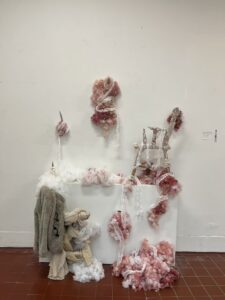
Figure 1. Installation view exploring the raw materiality and tactile friction of everyday fibers, ECA Sculpture Court, Edinburgh, 2026. Photograph by the author.
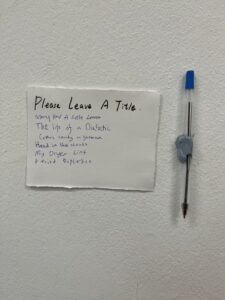
Figure 2. Detail of the interactive installation Please Leave A Title, demonstrating direct audience agency and curatorial participation, ECA Sculpture Court, Edinburgh, 2026. Photograph by the author.
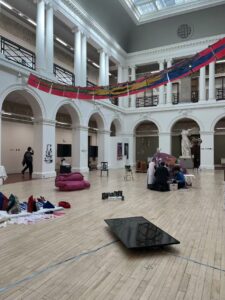
Figure 3. Installation view showing the contrast between contemporary exhibition and classical institutional structure, ECA Sculpture Court, Edinburgh, 2026. Photograph by the author.