The humble Table of Contents.

The humble Table of Contents.

With my holiday approaching, I thought it would be pleasant to talk about something less demanding, and which involved zero LaTeXing. So, I thought that I would speak up for the Table of Contents being included in journal articles. Of course its inclusion is commonplace in books, and one couldn’t imagine a textbook or monograph being without one.

At one time it was quite usual in journal articles too, and Bob Kraichnan’s pioneering paper, presenting the direct-interaction approximation, in the Journal of Fluid Mechanics in 1959 was a case in point [1]. In fact I have normally put in a table of contents in submitted manuscripts for many years now, and it can easily be removed once the paper has been accepted for publication. Some years back, I submitted a paper thus equipped to the JFM; and, still trying not to move with the times, I tried to avoid the web submission method and sent it as a pdf attachment in an email to an editor. His shocked reaction seemed not unlike that of a maiden lady in a Victorian novel encountering some coarse language. His complaints ended up with: ‘and you have even put an index in it!’

Well, I removed the ‘\toc’ command and submitted the MS through the website. However, worse was to come and the paper ultimately went elsewhere. The resulting transaction came under the heading of what someone has called ‘The combination of lazy editor and biased referees which plagues turbulence research’. Actually, I don’t think ‘lazy’ is quite the right word. Perhaps something like ‘conformist’ would be better?

Returning to the present time, my recent experiences as Guest Editor have made me aware of just how useful a table of contents is when one is assessing a new manuscript, particularly when it is a review article. Indeed, even recently, certain review journals did require a list of contents for each article. For example, see reference [2].

So I wish to conclude with a plea. At least put a temporary table of contents in in your preprints and submissions. And, if we can persuade editors to allow them in the journals, rather than draw their skirts aside, then it should improve communication by making it easier for us all to get to grips with each other’s work.

This is my last post for the moment. I hope to resume in September.

References.
[1] R. H. Kraichnan. The structure of isotropic turbulence at very high Reynolds numbers. J. Fluid Mech., 5:497-543, 1959.
[2] W. D. McComb. Theory of turbulence. Rep. Prog. Phys., 58:1117-1206, 1995.


An assessment of Onsager’s concept of scale invariance: 3

An assessment of Onsager’s concept of scale invariance: 3

I will complete this sequence of posts by discussing the scale-invariance paradox and showing how the Onsager criterion for the inertial range should be modified in order to resolve it.

We begin by noting that the first measurement of the transfer spectrum was made in 1963 by Uberoi, who measured the time-derivative and the viscous dissipation terms in the Lin equation and obtained the transfer spectrum as the remaining term in that equation [1]. He was surprised to find that $T(k,t)$ had a single zero crossing when he had expected that it would be zero over an extended range of wavenumbers, corresponding by simple calculus to an extended region of scale-invariant flux. He attributed this failure to the Reynolds number being too low. However, over the following years it became clear the transfer spectrum only ever has a single zero-crossing at even the highest Reynolds numbers, and so the scale-invariance paradox was born. A fuller account of this topic can be found in the article [2] or the book [3].


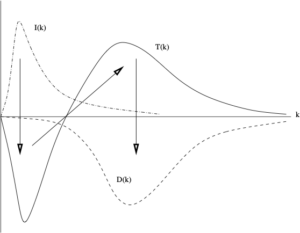
Sketch of the energy balance in the Lin equation.

The behaviour of the terms in the Lin equation is illustrated schematically in the figure. Note that the input term is $I(k) =- dE(k,t)/dt$ in this case, whereas if we were considering stationary turbulence it would be the rate of work done by the stirring forces. Further discussion of these points can be found in [3].

It is of interest to note that we can use simple mathematical reasoning to make two general observations from this figure. First, it could have been anticipated that $T(k)$ would only have a single zero-crossing at $k=k_{*}$. Evidently if the input term decreases monotonically as the inertial range is approached from below, while the dissipation spectrum also decreases monotonically as the inertial range is approached from above, then where these two terms are equal at $k=k_{*}$ (say) we must have the single zero of $T(k)$.

Secondly, from equation (9) in the first post in this sequence (on 27 June), we may infer from general conditions of smoothness corresponding to physical behaviour, that the flux must go through a maximum value at $k=k_{*}$. Thus the conclusion of Shanmugasundaram [4] from detailed computations of the LET theory could also have been anticipated.

Let us now consider the Onsager criterion in rather more detail and apply it to the interval $0\leq k \leq k_{*} $. We may write this in terms of the spectral density function $S(k,j)$ as: \begin{equation}\Pi(k_{*})=\int_0^{k_*}T(k)dk=\int_0^{k_*}dk\left[\int_0^\infty dj S(k,j)\right].\end{equation}We may then divide up the range of integration over $j$ at $j=k_{*}$ to obtain:\begin{equation}\Pi(k_{*})=\int_0^{k_{*}}dk=\int_0^{k_{*}}dk\left[\int_0^{k_{*}} dj\,S(k,j)+\int_{k_{*}}^\infty dj\,S(k,j)\right].\end{equation}From the antisymmetry of $S(k,j)$ under the interchange of $k$ and $j$, it follows that the first term in the square brackets gives zero and we are left with: \begin{equation}\Pi(k_{*})=\int_0^{k_{*}}dk\int_{k_{*}}^\infty dj\,S(k,j)\equiv \int_0^{k_{*}}dk T^{-+}(k|k_{*}),\end{equation} where we have introduced the filtered-partitioned form of the spectral transfer function $T^{-+}(k|k_{*})$.

Further details of these filtered-partitioned forms may be found in [2], where some results are cited which suggest that this procedure may resolve the scale-invariance paradox. However our main conclusion here is that it is necessary to introduce such forms, rather than just use $T(k)$, in order to understand results such as [3] and [4], particularly if we are to disentangle the effects of scaling on the Kolmogorov length versus the Taylor microscale.
References
[1] M. S. Uberoi. Energy transfer in isotropic turbulence. Phys. Fluids, 6:1048, 1963.
[2] David McComb. Scale-invariance in three-dimensional turbulence: a paradox and its resolution. J. Phys. A: Math. Theor., 41:75501, 2008.
[3] W. David McComb. Homogeneous, Isotropic Turbulence: Phenomenology, Renormalization and Statistical Closures. Oxford University Press, 2014.
[4] V. Shanmugasundaram. Modal interactions and energy transfers in isotropic turbulence as predicted by local energy transfer theory. Fluid. Dyn. Res, 10:499, 1992.
[5] M. Meldi and J. C. Vassilicos. Analysis of Lundgren’s matched asymptotic expansion approach to the Karman-Howarth equation using the eddy damped quasinormal Markovian turbulence closure. Phys. Rev. Fluids, 6:064602, 2021.


An assessment of Onsager’s concept of scale invariance: 2

An assessment of Onsager’s concept of scale invariance: 2
For many years, arising from Onsager’s observation in 1945 [1], the condition $\Pi_{max} = \varepsilon$ for a range of wavenumbers $k_{bot}\leq k \leq k_{top}$ has been seen as a criterion for the existence of an inertial range, and hence for the Kolmogorov $-5/3$ spectrum holding over that range. It has been a cornerstone of both statistical theories and direct numerical simulations of the Navier-Stokes equation. Thus, it is surprising that it has been subject to very little critical assessment. The picture established in many investigations is of the flux tending to a constant value, along with an increasing extent of the $k^{-5/3}$ spectrum, as the Reynolds number is increased.

However, a numerical investigation by Shanmugasundaram, which was based on the Local Energy Transfer (LET) theory [2], does not seem to support this conventional picture, which amounts to scale-invariance of the energy flux. For Taylor-Reynolds numbers $4.7\leq R_{\lambda} \leq 254$, the energy flux $\Pi$ was found to take the peaked form predictable from the general behavioural arguments given in our previous post, with the peak occurring at $k=k_\star$; while, as the Reynolds number increases, the energy spectrum tends to the $-5/3$ form.

For the particular case of $R_{\lambda} = 254$, the energy spectrum in their Fig. 3 shows at least a decade of $k^{-5/3}$, as one would expect at that value of the Taylor-Reynolds number. Whereas, from their Fig. 6 we see that the energy flux, corresponding to the energy balance in the upper panel of the figure, takes the form of a peak, with $\Pi_{max}/\varepsilon$ lying between 0.70 and 0.80, rather than the value of unity that Onsager suggested.

This would seem to be a good example of what prompted Kraichnan’s comment [3]: `Kolmogorov’s 1941 theory has achieved an embarrassment of success.’ In other words, despite the underlying conditions not apparently being satisfied, the $-5/3$ spectrum was still observed.

More recently, Meldi and Vassilicos [4] used the single-time EDQNM closure and, over a much greater range of Reynolds numbers, also found a small maximum in the inertial flux. They showed that the position of this maximum in wavenumber scaled on the Taylor micro length scale. Elementary calculus would then imply that the position of the single zero of the transfer spectrum also depended on the Taylor microscale and the authors confirmed that this was the case [5].

In the next post we shall argue that both these investigations were incorrect in using the flux $\Pi(k)$. Instead, they should have used the non-conservative part of the flux $\Pi^{-+}(k | k_{*})$ and the corresponding transfer spectrum: \begin{equation}T^{-+}(k|k_{*})=\int_{k_{*}}^\infty\,dj S(k,j) \quad \mbox{for} \quad 0\leq k \leq k_{*},\end{equation} as introduced by McComb [6] in the course of resolving the scale-invariance paradox.

References
[1] L. Onsager. The Distribution of Energy in Turbulence. Phys. Rev., 68:286, 1945.
[2] V. Shanmugasundaram. Modal interactions and energy transfers in isotropic turbulence as predicted by local energy transfer theory. Fluid. Dyn. Res, 10:499, 1992.
[3] R. H. Kraichnan. On Kolmogorov’s inertial-range theories. J. Fluid Mech., 62:305, 1974.
[4] M. Meldi and J. C. Vassilicos. Analysis of Lundgren’s matched asymptotic expansion approach to the Karman-Howarth equation using the eddy damped quasinormal Markovian turbulence closure. Phys. Rev. Fluids, 6:064602, 2021.
[5] M. Meldi and J. C. Vassilicos. Personal Communication, 2022.
[6] David McComb. Scale-invariance in three-dimensional turbulence: a paradox and its resolution. J. Phys. A: Math. Theor., 41:75501, 2008.